
Nama Nekemto
The recent political activism in Ethiopia has undoubtedly ignited significant hope and optimism regarding the nation’s era of change and democratic aspirations. Acknowledging the profound potential inherent in these struggles, ushers a renewed hope of more united and better organized civil disobedience.
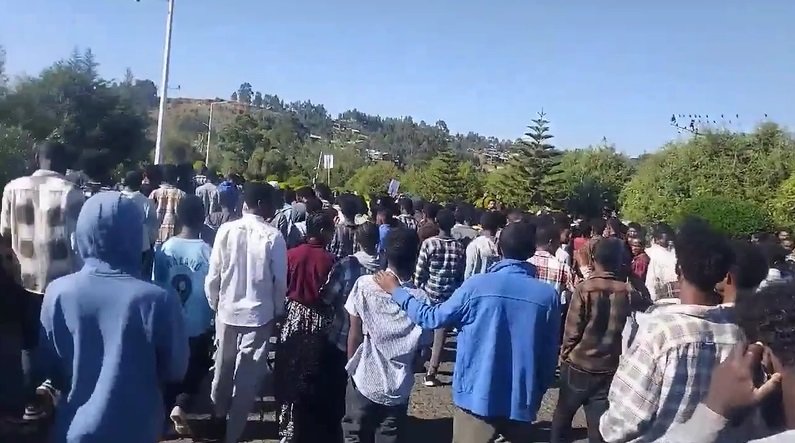
Recent weeks have witnessed the emergence of a significant number of students, teachers and truck drivers participating in public protests, which appears to be gaining considerable momentum, drawing widespread attention across various regions.
However, it is increasingly apparent that the government under Prime Minister Abiy Ahmed, along with its Prosperity Party dominated media apparatus and networked ‘cyber cadres,’ are not yet engaged in concerted efforts to stifle this burgeoning activism. They are told to stay put or say nothing for now. Their objective seems to minimize substantive attention of these grievances in the public sphere, and prevent publicizing the revolts, eventually decreasing attention to international media.
The silence of state-affiliated media and traditionally government-aligned media organizations regarding this critical development has been a calculated plan. This deliberate omission raises the usual serious questions about journalistic independence and the free flow of information essential for a healthy public discourse.
Role of Jawar Mohammed, Lidetu Ayalew and Other activists on peaceful protests:
The peaceful advocacy movement, spearheaded by experienced figures such as Jawar Mohammed and Lidetu Ayalew, appears to be gathering considerable momentum, catalyzing observable and impactful planned transformations. There are compelling indications that these initiatives are approaching a pivotal juncture, crucial for the realization of tangible and enduring outcomes across the societal spectrum.
These key individuals, particularly Jawar Mohammed and other activists, have previously demonstrated exceptional leadership acumen and strategic prowess. Their instrumental roles in guiding and successfully executing the Qeerroo and Fano movement unequivocally established their profound experience and unique capabilities in civic mobilization. The proficiency they exhibited in orchestrating and unifying diverse stakeholders—including both governmental and non-governmental entities—was fundamental in achieving the strategic objectives of the Qeerroo and Fano peaceful movement, toppling the EPRDF government.
This previously proven track record of effective coordination and strategic leadership is now widely regarded as providing a robust foundation for the current peaceful advocacy efforts that could augment the armed struggle.
Zemene Kasse’s Call urban apprising:
One of the prominent Fano leaders, Zemene Kasse, recently shared some valuable thoughts on civil disobedience, laying out strategic ideas that basically suggest a two-pronged approach for finding lasting solutions to bring down the dictatorial regime.
His idea is pretty insightful: one part focuses on keeping up existing ongoing armed resistance, making sure they’re effective and constant, adding another crucial element – getting people in urban areas involved through widespread public protest and peaceful civil disobedience. The goal here is to create a two-pronged pressure that can shorten the victory time.
He explained that relying solely on armed efforts might have its limits in achieving the big changes needed. His belief in combining it with folks in cities stepping up widespread protests, speaking out peacefully, by standing together.
He specifically highlighted Fano, and other armed movements to have an important role in organizing, coordinating, and inspiring city dwellers to contribute their share, participate in these peaceful actions. This combined effort, he believes, could be powerful enough to bring down the current government.
The past few days of student protest:
Upon initial review, the recent surge in student protests might be perceived as primarily focused on addressing specific administrative concerns and welfare-related issues. However, a more comprehensive and in-depth examination reveals that the underlying significance of these developments extends far beyond these surface-level observations.
Indeed, the current student engagement demonstrably acts as a pivotal catalyst, fostering and accelerating efforts towards achieving meaningful, peaceful societal transformation. It is crucial to recognize that these evolving circumstances have the potential to serve as a foundational impetus, propelling a broader and more profound movement towards fundamental, peaceful systemic change within the existing frameworks.
Can the government overcome the tide or buckle down under pressure?
Presently, It is obvious that there is a perceived decline in governmental efficacy and decision-making agility in addressing national complexities. Consequently public sentiment reflects a growing concern, translating into diminished confidence and a noticeable erosion of public trust.
The sustained and unwavering commitment of civic movements play a profoundly significant role in challenging and ultimately transforming entrenched authoritarian structures. The cumulative impact of collective action, characterized by persistent efforts and a unified purpose, exerts immense and inescapable pressure on systems that seek to maintain power through suppression.
Despite any concerted efforts by ruling powers to consolidate their control and resist calls for reform, relentless civic engagements invariably lead to a gradual yet profound erosion of their authority.
History consistently demonstrates that such sustained popular participation eventually paves the way for a fundamental reorientation or comprehensive transformation of the political landscape.
The collective will of a populace, when mobilized and sustained, represents an indomitable and irreversible force that cannot be indefinitely suppressed. It is this intrinsic power that serves as the ultimate catalyst for inevitable and enduring societal change.
Planning for equitable distribution of power while struggling for freedom:
Following the successful transition from the former authoritarian EPRDF regime, a considerable political vacuum emerged. This period witnessed intense, yet ultimately unfruitful, competition among various ethnically aligned factions, each striving to gain control over the state’s power structures.
This time around it is important to safeguard the hard-won fruits of of change and ensure their sustainability. It is paramount to proactively cultivate genuine and inclusive public participation across all levels of governance. Furthermore, fostering a vibrant, competitive, and truly multi-party political system is essential for diverse voices to be heard and represented. Equally, it is critical to ensure unwavering guarantee benefits to all ethnic groups in Ethiopia. It is also imperative to establish a comprehensive and meticulously planned framework designed to prevent the recurrence of past challenges, thereby fostering national unity and ensuring enduring peace. A foundational system that guarantees equitable and inclusive representation must be structured for all ethnic groups.
Editor’s Note : Views in the article do not necessarily reflect the views of borkena.com
__
Support Borkena : https://borkena.com/subscribe-borkena/
Join our Telegram Channel : t.me/borkena
Like borkena on Facebook
Borkena Ethiopian News Youtube Channel
To submit Press Release, send submission to info@borkena.com
Add your business to Ethiopian Business Listing / Ethiopian Business Directory
Join the conversation. Follow us on X (Formerly Twitter) @zborkena to get the latest Ethiopian News updates regularly.