
Author: Caleb Ta. (Dr.)Affiliation: Independent Researcher in African Political Affairs; Human Rights Advocate
Abstract
This investigative report analyzes the suspension of Dr. Biniyam Asrat, Medical Director of Jinka General Hospital, following his disclosure of a suspected Marburg virus outbreak in South Omo, Ethiopia. Despite the Ministry of Health’s acknowledgment of six deaths, including a healthcare worker, official statements publicly disputed laboratory confirmation in three cases, raising concerns about political interference and suppression of outbreak information. Drawing on official reports, WHO guidelines, and historical analyses of health governance in Ethiopia, this report examines the ethical, legal, and public health implications of silencing frontline clinicians during high-risk outbreaks. The findings demonstrate that bureaucratic retaliation, lack of transparency, and selective reporting threaten public trust and national health security. The case highlights the tension between government political interests and public health responsibilities in Ethiopia.
Introduction
In November 2025, Ethiopia faced a profound public health and political crisis triggered by reports of an infectious disease outbreak in Jinka, the administrative center of South Omo Zone. Dr. Biniyam Asrat, Medical Director of Jinka General Hospital, revealed to international media that multiple patients—and at least one healthcare worker—had died from symptoms consistent with Marburg virus disease (MVD), a highly virulent and often fatal viral hemorrhagic fever (WHO Regional Office for Africa, 2025). Marburg virus, a close relative of Ebola, is known for its rapid human-to-human transmission and mortality rates that can exceed 80% in uncontained outbreaks, making timely reporting and containment critical.
Rather than supporting transparency and urgent public health interventions, the Ministry of Health reportedly suspended Dr. Asrat, citing unauthorized communication and concerns that his disclosure might provoke public panic. This action raises serious ethical and governance concerns, highlighting the tension between political image management and the ethical responsibility of authorities to protect lives. By silencing a frontline physician, the government not only risked delaying critical containment measures but also sent a chilling message to other healthcare professionals who might consider reporting outbreaks, potentially undermining Ethiopia’s broader public health infrastructure.
Dr. Asrat’s case underscores the complex interplay between science, ethics, and politics in outbreak management. As a whistleblower, he illuminated a troubling reality: governmental priorities appeared more focused on controlling narratives and maintaining political reputation than on immediate, evidence-based interventions to save lives. The suspension highlights the potential costs of subordinating scientific integrity to political considerations, particularly during crises involving highly infectious and deadly pathogens. Beyond the individual case, this incident raises urgent questions about the structural safeguards in Ethiopia’s health governance system, the protection of frontline health workers, and the mechanisms for ensuring transparent communication during public health emergencies. In a broader context, it exemplifies how political interference in health reporting can exacerbate risk, compromise trust, and ultimately increase morbidity and mortality during epidemic outbreaks.
Background: The Outbreak in Jinka
The outbreak initially presented with clusters of patients exhibiting classic symptoms of viral hemorrhagic fever: sudden high fever, severe headache, bleeding tendencies, multi-organ dysfunction, and rapid clinical deterioration (WHO, 2023). According to Dr. Asrat’s reports, six individuals died, including one healthcare worker actively caring for infected patients.
Marburg virus is a highly lethal pathogen requiring immediate notification under international standards (WHO, 2005). Ethiopia’s Ministry of Health coordinated with WHO and Africa CDC, deploying emergency teams for case confirmation, contact tracing, and community surveillance (Africa CDC, 2025; WHO Regional Office for Africa, 2025).
Government Response and the Suspension of Dr. Asrat
On November 5, 2025, the Ministry of Health formally announced the suspension of Dr. Biniyam Asrat from his role as Medical Director of Jinka General Hospital. The official justification cited “unauthorized disclosure of outbreak information” and alleged public panic (Africanews, 2025). Local reports indicate that the suspension followed closely after international media coverage of the Marburg virus outbreak, raising questions about whether the decision was motivated more by political considerations and a desire to control public communication than by standard administrative procedures.
There is a broader, troubling pattern in Ethiopian public health governance. Authorities have repeatedly prioritized political image over the health and well-being of the population, sometimes at the direct cost of human lives. Hiding or delaying the reporting of communicable diseases is a documented practice used to maintain the appearance of stability, while communities suffer and individuals die from preventable or manageable outbreaks (Teferra, 2021). Historical evidence demonstrates that during crises such as the COVID-19 pandemic and cholera outbreaks in Oromia and Afar regions, suppression or delayed disclosure of vital health information contributed to increased morbidity and mortality. During the COVID-19 pandemic, the Ethiopian government declared a national state of emergency, but public health priorities were often secondary to political control; limited transparency, resource constraints, and political pressures complicated timely outbreak response (Fikadu et al., 2021; Tsegaye et al., 2022).
Similarly, Ethiopia’s cholera outbreaks highlight structural weaknesses in outbreak reporting and response. Despite the launch of the National Cholera Elimination Plan (2022–2028), gaps in data collection and delayed laboratory confirmation have undermined rapid intervention. Between 2023 and 2024, cholera cases surged in multiple regions, including Oromia and Afar, while logistical and financial constraints impeded government-led responses (WHO/Ethiopia, 2025). Large-scale operational and media reports indicate that international partners such as WHO and the Africa CDC have frequently had to support outbreak containment efforts due to limited domestic capacity (AllAfrica, 2025; The Reporter, 2025).
The suspension of Dr. Asrat fits within this broader context of administrative reluctance to fully acknowledge and transparently respond to communicable disease threats. Such actions reflect a governance approach in which bureaucratic control and political optics are prioritized over timely public health intervention and protection of frontline healthcare workers, directly endangering the population and undermining public trust. The case of Dr. Asrat exemplifies the risks faced by whistleblowers in Ethiopia and highlights the persistent tension between government image management and urgent public health imperatives.
Contradictions in the Ministry of Health Communications
A central concern is the Ministry of Health’s conflicting statements:
- While acknowledging six deaths, including a healthcare worker,
- The Ministry simultaneously denied laboratory confirmation for three of the cases, asserting that the etiology remained uncertain (Al Jazeera, 2025; Africanews, 2025).
This selective disclosure appears to serve political objectives: portraying Dr. Asrat’s reporting as premature or alarmist while justifying his suspension. Laboratory confirmation is a technical issue, not a disciplinary matter; thus, the Ministry’s actions suggest an effort to control narrative rather than enhance outbreak response.
International Response and Verification
The World Health Organization (WHO) deployed an emergency team to Jinka, including epidemiologists and laboratory specialists, in coordination with Africa CDC and Ethiopian authorities. WHO emphasizes rapid field response for high-threat pathogens such as Marburg virus, and the deployment highlights the outbreak’s seriousness (WHO, 2023; WHO Regional Office for Africa, 2025).
Laboratory testing and epidemiological investigations were undertaken; however, the Ministry of Health’s contradictory public messaging—acknowledging deaths but disputing laboratory confirmation for three cases—has eroded public trust and complicated risk communication.
Ethical, Legal, and Public Health Implications
Ethical Considerations
Dr. Asrat’s actions align with fundamental bioethical principles:
- Nonmaleficence: mitigating harm by reporting potential threats
- Beneficence: acting in the best interest of patients and communities
- Justice: protecting healthcare workers and ensuring equitable information dissemination
- Accountability: adhering to transparent reporting norms (Gostin, 2014)
Conversely, the Ministry’s punitive approach contravenes these principles by creating a culture of fear, discouraging clinicians from reporting outbreaks, and potentially increasing morbidity and mortality. By targeting a whistleblower, the government signals that political image is valued over public health, compromising ethical standards.
Legal and Regulatory Context
The WHO’s International Health Regulations (IHR 2005) require member states to report public health emergencies promptly and accurately. Ethiopia, as an IHR signatory, is obliged to facilitate transparent reporting and protect the scientific freedom of healthcare professionals (WHO, 2005). Punishing Dr. Asrat for disclosure represents a breach of these international obligations and undermines Ethiopia’s credibility in global health governance.
Public Health Consequences
Silencing frontline clinicians can:
- Delay outbreak recognition and containment
- Increase community transmission
- Undermine public confidence in government and healthcare institutions
- Hinder international collaboration during high-risk epidemics
The following table illustrates the contrast between ethical responsibilities and the Ministry’s actions:
| Ethical Principle | Ministry Action |
| Transparency in reporting | Suspended director |
| Protection of health workers | Failed to protect staff |
| Timely outbreak disclosure | Contradictory statements |
| Collaboration with WHO | Delayed confirmation release |
This comparison demonstrates the misalignment between international ethical standards and government actions, highlighting how political priorities compromised public safety.
Timeline of Key Events
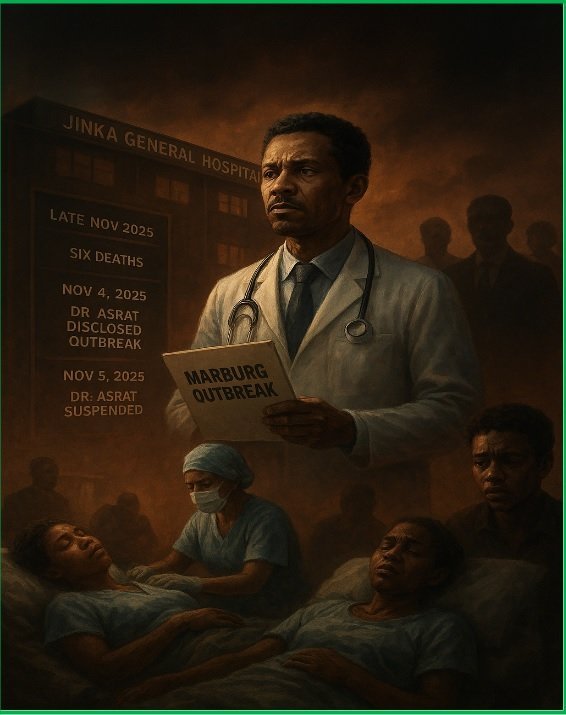
The sequence of events during the Marburg outbreak in Jinka illustrates the rapid escalation of the crisis and the controversial suspension of Dr. Biniyam Asrat. The timeline highlights key actions by the hospital, the Ministry of Health, and international agencies:
| Date | Event |
| Late Nov 2025 | The first cluster of patients presenting with viral fever and hemorrhagic symptoms was reported in Jinka. |
| Early Nov 2025 | Six deaths were reported, including one healthcare worker actively treating patients. |
| Nov 4, 2025 | Dr. Asrat discloses outbreak details to international media. |
| Nov 5, 2025 | Ministry of Health suspends Dr. Asrat from his position as Medical Director of Jinka General Hospital. |
| Nov 6, 2025 | The WHO emergency team deployed to Jinka to support outbreak investigation and laboratory confirmation. |
| Nov 6–15, 2025 | Ministry of Health releases contradictory statements, acknowledging deaths but disputing laboratory confirmation for three cases. |
This integrated timeline provides a clear visual summary of the unfolding events and government responses, making it easier for readers to understand the chronological sequence of actions and decisions within the outbreak context.
Conclusion
The suspension of Dr. Biniyam Asrat underscores the dangers of politicizing outbreak reporting. By prioritizing bureaucratic image over transparency, Ethiopia’s Ministry of Health has weakened trust, limited early response capacity, and placed communities and healthcare workers at increased risk. The case also highlights the broader issue of punishing whistleblowers who prioritize public health over political considerations, reinforcing a culture where lives may be sacrificed to protect the government’s image. Upholding transparency and scientific integrity is not optional—it is a moral and practical imperative during high-risk epidemics.
References
Africa Centres for Disease Control and Prevention. (2025). Statement on confirmed Marburg virus disease in Jinka, Southern Region, Ethiopia. Africa CDC Newsroom.
Africanews. (2025, November 14). Outbreak of viral hemorrhagic fever claims six lives in Ethiopia; WHO responds. https://www.africanews.com
Al Jazeera. (2025, November 14). Ethiopia confirms first outbreak of Marburg virus. https://www.aljazeera.com
AllAfrica. (2025, April 9). Health officials in Amhara push for temporary restrictions amid cholera spread. https://allafrica.com/stories/202504090537.html
Fikadu, T., Berhane, A., & Abebe, G. (2021). COVID-19 response in Ethiopia: A review of public health measures and challenges. Ethiopian Journal of Health Development, 35(3), 12–25.
Gostin, L. O. (2014). Global health law. Harvard University Press.
Teferra, S. (2021). State communication, press restrictions, and outbreak governance in Ethiopia. Journal of African Governance Studies, 12(1), 44–63.
The Reporter. (2025, October 5). Response proves inadequate as cholera spreads rapidly in Ethiopia. https://www.thereporterethiopia.com/39155/
Tsegaye, T., Alemayehu, D., & Mekonnen, T. (2022). COVID-19 and Ethiopia: Challenges of outbreak reporting and public health governance. BMJ Global Health, 7(6), e008173.
WHO/Ethiopia. (2025). Ethiopia Health Emergency Investment Case. WHO Regional Office for Africa. https://www.afro.who.int/sites/default/files/2025-08/2025%20ETHIOPIA%20HEALTH%20EMERGENCY%20INVESTMENT%20CASE_%20May%202025.pdf
World Health Organization. (2005). International Health Regulations (IHR). WHO Press.
World Health Organization. (2023). Marburg virus disease: Key facts. WHO Press.
World Health Organization Regional Office for Africa. (2025). Ethiopia confirms first outbreak of Marburg virus disease. https://www.afro.who.int