. Read)
Eyassu Epheraim G Hanna
London UK
Abstract
This article critically examines the circulation of a sensationalized and historically false claim in the Amharic translation Key Anbessa of Alejandro del Valle’s 1937 Spanish adventure narrative Un hombre blanco en el infierno negro. The narrative alleges that Ethiopian authorities executed prisoners by wrapping them in cloth and burning them with wax and honey. Drawing on Ethiopian legal codes, anthropological studies, royal chronicles, diplomatic archives, and consultation with members of the former imperial family, this study demonstrates the implausibility of the account. It further examines the role of the translator and media producer in presenting the story without historical verification. Using this case to illustrate broader concerns, it argues that media personalities, journalists, and translators bear moral and legal responsibility for public-facing historical narratives. The article concludes with recommendations for removal or contextualization of misleading content, emphasizing that public trust and cultural memory are endangered by the dissemination of unverified sensational narratives.
Keywords: Ethiopia, Haile Selassie, media ethics, historical accuracy, translation responsibility, Key Anbessa
Introduction
As a media personality and commentator on Ethiopia’s economic, social, and political landscape, I follow a wide range of materials published online. Among the platforms I regularly watch is the respected YouTube channel Endalegeta Multimedia (https://www.youtube.com/@endalegetamultimedia). Endalegeta, himself a writer and broadcaster, hosts thoughtful conversations with authors and engages in critical discussions about their work.
The channel describes its mission clearly:
“The main focus of this channel is Ethiopian literature, history, folklore, and social issues. Critical discussions and debates between writers and the reading public will be presented in this channel.”
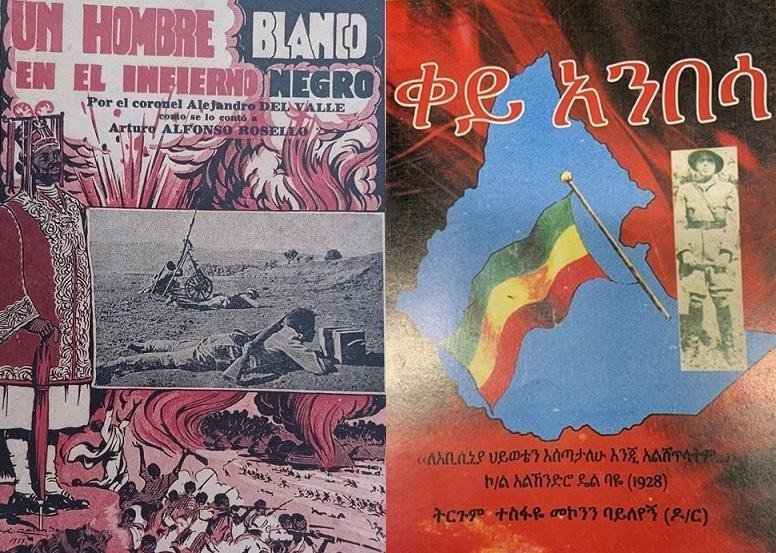
Recently, Endalegeta hosted Dr. Tesfaye Mekonnen Bayleyegn, a Cuban-educated Ethiopian medical doctor who translated the Spanish book Un hombre blanco en el infierno negro into Amharic under the title ቀይ አንበሳ (Key Anbessa)—“Red Lion” [YouTube, November 12, 2025]. 1 I watched the program with surprise, shock, and deep disappointment. While translation is a valuable cultural contribution, presenting a dramatic and historically questionable narrative without proper investigation or scholarly context is ethically and academically problematic.
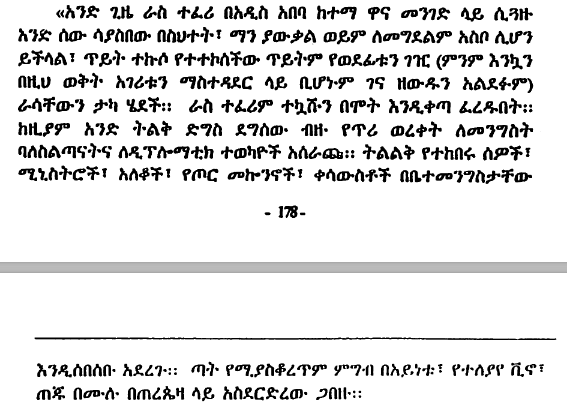
This article examines why the story presented in the book—particularly the alleged “wax-and-cloth burning” execution method—is historically inaccurate. It demonstrates the implausibility of the narrative through historical, legal, and anthropological evidence, critiques the internal contradictions of the Ras Mulugeta narrative (pp. 178–180), and emphasizes the ethical and legal responsibilities of translators and media professionals in disseminating historical material. Finally, it argues for public accountability and the removal or contextualization of content that misrepresents Ethiopian history.
Historical Analysis
Ethiopian Legal and Cultural Context
Ethiopia possesses one of Africa’s most extensive legal histories. The Fetha Nagast (“Law of the Kings”), translated to Ge’ez in the 15th century, remained influential through the 20th century (Crummey, 2000). Acceptable punishments included flogging, imprisonment, exile, confiscation of property, hanging, and occasional decapitation or amputation. There is no record of burning prisoners alive using wax or honey (Pankhurst, 1985).
Haile Selassie’s court was closely aligned with the Ethiopian Orthodox Church. Priests served advisory, ceremonial, and spiritual roles; the Emperor’s adherence to Christian ethics and liturgical norms would have made ritualized burning executions morally and religiously impossible (Bahru, 2001). The Amharic edition of Key Anbessa (pp. 65–66) notes that Haile Selassie was attended by 15–20 priests, emphasizing the strong Christian ethical environment of the court.
Anthropological studies across Ethiopia’s ethnic groups (Amhara, Tigray, Oromo, Sidama, Gurage, Wolayta) document various punitive practices such as corporal punishment, ostracism, and ritual cursing, but never burning with wax (Levine, 1974; Donham & James, 1986). Even groups known for strict punishments avoided fire due to religious and cultural taboos.
Ras Mulugeta Narrative (pp. 178–180)
A particularly sensational claim is attributed to Ras Mulugeta Yigezu, Minister of War. Del Valle’s text alleges that:
- Haile Selassie was fired upon in public.
- The alleged gunman was arrested and later burned alive in front of foreign diplomats and nobility.
- Guests were given spears, the prisoner was wrapped in cloth, covered with wax and honey, and ignited before the attendees.
ቀይ አንበሳ 2003 ፡ ምንጭ https://www.dirzon.com
Critical Analysis
- Historical Implausibility: No Ethiopian or foreign record documents a public assassination attempt or execution. Diplomatic archives and newspapers of the period do not corroborate the story. 2
- Diplomatic and Public Context: Foreign delegations, including European royalty and international journalists, would have reported a burning in front of dignitaries. Its absence in international accounts indicates fabrication.
- Ras Mulugeta’s Character: Known as disciplined, Christian, and respected, Ras Mulugeta’s character contradicts such claims (Prouty, 1986).
- Cultural Incompatibility: Ethiopian court culture did not sanction collective execution, ceremonial burning, or distribution of weapons to guests. These details mirror colonial adventure literature motifs rather than Ethiopian practices.
- Chronological Contradiction: The event allegedly occurred shortly before Haile Selassie’s 1930 coronation, attended by international guests. Its absence in contemporary records confirms it did not occur.
- Literary Analysis: The narrative contains tropes typical of 1930s adventure fiction: mysterious gunmen, dramatic royal feasts, ritualized violence, and exotic spectacle (Méndez, 1999).
- Literary Analysis: The narrative contains tropes typical of 1930s adventure fiction: mysterious gunmen, dramatic royal feasts, ritualized violence, and exotic spectacle (Méndez, 1999).
Media Ethics
Translators and media producers are gatekeepers of cultural knowledge. Presenting unverified or sensational historical narratives violates ethical standards (Baker, 2018; Tymoczko, 2007).
Media figures have moral and potentially legal responsibilities:
- They must avoid misleading the public with fabricated claims.
- They must contextualize extraordinary narratives and provide commentary.
- Platforms may bear civil or reputational liability for disseminating false information.
In this case, Endalegeta Multimedia and the translator failed to verify claims and presented fiction as fact, contributing to public misperception and historical distortion.
Legal Context and Liability for Translators and Media Producers in Ethiopia
In Ethiopia, translators and media producers who publish, distribute, or broadcast inaccurate or false material may face legal liability, particularly if such material harms the reputation of individuals, spreads disinformation, or threatens public order. The legal framework provides both criminal and civil remedies, emphasizing that publishing is not risk-free, especially when dealing with historical narratives involving prominent figures.
Relevant Ethiopian Laws
Criminal Code of the Federal Democratic Republic of Ethiopia (Proclamation No. 414/2004):
- Defamation and Calumny: Article 483 criminalizes the act of publishing false statements that injure another person’s honour or reputation. Both intentional and negligent dissemination may constitute an offense.
- False Information and Public Order: Sections 486–487 cover false statements that disturb public order or incite hatred. Publishing false historical claims that portray figures or groups as barbaric could arguably fall under these provisions.
Civil Remedies: Ethiopian civil law allows victims of defamation to seek compensation for harm to reputation, emotional distress, or economic loss. Families of historical figures, including the descendants of Haile Selassie, could pursue civil action if the publication is demonstrably injurious. 3
Liability of Translators
A translator who republishes material digitally or in print may face liability if:
- They knowingly translate false or defamatory content.
- They negligently fail to verify the accuracy of the content, particularly when the claims are extraordinary or involve living persons or families with public standing.
- The content is presented as fact rather than fiction, increasing the risk that audiences will treat it as historical truth.
The Key Anbessa publication and the accompanying YouTube program demonstrate these risks. By presenting sensational claims about Haile Selassie and his associates without verification, the translator and media producer potentially exposed themselves to legal scrutiny under both criminal and civil provisions.
Ethical and Practical Considerations
- Media personalities, publishers, and translators must cross-check historical claims with multiple scholarly sources.
- Disclaimers or contextual annotations can reduce liability, clarifying that extraordinary claims are unverified or speculative.
- Legal consultation prior to publishing can prevent lawsuits or criminal complaints.
Implications for Public Discourse
The dissemination of unverified historical narratives, such as the alleged “wax-and-cloth burning” story, has already misled audiences into believing they have uncovered hidden history. Misrepresentation affects not only Haile Selassie’s historical image but also the reputations of individuals and groups associated with him. Families may consider civil action to seek remedies for reputational harm, and public media platforms have a responsibility to remove or contextualize the content.
Recommendations
- Translators should annotate and contextualize unverifiable historical claims.
- Media producers should remove or clearly contextualize misleading content.
- Collaboration between historians, translators, and media personnel is necessary.
- Public awareness campaigns should encourage critical media literacy and historical verification.
- Families and scholars should be empowered to pursue civil remedies to protect reputational and historical integrity.
Conclusion
The “wax-and-cloth burning” narrative is factually baseless, culturally inconsistent, and ethically irresponsible. The Ras Mulugeta attribution is implausible, and Haile Selassie’s court would not have sanctioned such an execution. Translators and media producers are responsible for perpetuating false narratives. Scholars, journalists, and media platforms must act to remove or contextualize such content, protecting Ethiopia’s historical and cultural integrity. Legal and civil accountability mechanisms exist and should be invoked when historical misrepresentation damages public trust or the reputation of families and individuals.
Footnotes
- YouTube video of Endalegeta Multimedia, Dr. Tesfaye Mekonnen Bayleyegn on Key Anbessa, published November 12, 2025.
- British Foreign Office archives, Addis Ababa station reports, 1929–1931; Italian diplomatic correspondence, Rome, 1930.
- Private communication with a member of the Ethiopian Imperial Family, November 13, 2025.
References
Baker, M. (2018). In other words: A coursebook on translation (3rd ed.). Routledge.
Bahru, Z. (2001). A history of modern Ethiopia, 1855–1991. James Currey.
Crummey, D. (2000). Land and society in the Christian kingdom of Ethiopia: From the thirteenth to the twentieth century. University of Illinois Press.
Donham, D., & James, W. (Eds.). (1986). The southern marches of imperial Ethiopia: Essays in history and social anthropology. Cambridge University Press.
Levine, D. N. (1974). Greater Ethiopia: The evolution of a multiethnic society. University of Chicago Press.
Marcus, H. G. (1994). A history of Ethiopia. University of California Press.
Méndez, J. (1999). Representaciones africanas en la literatura cubana: El caso de Alejandro del Valle. Revista de Estudios Caribeños, 12, 55–72.
Mockler, A. (2003). Haile Selassie’s war. Signal Books.
Pankhurst, R. (1985). History of Ethiopian towns from the Middle Ages to the early nineteenth century. Franz Steiner Verlag.
Prouty, C. (1986). Empress Taytu and Menilek II: Ethiopia 1883–1910. Holmes & Meier.
Tymoczko, M. (2007). Enlarging translation, empowering translators. St. Jerome Publishing.
Federal Democratic Republic of Ethiopia. (2004). Criminal Code Proclamation No. 414/2004. Addis Ababa: Government of Ethiopia.
Editor’s Note : Views in the article do not necessarily reflect the views of borkena.com
__
Support Borkena : https://borkena.com/subscribe-borkena/
Join our Telegram Channel : t.me/borkena
Like borkena on Facebook
Borkena Ethiopian News Youtube Channel
To submit Press Release, send submission to info@borkena.com
Add your business to Ethiopian Business Listing / Ethiopian Business Directory
Join the conversation. Follow us on X (Formerly Twitter) @zborkena to get the latest Ethiopian News updates regularly.
I appreciate the concerns raised about the depiction of historical events in the Amharic
translation Key Anbessa. The allegation that Ethiopian authorities carried out executions by
burning prisoners with wax and honey is indeed serious. However, it is important to note
that such claims originate in Alejandro del Valle’s 1937 adventure narrative Un hombre
blanco en el infierno negro, a work shaped by the conventions and exaggerations of its
genre rather than corroborated historical evidence. No credible Ethiopian historical
sources substantiate this description, and it should be understood as part of the author’s
literary imagination, not as fact.
My role as translator was to render the original text faithfully into Amharic, without altering
or suppressing the author’s words. Translation is not the rewriting of history but the
transmission of an existing narrative to another language community. While I agree that
contextual framing is valuable, the responsibility for verifying or contesting historical
claims lies with historians and scholars, not translators. That said, I welcome efforts to
provide readers with the necessary context to recognize the biases and limitations of
foreign adventure literature from the 1930s.
I share the commitment to protecting Ethiopia’s cultural memory and ensuring that public-
facing narratives do not distort the past. My hope is that this dialogue strengthens
understanding of both the source text and the translation process, rather than attributing
intent or negligence to those who make historical literature accessible.
LETTER TO THE TRANSLATOR
Subject: Request for Responsible Correction and Removal of Misleading Historical Material
Dear Dr. Tesfaye Mekonnen Bayleyegn,
I write to you with respect for your professional background and your contribution to Ethiopian literature through translation. Your Amharic edition of Key Anbessa has received considerable public attention, not least because of its dramatic narrative and the recent discussion hosted on Endalegeta Multimedia.
However, I must express serious concern regarding the depiction, in both the translation and the associated YouTube presentation, of the alleged execution of a prisoner using wax, honey, and fire in the presence of foreign dignitaries — a scene that originates not from Ethiopian historical sources but from Alejandro del Valle’s 1937 adventure novel.
No credible archival, diplomatic, or scholarly evidence supports this account.
It stands entirely outside the documented historical record of Ethiopia during the imperial period.
1. The Translator’s Duty Goes Beyond Literal Fidelity
While your public response argues that a translator’s task is merely to render the author’s words faithfully, it is equally true that any translator — especially one publishing in a country with a complex and sensitive historical memory — must consider the broader consequences of transmitting unverified or harmful claims.
In Ethiopia, where many readers assume historical accuracy when encountering translated foreign texts, the act of translation becomes an act of public influence.
With that influence comes responsibility.
2. Misinterpretation Has Already Occurred
Following the YouTube program and circulation of Key Anbessa, many viewers believe they have uncovered “hidden history” and are now repeating a fictional execution narrative as documented fact. Some have even begun to weaponize it against:
Emperor Haile Selassie’s legacy,
members of the imperial family,
groups associated with his administration, and
Ethiopia’s broader historical heritage.
This demonstrates that the issue is not academic. It is active historical misinformation.
3. Ethiopian Law Recognizes Accountability for Published Falsehoods
As you know, Ethiopia’s legal framework — including the Criminal Code provisions on defamation, false statements, and the distribution of misleading material — places responsibility not only on authors but also on publishers, translators, and media distributors when harmful inaccuracies enter the public sphere.
This is not a theoretical risk. Families affected by the narrative, including members of the former imperial family, have strong grounds to pursue civil remedies.
4. A Call for Corrective Action
In light of the above, and with full respect for your intentions, I urge you to take the following responsible steps:
Issue a public clarification stating that the execution story is fictional and has no basis in Ethiopian historical record.
Request the removal or correction of the YouTube episode on Endalegeta Multimedia.
Add an explanatory preface or note to the book if it remains in circulation.
Consider withdrawing the current edition to avoid ongoing misinformation.
Offer an apology to readers for the confusion caused by presenting the material without historical contextualization.
These actions would not diminish your work as a translator. On the contrary, they would demonstrate scholarly integrity, national responsibility, and commitment to ethical publication.
5. Your Role as an Ethiopian Intellectual
As an Ethiopian intellectual and medical professional, you are in a unique position to uphold high standards of truthfulness and historical responsibility. When false narratives infiltrate public discourse — especially those that distort Ethiopia’s imperial history — the consequences for national identity and collective memory are profound.
Your leadership in correcting this misunderstanding would be welcomed and respected by many.
It would also help prevent further division, misunderstanding, and reputational harm.
Conclusion
This is not a request made lightly. It is made out of respect — for you, for Ethiopia’s historical heritage, and for the public who deserve accurate information.
I ask you, sincerely and firmly, to take the honorable course of action and correct this situation before further damage is done.
With respect,
RESPONSE TO LETTER TO THE TRANSLATOR
Subject: Clarification Regarding Translation of Key Anbessa
Dear Eyassu Epheraim G Hanna,
I acknowledge receipt of your letter concerning my Amharic translation of Key Anbessa and the subsequent discussion hosted on Endalegeta Multimedia. I appreciate the seriousness with which you approach matters of historical representation, and I welcome the
opportunity to clarify my position.
1. On the Translator’s Role
The primary duty of a translator is fidelity to the source text. Key Anbessa is a literary work, not a historical archive. My task was to render Alejandro del Valle’s novel into Amharic with accuracy to its narrative voice and style. To conflate the translator’s role with that of a historian risks misunderstanding the nature of literary translation itself.
2. On Fiction Versus History
The scene you reference — involving wax, honey, and fire — is indeed a product of the
author’s imagination. It does not originate from Ethiopian historical sources, nor was it
presented by me as archival fact. Readers of literature understand that novels often
dramatize or invent episodes, and it is the responsibility of critical discourse, not
censorship, to distinguish between fiction and history.
3. On Public Interpretation
I regret if some members of the public have misinterpreted a fictional passage as historical record. However, the phenomenon of misinterpretation is not unique to Ethiopia; it is a universal challenge in the reception of literature. The solution lies in education, dialogue, and critical literacy — not in silencing or withdrawing published works. To demand removal of a translation risks setting a precedent of restricting literary expression whenever a fictional narrative touches upon sensitive themes.
4. On Legal Responsibility
I categorically reject the suggestion that my translation constitutes defamation or
dissemination of falsehood under Ethiopian law. The work is clearly a translation of a
foreign novel, not a historical treatise. Holding translators legally accountable for the imaginative content of authors would undermine the very possibility of literary exchange and cultural dialogue.
5. On Scholarly Integrity
I remain committed to scholarly integrity and to Ethiopia’s cultural dignity. To that end, I am
open to adding clarifying notes in future editions that distinguish fictional episodes from historical record. Such contextualization strengthens public understanding without
diminishing the literary value of the work. What I cannot accept is the demand for
withdrawal or apology for faithfully translating a novel — an act that falls squarely within the bounds of intellectual freedom.
Conclusion
Ethiopia’s historical heritage is vast, complex, and resilient. It cannot be undone by a single
fictional passage, nor should it be policed through threats of legal action against
translators. My role is to make literature accessible; the role of historians and educators is to guide readers in discerning fact from fiction. I stand by my translation as a legitimate contribution to Ethiopia’s literary landscape, and I reject any implication of wrongdoing.
With respect,
Dr. Tesfaye Mekonnen Bayleyegn
I salute the writer for bringing to our attention a growing risk associated with the production and consumption of social media outputs. Social media is becoming a major vehicle for dumbing down people and propagation of shallow cosmopolitanism. I hope the producer of the show will accept this critique in earnest and respond accordingly.
Critical Rebuttal of the Article by Eyassu Epheraim G Hanna, London, UK. Published by
borkena.com.
Kinfu Damene, Atlanta, Georgia, USA
1.) Contextualizing the Translator’s Role:
The critique presumes that translators and media hosts must function as historians,
verifying every claim in the source text before dissemination. This expectation
misunderstands the primary responsibility of translation, which is to render a text faithfully
into another language, preserving its tone, structure, and cultural resonance. Translators
are not authors; they are mediators. Holding them legally or morally accountable for the
veracity of the original author’s claims risks conflating authorship with transmission.
2.) Literary vs. Historical Genres:
Alejandro del Valle’s Un hombre blanco en el infierno negro is not a legal chronicle or
diplomatic archive but an adventure narrative. Its sensationalism reflects the conventions
of serialized war memoirs and colonial adventure literature of the 1930s. Translating such a
text into Amharic (Key Anbessa) does not transform it into a historical document; it remains
a literary artifact. Criticism should therefore target the genre’s exaggerations rather than the
translator’s fidelity.
3.) Audience Agency and Critical Literacy:
The critique assumes that readers passively absorb sensational claims without
discernment. In reality, Ethiopian audiences — especially those familiar with the country’s
legal and religious traditions — are capable of recognizing exaggeration. The translator’s
role is to make the text accessible, not to censor or rewrite it. To demand removal or heavy
contextualization risks infantilizing audiences and undermining their ability to engage
critically with literature.
4.) Historical Verification: Whose Responsibility?
Historians, archivists, and scholars are tasked with verifying claims against legal codes,
chronicles, and anthropological evidence.
– Translators and media hosts, by contrast, are tasked with cultural transmission.
– To impose historical verification duties on translators risks creating a chilling effect,
discouraging the translation of controversial or politically charged works. This would
impoverish cultural exchange and limit access to diverse narratives.
5.) Ethical Balance:
While it is valid to highlight the implausibility of the wax‑burning execution claim, the
critique overreaches by assigning moral and legal responsibility to the translator. A more
balanced approach would:
– Recognize the translator’s fidelity to the source text.
– Encourage supplementary scholarly commentary (prefaces, footnotes, afterwords) to
contextualize sensational claims.
-Preserve the literary work as a historical artifact of Cuban adventure writing, while
clarifying its limits as a historical source.
Conclusion:
The article rightly identifies the danger of sensationalized narratives distorting cultural
memory. However, its call to hold translators and media hosts legally responsible is
misplaced. Translation is not authorship, and media hosting is not historical certification.
The appropriate remedy is contextualization through scholarship, not censorship or
punitive accountability. Public trust is best served when readers are given both the
translated text and the Critical tools to evaluate it — not when translators are burdened
with responsibilities that properly belong to historians.
To: Eyassu Epheraim G Hanna,
Q: Would you threaten legal action against a bookstore in Ethiopia for importing and selling the same book in its original form and language? I am Just curious?
As to the rest of the story….:
I noticed you sent a “warning letter” demanding censorship of Key Anbessa. Let’s be clear: a
translator is not a historian. Fidelity to the author’s words is the duty — not rewriting novels
to appease political sensitivities.
2/ The wax‑and‑honey scene? Pure fiction. Born in a 1937 adventure novel, not in Ethiopia’s
archives. To confuse literature with history is to confuse imagination with fact.
3/ Misinterpretation happens everywhere. Readers of Shakespeare don’t assume witches
were official policy in Scotland. Readers of del Valle shouldn’t assume Ethiopia practiced
rituals invented for drama.
4/ Threatening translators with “legal accountability” for fictional passages is absurd.
Should Ethiopians be forbidden from reading Dostoevsky because his novels depict crime?
Should Amharic editions of Homer be withdrawn because gods intervene in battles?
5/ Ethiopia’s heritage is strong enough to withstand a novel. Our dignity is not so fragile that
a fictional scene can erase centuries of imperial history.
6/ The real danger is censorship disguised as “responsibility.” Once you demand
withdrawal of a translation, you open the door to silencing every uncomfortable book,
every inconvenient idea.
7/ We stand for literary freedom, historical truth, and Ethiopia’s cultural pride. Fiction is
fiction. History is history. And translators are bridges, not scapegoats.
8/ Ethiopia’s story will not be policed by intimidation. Our memory is resilient, our literature
alive, and our dignity untouchable.
Best regards