
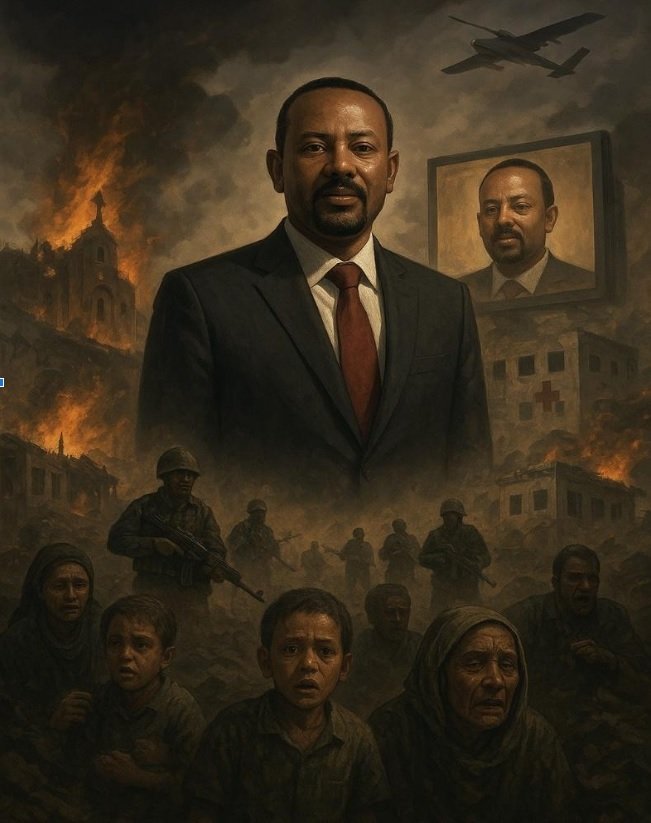
Author: Caleb Ta. (Dr.)
Affiliation: Independent Researcher in African Political Affairs; Human Rights Advocate
Abstract
Since assuming office in 2018, Ethiopian Prime Minister Abiy Ahmed has transitioned from a celebrated reformist to an increasingly authoritarian ruler. His administration has been marked by centralization of power, political repression, and military campaigns that have claimed the lives of tens of thousands of Ethiopians. This article examines how Abiy consolidated power through propaganda, institutional manipulation, and coercion—transforming Ethiopia into a landscape of fear and fragmentation. Drawing on international media, human-rights documentation, and field reports, the study exposes a leadership model driven by narcissistic control and personal glorification, sustained through bloodshed and suppression.
Keywords: Ethiopia, Abiy Ahmed, authoritarianism, narcissistic leadership, human rights abuses, Tigray war, political repression
Introduction
When Abiy Ahmed came to power in April 2018, Ethiopians hailed him as a visionary reformer. His early gestures—releasing political prisoners, reconciling with Eritrea, and opening political space—earned him the 2019 Nobel Peace Prize (BBC News, 2018). Yet within two years, Ethiopia descended into one of the world’s most brutal conflicts, marked by massacres, sexual violence, and famine (Amnesty International, 2021; Human Rights Watch, 2022).
Behind Abiy’s rhetoric of peace and unity lies a pattern of narcissistic leadership, characterized by self-aggrandizement, intolerance of criticism, and a messianic belief in his personal destiny to “save” Ethiopia (The Guardian, 2021). His image-making—portraying himself as a divine reformer and visionary—has been accompanied by repression, mass imprisonment, and bloodshed across Tigray, Oromia, and Amhara (Reuters, 2022).
Step 1 — Control the Message: The Cult of the “Messiah Prime Minister”
From the moment Abiy Ahmed assumed power, his government embarked on an intensive media campaign designed to shape his image as a prophetic reformer and the spiritual savior of Ethiopia. State-run broadcasters and loyalist outlets saturated the airwaves with images of Abiy praying, planting trees, and preaching about “Ethiopia’s rebirth,” while state television portrayed him as a divinely guided visionary destined to unite the nation (BBC News, 2021). The regime’s communications strategy blended religious rhetoric with nationalist symbolism, presenting Abiy not merely as a politician but as a God-sent liberator.
Simultaneously, dissenting narratives were systematically erased. Independent journalists were harassed or imprisoned, news outlets shuttered, and internet blackouts imposed during critical political moments—particularly in Oromia and Tigray (Committee to Protect Journalists, 2022). Online disinformation networks operated by state-linked actors flooded social media with coordinated propaganda, branding critics as “traitors,” “junta,” or “anti-peace elements” (Amnesty International, 2021).
By monopolizing the national narrative, Abiy’s administration constructed a hermetically sealed propaganda environment. Government offensives in Tigray and other regions were described as “law-enforcement operations for unity,” while reports of massacres, looting, and deliberate starvation were dismissed as “enemy fabrications” (Amnesty International, 2021). The cult of the “Messiah Prime Minister” thus became a mechanism of total narrative control—transforming the instruments of communication into tools of repression, and transforming Abiy himself into the central object of faith in an authoritarian state.
Step 2 — Rig the Political Field: Eliminate Opposition by Force or Fear
Having secured dominance over the media, Abiy turned to dismantling Ethiopia’s fragile pluralism. In 2019, he dissolved the Ethiopian People’s Revolutionary Democratic Front (EPRDF)—a multi-ethnic coalition that had governed for nearly three decades—and replaced it with his centralized Prosperity Party, consolidating power in his own hands (Reuters, 2019). This move alienated several regional and ethnic parties, particularly in Tigray, whose leadership rejected the merger as unconstitutional.
Abiy’s regime pursued opponents through arrests, intimidation, and assassination. The killing of Oromo musician and activist Hachalu Hundessa in 2020 triggered nationwide protests, met with disproportionate and lethal force—over 200 civilians were reportedly killed by security forces and militias acting under government orders (Al Jazeera, 2020). Opposition leaders such as Jawar Mohammed and Bekele Gerba were imprisoned on terrorism charges after calling for justice, while thousands of demonstrators were detained without trial (Human Rights Watch, 2021).
Under the guise of pandemic control, the government indefinitely postponed national elections, allowing Abiy to rule by decree. Political gatherings were banned, press briefings restricted, and opposition offices raided. Several regional parties were barred from running, while state institutions—including the electoral board and judiciary—were stacked with loyalists (Reuters, 2022).
Through these measures, Abiy effectively hollowed out Ethiopia’s democratic framework. The combination of legal manipulation, coercion, and violence ensured that the only viable political space left was his own—a single-party system masquerading as reformist democracy, sustained by fear and enforced obedience.
Step 3 — Manufacture Legitimacy Through War and Religion
From the earliest days of his premiership, Abiy Ahmed positioned his political project within a sacred framework, deliberately merging religious imagery and nationalist rhetoric to legitimize his rule and sanctify violence. He frequently invoked biblical allegories and divine selection, presenting himself as a modern-day Joshua or King David tasked with delivering Ethiopia from moral and political decay (The Guardian, 2021). In televised speeches, Abiy claimed that his government’s struggle against internal and external enemies was not merely political but spiritual—framing opposition forces as embodiments of evil and chaos (BBC News, 2021).
This fusion of religion and nationalism served a dual purpose: it mobilized mass support among Ethiopia’s devout Christian majority and silenced critics by equating dissent with blasphemy (Human Rights Watch, 2022). As Abiy’s cult of personality expanded, his portrayal as a divinely ordained leader allowed the state to conflate loyalty to the prime minister with loyalty to God and country. Those who opposed the government’s military campaigns were labeled “anti-Ethiopian,” “agents of the devil,” or “terrorists”—terms that justified extreme force and moral suppression (Amnesty International, 2023).
The Tigray war (2020–2022) exemplified this political theology. When hostilities erupted between the federal government and the Tigray People’s Liberation Front (TPLF), Abiy framed the conflict as a “law-enforcement operation” against traitors (Reuters, 2022). As war escalated, federal and Eritrean forces engaged in systematic ethnic targeting, extrajudicial killings, and mass sexual violence—atrocities documented as war crimes by the UN Human Rights Council (2022) and independent investigations (Amnesty International, 2021; Human Rights Watch, 2022).
Despite international condemnation, Abiy’s administration continued to invoke divine justification for military action. State media and aligned clergy echoed biblical language, describing the war as a “purification” of the nation (BBC News, 2021). Religious figures who questioned the narrative were harassed or silenced (Committee to Protect Journalists, 2022). Through sermons, addresses, and symbolism, Abiy recast state violence as divine duty. Military campaigns were framed as holy wars for national salvation, even amid evidence of massacres, looting, and deliberate starvation (UN OCHA, 2023).
By intertwining religion with governance, Abiy transformed the state into a quasi-theocratic autocracy, where criticism equaled heresy and obedience became worship. This mirrors other forms of charismatic authoritarianism, where mystical authority fuses with coercive power to entrench personal rule. The Tigray war thus became more than a regional conflict—it was the crucible through which Abiy manufactured divine legitimacy, transforming himself from reformist premier to self-styled messiah commanding loyalty through faith, fear, and force (The Guardian, 2021; Human Rights Watch, 2022).
Step 4 — Expand Executive Power Through Blood and Fear
The federal government expanded control over regional states through large-scale military interventions, targeted purges of regional officials, and the use of emergency powers that sharply increased executive authority (Reuters, 2022). Security forces and allied militias have been implicated in arbitrary detention, extrajudicial killings, forced disappearances, and the brutal suppression of local resistance in Oromia and Amhara—practices documented by Human Rights Watch (2022) and Amnesty International (2023). Entire communities were terrorized through raids, bombings, and forced displacement, with civilians often targeted regardless of age or gender (Human Rights Watch, 2022).
Under the guise of “national security,” Abiy’s administration repeatedly invoked emergency decrees and anti-terror laws to limit civil liberties, suspend normal checks on executive power, and silence political opponents (Amnesty International, 2023; Reuters, 2022). Courts were undermined, the legislature subordinated, and regional leaders purged or coerced into compliance, effectively removing institutional constraints on executive authority (BBC News, 2021; Human Rights Watch, 2022).
These measures created a pervasive climate of fear. Citizens lived under constant threat of raids, detention, or violent reprisal, while journalists and human-rights defenders faced imprisonment, harassment, or expulsion (Committee to Protect Journalists, 2022; Amnesty International, 2023). Civil society was systematically curtailed, and entire regions became zones of militarized control. The combination of direct violence, political repression, and institutional capture facilitated the consolidation of Abiy Ahmed’s power through coercion rather than democratic process, leaving citizens with limited recourse and a deeply fractured state apparatus (BBC News, 2021; Reuters, 2022).
Step 5 — Silence the Critics: The Anatomy of a Modern Dictatorship
Independent journalists, human rights defenders, and even members of the clergy were detained for questioning the regime. The Ethiopian Human Rights Commission (2021) documented arbitrary arrests, ill-treatment, and the use of prolonged detention without trial. International correspondents were expelled, and several NGOs faced operational restrictions that curtailed their ability to monitor human-rights conditions and report on abuses.
Abiy Ahmed’s government also weaponized digital repression—employing surveillance technologies, internet shutdowns, and coordinated disinformation campaigns to intimidate critics and control the political narrative (Amnesty International, 2023; Committee to Protect Journalists, 2021). In a pattern reminiscent of other modern autocracies, the administration conflated loyalty to the ruling Prosperity Party with patriotism, redefining dissent as treasonous behavior.
From 2023 onward, a wave of arrests targeted opposition politicians and activists, particularly those associated with the Amhara regional movement. Among those detained were sitting and former parliamentarians Christian Tadele, Yohannes Buaylalew, and Kassa Teshager, whose parliamentary immunities were revoked before or after arrest (Addis Standard, 2024; Borkena, 2024). Advocacy groups and diaspora human-rights organizations have reported that some of these detainees are being held under harsh conditions in Kaliti and Kilinto correctional facilities, facing restricted medical care and limited legal access (Zehabesha, 2024; Addis Insight, 2025).
These arrests exemplify the regime’s broader strategy of neutralizing opposition through intimidation and the criminalization of political dissent. The silencing of lawmakers and civic leaders—together with restrictions on the press and civil society—illustrates how Abiy’s government systematically dismantled pluralism while sustaining a façade of reformist legitimacy.
Step 6 — The Blood Cost of Power
Abiy’s consolidation of power has come at a staggering human cost. Since taking office in 2018, Ethiopia has been engulfed in waves of brutal conflict. The Tigray war (2020–2022) alone resulted in hundreds of thousands of deaths, widespread famine, and the displacement of millions, with civilians subjected to massacres, sexual violence, starvation, and looting (UN OCHA, 2023; Amnesty International, 2021). Entire towns were razed, hospitals and clinics destroyed, and humanitarian aid deliberately blocked, leaving populations exposed to disease and starvation.
Similar violence erupted in Oromia and Amhara regions, where federal and regional forces carried out systematic killings, forced disappearances, and indiscriminate bombings. Villages were burned, crops destroyed, and civilians—including women, children, and the elderly—were killed in attacks on homes, churches, mosques, and marketplaces (Reuters, 2022; Human Rights Watch, 2022). Armed militias loyal to the government or regional factions contributed to the chaos, creating a fragmented, patchwork landscape of war zones across the country.
The humanitarian crisis is compounded by a climate of terror. Arbitrary arrests, torture, and political imprisonment have targeted journalists, opposition leaders, and ethnic minorities, while internet blackouts and digital surveillance prevent the outside world from documenting atrocities (Committee to Protect Journalists, 2022; Amnesty International, 2023). In Tigray, reports describe deliberate attacks on hospitals, maternity wards, and health clinics, leaving thousands of vulnerable civilians without essential medical care (BBC News, 2021).
Beyond physical destruction, Abiy’s campaigns have created national-scale psychological trauma. Communities live under constant fear of raids, bombings, and retribution. Displacement camps are overcrowded and under-resourced, with malnutrition, disease, and lack of education compounding the suffering of millions. Children are growing up amid extreme insecurity, with entire generations experiencing loss, violence, and the breakdown of social cohesion.
This ongoing bloodshed illustrates a chilling pattern: the consolidation of power through terror, where the leader’s personal ambition is pursued at the expense of human life and societal stability. Behind the public image of a Nobel laureate lies a legacy of ruthless centralization and human devastation—a leader whose narcissistic pursuit of control has left Ethiopia bleeding, fractured, and silenced.
References
Addis Insight. (2025, September 17). Ethiopian MP Christian Tadele critically ill in detention, family and lawyer warn. https://www.addisinsight.net/2025/09/17/ethiopian-mp-christian-tadele-critically-ill-in-detention-family-and-lawyer-warn/
Addis Standard. (2024). House of People’s Representatives revokes immunity of Christian Tadele seven months after his arrest. https://addisstandard.com/news-house-of-peoples-representatives-revokes-immunity-of-christian-tadele-seven-months-after-his-arrest/
Al Jazeera. (2020, July 3). Ethiopia unrest: At least 239 killed in protests after singer’s death. https://www.aljazeera.com/news/2020/7/3/ethiopia-unrest-at-least-239-killed-in-protests-after-singers-death
Amnesty International. (2021). Ethiopia: The Tigray conflict and crimes against humanity. https://www.amnesty.org/en/latest/news/2021/08/ethiopia-tigray-conflict/
Amnesty International. (2023). Ethiopia: Human rights under pressure. https://www.amnesty.org
BBC News. (2018, April 2). Abiy Ahmed becomes Ethiopia’s new prime minister. https://www.bbc.com/news/world-africa-43624119
BBC News. (2021, June 30). Ethiopia’s government accused of using starvation as a weapon in Tigray. https://www.bbc.com/news/world-africa-57659674
Borkena. (2024, January 29). Ethiopian parliamentarians arrested in Awash Araba transferred to Addis. https://borkena.com/2024/01/29/ethiopia-parliamentarians-arrested-in-awash-araba-transferred-to-addis/
Committee to Protect Journalists. (2021). Ethiopia: Journalists detained and intimidated. https://cpj.org
Committee to Protect Journalists. (2022). Ethiopian journalists detained amid civil conflict. https://cpj.org/africa/ethiopia
Ethiopian Human Rights Commission. (2021). Annual report. https://ehrc.org
Human Rights Watch. (2022). “We will erase you from this land”: Crimes against humanity and ethnic cleansing in Ethiopia’s Western Tigray Zone. https://www.hrw.org/report/2022/04/06/we-will-erase-you-land/crimes-against-humanity-and-ethnic-cleansing-ethiopias
Reuters. (2019, December 3). Ethiopia’s Abiy launches new party, cementing power. https://www.reuters.com/article/us-ethiopia-politics-idUSKBN1YA1I3
Reuters. (2022, November 15). Ethiopia’s government consolidates power amid ceasefire efforts. https://www.reuters.com/world/africa
The Guardian. (2021, November 7). Ethiopia’s Abiy Ahmed: From peace prize to civil war. https://www.theguardian.com/world/2021/nov/07
UN OCHA. (2023). Ethiopia humanitarian response plan. https://www.unocha.org/ethiopia
Zehabesha. (2024). Urgent human-rights appeal letter. https://zehabesha.com/urgent-human-rights-appeal-letter/
Editor’s Note : Views in the article do not necessarily reflect the views of borkena.com
__
Support Borkena : https://borkena.com/subscribe-borkena/
Join our Telegram Channel : t.me/borkena
Like borkena on Facebook
Borkena Ethiopian News Youtube Channel
To submit Press Release, send submission to info@borkena.com
Add your business to Ethiopian Business Listing / Ethiopian Business Directory
Join the conversation. Follow us on X (Formerly Twitter) @zborkena to get the latest Ethiopian News updates regularly.
The war in Tigray was instigated and executed by The TPLF leadership to capture the “lost Throne “in Ethiopia as theirs legitimate destiny. You inject hard facts with false narrative as agent of TPLF.