
(Getahun Assefa)
Conceptually, gentrification is anti-social and anti-developmental. It entails systematic replacement of the urban poor by wealthier people. It also connotes improvement in infrastructure, housing and attracting investment and new businesses by displacing urban dwellers and the poorest segment of society. The overall objective is to chase out the urban poor and replace them by wealthier and capital-rich from higher social and political classes. In Ethiopia, gentrification of the capital city, Addis Ababa, is the process of evicting ethnic Amharas from their ancestral land in the name of demographic re-engineering with the view to ensuring social, economic and political supremacy of the Oromo ethnic group. In technical terms, the process is perfectly synonymous with ethnic cleansing. Sadly, such an open uprooting of citizens (in the name of modernizing Addis Ababa) is happening under the naked eyes of the international community in broad daylight. The gentrification process of the capital city is not authorized or sanctioned by the country’s legislatures or executives. Nor is it financed from legitimate public resources. The process is fully and completely driven by Abiy Ahemed himself and his ethnic associates. Rumours also indicate that the funding is directly coming from the Emirates often at the exchange of gold, other commodities such as coffee and productive land in the country. Emirates is also behind Abiy Ahemed’s acquisition of arms including drones and fighter jets which are deployed in the destruction of the country’s infrastructure and killing innocent citizens largely in the Amhara, Tigray and Oromia regions in a bid to silence uprising and opposition to the regime in Addis Ababa.
The Facade of Modernity in Addis Ababa
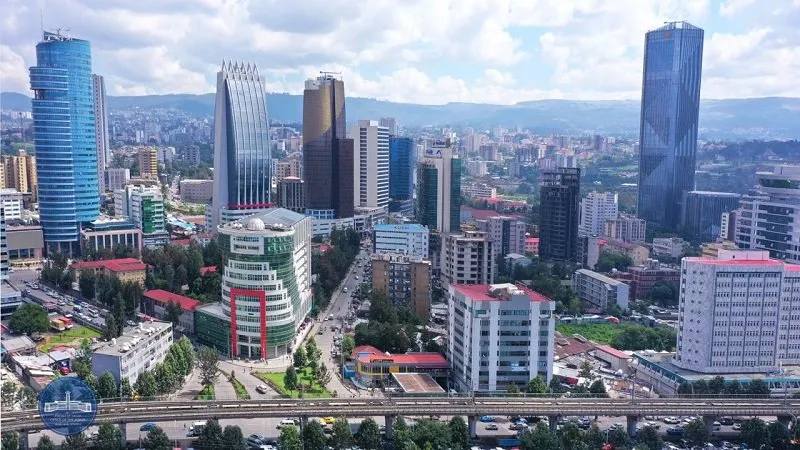
For casual onlookers and foreigners who do not understand the political drama, Addis Ababa, may have undergone a dramatic transformation in recent years, emerging as a symbol of urban renewal and progress. The city boasts gleaming skyscrapers, illuminated gardens, and expansive corridor developments that evoke comparisons to glittering modern Asian metropolises. However, these glossy exterior masks a deeper crisis: widespread poverty and ethnic tensions that afflict the nation. While the city’s lights shine brightly day and night, much of Ethiopia grapples with the lowest electricity access rates in sub-Saharan Africa, highlighting a stark disparity between urban showcase projects and rural neglect. The “project” is a typical gentrification—characterized by rapid redevelopment and displacement—prioritizes aesthetics over equity. For instance, projects like the corridor developments have led to forced evictions of Amhara’s and people of Tigryan descent without adequate compensation for residents, often leaving low-income families in peripheral areas without shelter and basic amenities. Peri-urban farmers, the poor and politically marginalized ethnic groups bear the brunt, with compensation averaging just 190 ETB per square meter, far below market values of 1.2 to 1.8 million ETB. This process, dubbed “gentrification on steroids,” has displaced thousands of Amharas and other politically marginalized ethnic groups, exacerbating social fragmentation, ethnic polarization and conflicts.
Lights and Luxury versus Basic Needs: A Tale of Two Parallel Ethiopia
In Addis Ababa, gardens adorned with decorative lights and flowing fountains create an illusion of prosperity, yet millions across Ethiopia including in the capital city lack access to clean drinking water and reliable electricity. National electricity access stands at around 55%, with rural areas faring worse, while urban centres like Addis remain prioritized. This electrified coverage is the lowest in Africa which the World Bank reported 60% in 2023 (latest available data). Ethiopia’s power generation has grown, particularly through hydropower like the Grand Ethiopian Renaissance Dam, but distribution remains uneven, leaving households deprived even as the capital’s exterior glows day and night. Just for the regional comparison, in 2023, Asia’s and Latin America’s electricity access rate reached a whopping 98 % (universal access).
Water access tells a similar story: only 42% of Ethiopia’s population has clean water supply, and just 11% enjoy adequate sanitation. In Addis, luxury features like flushing waters in public spaces contrast sharply with nationwide shortages, where urban demand is projected to rise 140% by 2043, yet current supply meets only 40% of the demand. This imbalance fuels resentment, as onlookers perceive a modern city while citizens endure basic deprivations. Average rate of access to water in Africa has significantly improved in recent years reaching 71% with north Africa leading at 92 %. It can take several decades for Ethiopia to catch-up with the African average access rate of 71%. In short, the so-called transformation of Addis Ababa is not only a form of utter gentrification that benefits elites at the expense of the poor, but it is also a systematic attempt to alter the ethnic composition of the capital city. The sham modernization being pushed in Ethiopia, displaces Amhara residents and other politically marginalized ethnic groups at huge political and socioeconomic cost to vulnerable populations. The urban land so cleared of the poor and marginalized ethnic groups is passed onto Arab investors, Oromo political elites and supporters of the ethnocentric and warmongering regime of Abiy Ahemed Ali.
Abiy Ahmed’s Non-existent “Development Model”: Lacking Vision, Professionalizing Prosperity Gospel
Unlike his predecessors—Meles Zenawi, who pursued a disciplined developmental state model rooted in state-led industrialization, or Hailemariam Desalegn, who maintained continuity in infrastructure and agricultural modernization—Abiy Ahmed lacks a coherent vision or structured development framework. His approach has been characterized as ad hoc, reactive, spontaneous, illusionary and devoid of long-term strategic planning. Where prior regimes invested in institutions, human capital, and rural transformation, Abiy’s governance pivots toward spectacle-driven urbanization and symbolic mega-projects that benefit political elites and ethnic entrepreneurs.
As I articulated repeatedly in the past, Abiy has professionalized development under the utopia of prosperity gospel—a faith-infused narrative that frames economic success as divine favor and personal breakthrough rather than systemic reform, state-led investment and development-oriented policies. Abiy public declared that “if one thinks positive, poverty will disappear overnight”. His constant illusions and delusions are akin to the prosperity gospel ideology popularized in evangelical circles. This is reflected not only in his public rhetoric but also in ghost writing: promises of “medemer” (synergy) as spiritual and economic unity, palace inaugurations with prayer ceremonies, and urban beautification presented as moral and material redemption. Development becomes performative—glossy corridors, lit-up parks, and luxury fountains serve not just as infrastructure but as theological symbols of breakthrough, while rural and urban poverty, war-displaced communities, and systemic failures are sidelined as spiritual tests. The irony is that the regime, while prophesizing prosperity gospel, has been busy waging wars and wanton destruction of infrastructure and killing citizens- largely women, children and the elderly.
This fusion of ethnic politics and prosperity theology depoliticizes structural issues. Poverty is not addressed through redistribution, agriculture development or industrial policy but through motivational speeches and elite-led philanthropy. Economists call this “pastoral capitalism,” where national progress is measured by the visibility of divine favor in the capital, not by reductions in child malnutrition, destitution, or school enrolment. “Abiy’s model” which is full of empty promises offers no developmental anchor—only the promise that faith, positive thinking, and photo-op infrastructure will deliver prosperity.
Warmongering as a Deterrent to Development: Consolidating Power at Colossal Costs
The continued policy of war, interethnic clashes, and warmongering under Abiy Ahmed serves as a major deterrent to Ethiopia’s socioeconomic development, primarily benefiting his efforts to maintain power at a colossal cost to the people and the country. Ongoing conflicts, including those in Tigray, Amhara, and Oromia, have significantly impacted economic growth, leading to increased poverty, hunger and instability. The World Bank has just projected a 43% poverty rate by 2025, attributing this rise largely to war and conflict under Abiy’s administration. Joint Oxford University and UNDP poverty measures indicate that 73 % of the Ethiopian population is in multidimensional poverty. The Abiy-orchestrated ethnic wars have exacerbated economic crises, with high inflation, unemployment, and threats of regional catastrophe amid economic collapse. Abiy used warmongering to consolidate power, exploiting ethnic politics and dangerous rhetoric to hook onto authority indefinitely. His shift from Nobel laureate to a figure accused of tyranny and genocidal wars has drawn international criticism, with policies seen as prioritizing personal power over national development. Abiy’s dangerous policies are causes and effects of rising poverty and conflict, emphasizing the detrimental effects on inclusive growth and sustainable development of the country.
The Stark Reality of Poverty in Ethiopia
As indicated above, with a population of approximately 127 million, over 73%—or more than 80 million—live in extreme multidimensional poverty, a reversal from earlier declines. International organizations and prominent economists attribute this spike to conflicts, climate shocks, and inflation, with rural areas hit hardest. Currently, over 25 million depend on food aid, though recent estimates indicate 21 million need emergency humanitarian assistance amid ongoing crises. Education suffers too: 11 million children are out of school, with conflicts closing thousands of institutions, particularly in regions like Amhara and Tigray. UNICEF reports over 9 million school-aged children affected by violence and disasters. These statistics paint a grim picture, where urban gentrification in Addis diverts resources from nationwide needs.
Ethnic Polarization: Deepening Divisions Under Abiy
Ethnic federalism, introduced in the 1990s, promised to address Ethiopia’s diversity but has instead fuelled fractionalization, polarization and incessant interethnic conflicts as well as the emergence of ethnic entrepreneurs. Under Abiy, reforms initially lifted lids on tensions, leading to violence and displacement of millions notably the Amharas and non-Oromo ethnic groups. Abiy’s administration is deepening divides, with perceptions of favoritism toward pro-regime Oromo nationalists while eroding public trust in institutions. Ethnic conflicts in Tigray, Amhara, and Oromia have already displaced 4.7 million, exacerbating fragility.
Pathways Forward: From Spectacle to Substance
Ethiopia’s path forward requires rejecting both warmongering and prosperity gospel theatrics in favor of data-driven and evidence-based, inclusive growth and development. A return to institutional planning, investment in rural development, and conflict resolution is essential. True progress will not come from lit-up gardens or divine promises—but from hard-work, equitable and inclusive policies, political accountability, and a leadership vision that sees development as a collective duty, not a personal miracle under utterly biased political machination. As the nation stands at a crossroads, the choice is clear: substance over spectacle, unity over division, and people over power.
Editor’s Note : Views in the article do not necessarily reflect the views of borkena.com
__
Support Borkena : https://borkena.com/subscribe-borkena/
Join our Telegram Channel : t.me/borkena
Like borkena on Facebook
Borkena Ethiopian News Youtube Channel
To submit Press Release, send submission to info@borkena.com
Add your business to Ethiopian Business Listing / Ethiopian Business Directory
Join the conversation. Follow us on X (Formerly Twitter) @zborkena to get the latest Ethiopian News updates regularly.
Your article is a powerfully articulated critique, highlighting critical issues often overlooked. Your strength lies in framing urban development within the context of nationwide poverty, using stark statistics from verifiable sources to ground your argument. The comparison between Addis Ababa’s “glittering” corridors and the rural electricity crisis is a compelling and damning juxtaposition.
However, your analysis ultimately lacks the objectivity required for persuasion. The piece presents a singular, heavily one-sided view, a fashionable but ultimately unproductive approach that has become ubiquitous in contemporary political writing. By framing complex urban renewal solely as state-sponsored “ethnic cleansing” and dismissing the entire administration’s approach with terms like “prosperity gospel,” you forgo balance. A more robust analysis would acknowledge the government’s stated development goals, even if to critique their execution, and would avoid attributing all events to a single conspiratorial motive. Presenting a more fine distinction perspective, rather than a monolithic indictment, would strengthen your argument and elevate it beyond the echo chamber of polarized discourse.