
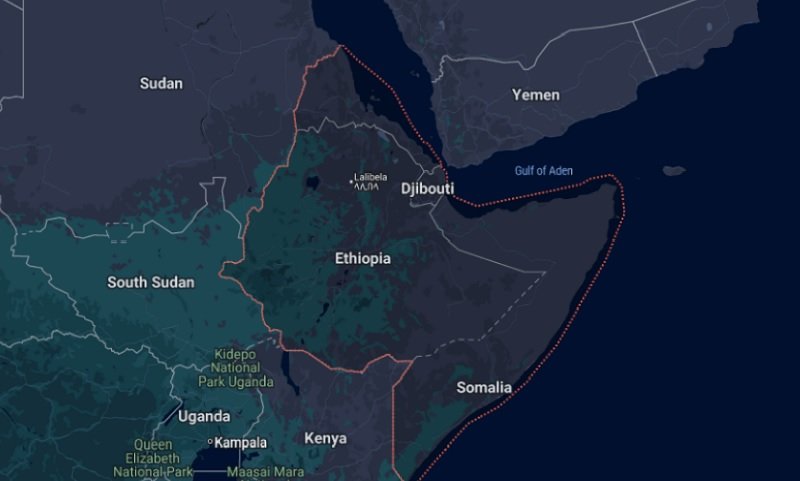
By Eyassu Epheraim G Hanna,
UK London: Independent Analyst on Horn of Africa Geopolitics
Abstract
The Horn of Africa’s geopolitical landscape is shifting under the combined weight of Gulf investment, militarised diplomacy, and regional fragmentation. This paper examines how the United Arab Emirates (UAE), Eritrea, and Sudan are reshaping the security order around Ethiopia’s northern frontier and explores what these changes mean for Amhara’s Fano movement. Using open-source data, media reporting, and field-based analysis, it argues that the Tsimdo realignment—linking Eritrea with Ethiopian opposition groups—has created both short-term opportunities and long-term risks for Fano. The study concludes that cooperation with historical adversaries such as the TPLF or Eritrea, if not grounded in a clear political strategy, could undermine Fano’s legitimacy and weaken Amhara’s bargaining position within Ethiopia’s federal framework. The paper offers strategic recommendations on alliance discipline, political articulation, and engagement with regional diplomacy.
1 The Horn as the New Frontline
Few regions capture the convergence of global and local rivalries as acutely as the Horn of Africa. The Red Sea is a chokepoint for roughly 12 percent of world trade, yet its littoral states are internally fragile. Since 2017, Gulf powers—principally the UAE and Saudi Arabia—have invested heavily in ports, airfields and logistics from Port Sudan to Berbera and Bosaso. Their presence filled a vacuum left by reduced Western engagement after the “war on terror” era. What began as commercial outreach has evolved into a layered security footprint involving training missions, maritime surveillance and humanitarian operations.
For the UAE, access to the Red Sea complements its Indian Ocean and Mediterranean routes, linking the Suez Canal to Fujairah through a chain of friendly facilities. But this outward projection coincides with deep internal turbulence within Horn states. In Sudan, rivalry between the Sudanese Armed Forces (SAF) and the Rapid Support Forces (RSF) has fractured the country. Ethiopia, after the Tigray war, faces centrifugal pressures from Amhara, Oromo and other regions. Eritrea, long isolated, has re-entered the regional stage through its influence on both Sudanese and Ethiopian actors. Together, these shifts amount to a strategic re-ordering of the northern Horn.
2 The UAE’s Expanding Geostrategic Footprint
The UAE’s approach combines hard infrastructure with soft-power diplomacy. Its companies—most prominently DP World—operate or manage ports in Berbera (Somaliland) and Bosaso (Puntland), while Emirati trainers have assisted local police and coast-guard units. The Emirates also fund hospitals, humanitarian airlifts and development projects across the region, portraying themselves as stabilising partners.
Economically, Dubai’s gold market lies at the heart of the Horn’s conflict economy. Sudan produces more than 60 tonnes of gold annually, much of it exported—legally or illicitly—to the UAE. Chatham House and UN Comtrade data show nearly 90 percent of Sudan’s
recorded gold exports in 2024–25 went to Emirati refineries. Ethiopia’s official exports are smaller (about 4 tonnes in 2023–24) but illicit flows from artisanal mining mirror Sudan’s pattern. The result is a financial ecosystem in which Dubai traders and logistics firms exert disproportionate influence over Horn-based producers.
Strategically, Emirati facilities in Berbera and Assab (Eritrea) give the UAE forward reach across the Bab el-Mandeb strait. During the Yemen conflict, the Assab base supported coalition operations. Today it offers proximity to both Sudanese and Ethiopian theatres, reinforcing the UAE’s position as an indispensable intermediary between African and Arabian security agendas.
3 Sudan, Gold and Proxy Networks
Sudan’s civil war has become a magnet for external patrons. The RSF, led by Mohamed Hamdan Dagalo (Hemedti), relies on financial networks tied to Darfur’s gold fields and external backers in the Gulf. The SAF under Abdel Fattah al-Burhan draws support from state institutions, Egyptian sympathy and, increasingly, Eritrean logistical cooperation. Two coalitions—one anchored in Cairo and Asmara, the other in Abu Dhabi and Addis Ababa— now compete for dominance along the Nile corridor.
Independent journalist Martin Plaut notes that Eritrea has “ingratiated itself with the [Sudanese] military by arming and training thousands of fighters drawn from eastern Sudanese communities” and that the SAF even relocated aircraft to Asmara after RSF drone strikes on Port Sudan [3]. Such operational intimacy transforms the Sudan–Eritrea border into a single military ecosystem. Any Ethiopian incursion into Eritrea would therefore risk immediate retaliation or containment from SAF forces positioned along Ethiopia’s north
western frontier.
Figure 1 illustrates the territorial distribution of forces in Sudan as of October 2025. The SAF-controlled eastern corridor (red) abuts Eritrea and Ethiopia’s Amhara Region, creating a continuous belt of cooperation between Burhan and Isaias Afwerki.
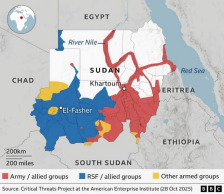
Figure 1. Territorial control in Sudan, October 2025
Source: Critical Threats Project (AEI); BBC News, 28 Oct 2025.
This spatial configuration has direct implications for Ethiopia’s internal security. Because SAF-held zones run contiguous to Amhara territory, any interaction between Eritrean and SAF networks can open logistical or political corridors accessible to Amhara irregulars,
including elements of the Fano movement. The proximity of these frontlines helps explain why Addis Ababa views Eritrea–SAF cooperation as an existential threat.
4 Eritrea, Tsimdo and the Northern Front
On 8 October 2025 the BBC reported that Ethiopia’s foreign minister Gedion Timothewos had written to UN Secretary-General António Guterres accusing Eritrea of preparing to wage war in concert with an opposition grouping known as Tsimdo [1]. The letter claimed that this “collusion had become more evident over the past few months.” Although Asmara denied the charge, the episode underscored the re-emergence of an entrenched rivalry.
The alleged Tsimdo framework links disparate Ethiopian opposition factions—elements of the Tigray People’s Liberation Front (TPLF), Fano militias from Amhara, and segments of the Oromo Liberation Army—under a loose anti-Abiy Ahmed umbrella. Eritrea’s president Isaias Afwerki is portrayed by Ethiopian officials as its principal architect. For Asmara, cooperation with the SAF in eastern Sudan complements this design, providing strategic depth and deniability.
4.1 External Support for Fano and Ideological Contradictions
Plaut reports that “Eritrea continues to arm and train elements of the Fano militias … [turning them] into a more cohesive and effective fighting force.” [3] This corroborates Addis Ababa’s assertions that Eritrean engagement extends beyond diplomacy. Norwegian scholar Kjetil Tronvoll describes Isaias’s foreign policy as one of “control through destabilisation,”
maintaining regional leverage by empowering insurgents rather than direct occupation [4]. Taken together, these assessments depict a deliberate strategy by Asmara to influence Ethiopian internal politics through proxy empowerment.
Yet the alliance exposes deep ideological fissures. Fano originated as an Amhara self defence movement, devoted to protecting Amhara. Cooperation with traditional adversaries such as the TPLF and Eritrea therefore conflicts with its founding narrative. The TPLF still claims Welkait (Western Tigray) as its own, while Isaias’s historical politics opposed Amhara-dominated rule. Egyptian alignment with Eritrea adds another incongruity: Cairo’s longstanding Nile-water rivalry with Ethiopia makes any association suspect to nationalist constituencies.
Public backlash was evident in Deputy Prime Minister Temesgen Tiruneh’s October 2025 speech lamenting that “the Amhara have never been banda (traitor) in their history as today,” widely interpreted as a rebuke to Fano leaders cooperating with Eritrea and the TPLF [2]. The speech echoes fears that Fano could be instrumentalised to undermine the federal government and then discarded once its utility expires—a pattern familiar from earlier TPLF tactics.
5 Ethiopia’s Strategic Dilemma
Prime Minister Abiy Ahmed now faces a delicate balance. His rapprochement with the UAE provides critical investment, humanitarian aid, and military technology but also ties Addis Ababa to Abu Dhabi’s preferred partner in Sudan—the RSF. Aligning too closely with Hemedti risks alienating both the SAF and Eritrea; distancing himself jeopardises Emirati funding. Abiy’s strategic space is therefore constrained by the very alliances that once appeared to strengthen him.
Domestically, Ethiopia’s federation remains under strain. The Tigray war’s end did not bring national consolidation. In Amhara, the Fano insurgency persists; in Oromia, the OLA conducts sporadic attacks; other peripheries remain unstable. Tronvoll argues that Ethiopia’s ethnic-federal structure leaves it vulnerable to manipulation by external actors whenever
federal legitimacy falters [4]. The Tsimdo alignment thus amplifies an internal weakness rather than creating a new one.
Diplomatically, Abiy’s bid for maritime access through deals with Somaliland and other coastal entities alarmed Eritrea and Djibouti, both of which feared encirclement. The UAE— invested in Berbera and Bosaso—encouraged quiet negotiation but avoided overt endorsement. This cautious Emirati posture demonstrates how Horn politics increasingly revolve around Gulf arbitration rather than African institutions.
6 The Wider Red Sea Chessboard
The Horn’s turbulence must be seen within the broader militarisation of the Red Sea. Djibouti now hosts American, Chinese, French, and Japanese bases within a few square kilometres; across the water, Saudi Arabia, the UAE, Iran and Turkey pursue overlapping agendas. The Bab el-Mandeb has become both an artery of trade and a zone of contestation.
Plaut’s October 2025 analysis situates any potential Ethiopia–Eritrea war within this trans regional arena. He warns that a new conflict “would no longer be contained” but could stretch “from Darfur in western Sudan to the Bab el-Mandeb” as Gulf and Middle Eastern powers transpose their Sudanese alignments onto the Red Sea front [3]. Egypt’s growing military cooperation with Asmara—trainers, arms deliveries and a possible Red Sea naval presence— illustrates this diffusion. Cairo’s ambition to regain leverage after losing the GERD dispute ensures that any confrontation between Addis and Asmara would resonate far beyond the borderlands.
Great-power involvement adds another layer of complexity. Russia maintains official relations with the Sudanese Armed Forces (SAF) through defence and mining agreements—most notably the still-pending Port Sudan naval-base deal—while elements of the former Wagner Group have simultaneously traded with companies tied to the Rapid Support Forces (RSF). The United States, for its part, co-chairs the Jeddah peace process with Saudi Arabia but engages more regularly with RSF political intermediaries than with the SAF hierarchy aligned to Cairo and Moscow. This asymmetry has prompted speculation in Arab media that Washington tacitly favours Hemedti. A recent i3 Politics “i3 Pulse” discussion interpreted the conflict as reflecting a partial convergence between Emirati and U.S. priorities in containing Islamist movements and securing the Red Sea corridor, rather than an explicit partition strategy. Taken together, these dynamics suggest not a simple proxy war between great powers but a competitive management of instability, where each external actor seeks access and influence without assuming full responsibility for Sudan’s outcome.
For the UAE, continued stability in Sudan’s east and the Somali coast is essential to safeguard maritime commerce. For Egypt and Eritrea, counter-balancing Ethiopia’s hydro political ascendancy remains paramount. Saudi Arabia, once perceived as a neutral mediator, has moved into closer alignment with the Sudanese Armed Forces. Al Burhan’s March 2025 visit to Riyadh produced a “coordination council to strengthen relations,” while a high-level Saudi delegation’s trip to Port Sudan days earlier underscored long-term reconstruction plans. This sequence of engagements suggests that Riyadh now views a stable, SAF-led Sudan as central to its Red Sea security strategy. Western powers remain peripheral. The resulting matrix of influence can therefore be summarised as:
– UAE – Ethiopia – RSF: (Wagner: USA)
– Egypt – Eritrea – SAF (with growing Saudi support) (Russia State, TPLF)
Within this structure, Puntland and Berbera operate as Emirati logistics hubs and are unlikely refuges for Ethiopian insurgents, aligning instead with Abiy’s interests. The genuine flashpoints lie along the Eritrea–Sudan–Amhara axis.
7 Scenarios and Policy Implications
7.1 Regionalised Proxy War
The most plausible trajectory is a sustained proxy contest. Eritrea and the SAF could deepen coordination, offering sanctuary and supply routes to Tsimdo-aligned elements. The UAE may maintain indirect assistance to both the RSF and Addis Ababa, preserving leverage without overt confrontation. Plaut concludes that simultaneous wars on multiple fronts could “threaten not only Ethiopia’s economic stability but even Abiy’s political survival.” [3] Such an outcome would prolong insecurity from Darfur to Gondar and complicate humanitarian operations.
7.2 Managed Containment
A less probable but desirable outcome is pragmatic diplomacy. The Intergovernmental Authority on Development (IGAD), supported by the AU and Gulf mediators, could establish border-monitoring missions and regulate gold exports to curb militia financing. Success would hinge on sustained pressure from the UAE and Saudi Arabia—the only actors with sufficient economic leverage over both Addis Ababa and Khartoum.
7.3 Fragmentation and Statelet Economies
Failure of containment could see portions of Sudan and northern Ethiopia devolve into quasi autonomous zones financed by contraband and resource rents. In such a landscape, governance would yield to commerce; gold and arms smuggling would supplant taxation. Ideology would matter less than survival, entrenching instability for years to come.
7.4 – The Partition Scenario
A fourth and increasingly discussed trajectory is the de facto partition of Sudan. Analysts from the European Council on Foreign Relations observe that the conflict has already yielded “four recognisable administrative entities,” with the SAF entrenched along the Red Sea corridor and the RSF controlling much of Darfur and Kordofan. [16] In February 2025, the RSF and allied groups met in Nairobi to sign a charter for a parallel administration, effectively codifying the structure of a rival government. [18] The so-called “Hope Government” announced later that year in Nyala gave the initiative a territorial face, even if its institutions remain symbolic.
The move provoked a sharp regional backlash. Saudi Arabia, joined by Qatar and Kuwait, publicly rejected the Nairobi Charter, declaring opposition to “any illegitimate steps taken outside Sudan’s official institutions that threaten its unity.” [19] This statement clarified Riyadh’s alignment with the SAF and underscored the Gulf consensus against fragmentation. Yet on the ground, the realities of divided command, separate revenue systems, and divergent foreign patrons continue to push Sudan toward a Libya-style dual authority that could last for years. [17]
Such a partition would not resolve the conflict; it would reconfigure it. Each side would claim sovereign legitimacy while exploiting resources in its zone—gold and cross-border trade in Darfur for the RSF, port and customs revenue in the east for the SAF. Regional powers could then entrench proxy interests along a new frontier, transforming Sudan from a single failing state into two rival security economies. For Ethiopia, Eritrea, and the Red Sea corridor, this outcome would institutionalise instability on their western flank and further intertwine Horn conflicts with Gulf rivalries.
8. Conclusion: Understanding the Geopolitical Terrain of Fano’s Struggle
The Horn of Africa’s shifting alliances have turned Ethiopia’s internal contest into a regional power struggle. For Amhara Fano, whose origin lies in defending the Amhara people from persecution and political marginalisation, the battlefield is no longer confined within Ethiopia’s borders. Eritrea, Egypt, and Gulf powers each view the Amhara front through their own strategic lenses—none of which align with the movement’s core interests.
The most urgent lesson is the historical unreliability of both the TPLF and EPLF (Shaebia) as partners in any Ethiopian or Amhara cause. History demonstrates that the political visions of these two organisations have consistently revolved around weakening Ethiopia’s unity. From the 1970s onward, the TPLF and EPLF collaborated not to reform Ethiopia but to dismantle the idea of a cohesive Ethiopian state. Their success culminated in the post-1991 settlement that produced the current federal constitution. Article 39, guaranteeing the right of secession, institutionalised ethnic fragmentation and legitimised centrifugal politics. For the Amhara, this arrangement became a slow-moving catastrophe— transforming the community that had historically anchored the Ethiopian state into the main casualty of an ethnically divided order.
The current outreach from elements of the TPLF and from Asmara’s regime to segments of Fano should therefore be viewed through this historical lens. These are not alliances of solidarity but tactical manoeuvres to weaken Abiy Ahmed’s government and to re-engineer Ethiopia’s balance of power to their advantage. Any Amhara or Fano leader who forgets this history risks repeating it.
At the same time, external powers—particularly the UAE, Egypt, and Eritrea—are pursuing their own strategic objectives: control of Red Sea routes, mineral corridors, and political influence in the Horn. Their interests intersect with Ethiopia’s instability, not its unity. Fano’s alignment with such actors, if pursued without strategic discipline, would compromise its legitimacy and erode the Amhara public’s trust.
Yet the greatest threat to the Amhara cause does not come from abroad—it comes from within. Amhara remains one of Ethiopia’s largest populations, with a vast and resource rich territory that stretches across the country’s central highlands and borders Sudan. These geographic and demographic realities give the Amhara people an unparalleled capacity to mobilise resources and sustain a long-term struggle. However, this potential can only be realised through internal unity. Disunity among Fano groups—fragmented leadership, competing visions, and localised loyalties—has diluted the movement’s effectiveness. It would be hypocritical to seek unity with historic adversaries such as the TPLF and EPLF while remaining divided among us. True ፅምዶ (Tsimdo) must begin at home. Only a united Fano, grounded in collective discipline and a shared political horizon, can translate Amhara resilience into national strength.
In short, Fano stands at a decisive historical crossroads. It can either become a transient tool in other actors’ agendas or assert itself as the authentic voice of Amhara self determination within a united Ethiopia. The wisdom of its leaders in consolidating unity, avoiding historical traps, and understanding the broader geopolitical chessboard will determine not only the survival of the movement but the future of Ethiopia itself.
Selected References
1. BBC News, “Ethiopia Accuses Eritrea of Preparing for War as Red Sea Tensions Rise,” 8–9 Oct 2025.
2. Temesgen Tiruneh, public speech, YouTube and Facebook, Oct 2025.
3. Martin Plaut, “Brothers No More: Ethiopia and Eritrea Edge Closer to War,” Ethiopian Cable Issue 304, 15 Oct 2025.
4. Kjetil Tronvoll, interviews on Horn of Africa politics, YouTube (IDs 6NEcSymGKvQ, Mg90Rhz8pHw, Kjd3pIGpdjQ, 2024–25); The Ethiopian State in Flux: Power, Ethnicity and External Influence, Norwegian Centre for Humanitarian Studies Working Paper 2023.
5. Chatham House, The Politics of Gold in Sudan and Ethiopia, 2024.
6. UN Comtrade Database, Gold Export Statistics 2023–2025.
7. Critical Threats Project, AEI, Sudan Conflict Map, 28 Oct 2025.
8. Swissaid, Illicit Gold Flows from Africa, 2023.
9. International Crisis Group, Red Sea Rivalries and the Horn of Africa, 2024.
10. ADF Magazine, “Saudi-UAE Rivalry Underpins Sudan Conflict,” April 2025.
11. Responsible Statecraft, “Saudi Arabia’s New Role in Sudan: From Mediator to Strategic Partner,” April 2025.
12. i3 Politics (YouTube Channel), “Sudan War Explained: What the Media Won’t Tell You,” i3 Pulse episode, 2025.
13. Jonas Horner, “Split Decision: Why Sudan is on the Brink of Partition—Again,” European Council on Foreign Relations Policy Brief, Feb 2025.
14. ADF Magazine, “History Shows a Divided Sudan Could Face Prolonged War,” Oct 2025; TLDR News Global, “Why Sudan’s Partition Now Looks Inevitable,” YouTube 2025.
15. New York Times, “Amid Regional Diplomatic Furor, Sudan’s Paramilitaries Forge a Rival Government,” 23 Feb 2025.
16. Responsible Statecraft, “Saudi Arabia’s New Role in Sudan: From Mediator to Strategic Partner,” Apr 2025.
Editor’s Note : Views in the article do not necessarily reflect the views of borkena.com
__
Support Borkena : https://borkena.com/subscribe-borkena/
Join our Telegram Channel : t.me/borkena
Like borkena on Facebook
Borkena Ethiopian News Youtube Channel
To submit Press Release, send submission to info@borkena.com
Add your business to Ethiopian Business Listing / Ethiopian Business Directory
Join the conversation. Follow us on X (Formerly Twitter) @zborkena to get the latest Ethiopian News updates regularly.