
Caleb Ta. (Dr.)
Independent Researcher in African Political Affairs; Human Rights Advocate
Abstract
This article investigates the humanitarian and geopolitical crisis in Sudan—a war that has displaced more than 12 million people and pushed millions toward hunger. It interrogates the silence of African leadership, the economic interests driving the conflict, and the foreign actors profiting from Sudan’s disintegration. Drawing from human rights reports and geopolitical analyses, the discussion reveals that Sudan’s conflict is not merely an internal struggle between two generals but a transnational business enterprise involving gold smuggling, proxy militias, and regional complicity.
Introduction
Sudan is currently experiencing one of the most devastating and least reported wars in modern Africa. While global attention remains fixed on conflicts in Gaza and Ukraine, the humanitarian collapse in Sudan continues to deepen (Amnesty International, 2023). More than 12 million people have been displaced, and 14 million face starvation. Yet, African presidents remain silent.
This silence raises profound questions: Why are African leaders quiet about Sudan’s suffering? What role does the United Arab Emirates (UAE) play in this crisis—from gold and farmland to power and politics across the Red Sea? This article explores the intersection of silence, money, and influence, arguing that Sudan’s war is not about tribes or religion, but about who controls Africa’s future.
Power, Greed, and Betrayal Behind Sudan’s Collapse
Sudan’s destruction did not occur overnight. It has been dismantled piece by piece by leaders who learned that in Africa, power is often seized by the gun and sold through a handshake. The two central figures are General Abdel Fattah al-Burhan, head of the Sudanese Armed Forces (SAF), and Mohammed Hamdan Dagalo, known as Hemeti, commander of the Rapid Support Forces (RSF). Once allies in toppling longtime dictator Omar al-Bashir, the two now lead opposing armies in a fight for dominance (International Crisis Group, 2023).
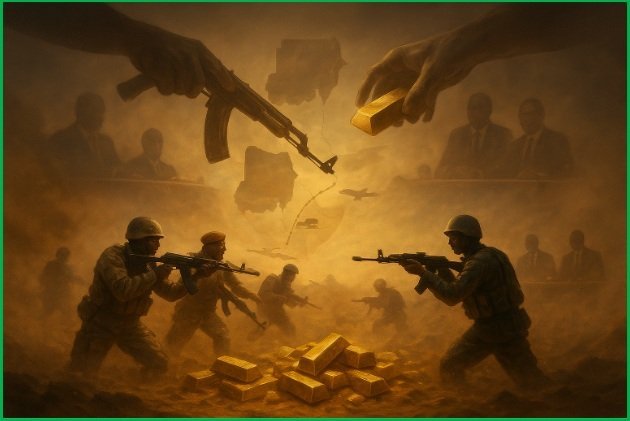
The conflict has evolved from a political rivalry into an economic war fueled by Sudan’s immense natural wealth—particularly gold. According to reports, Sudan has some of the largest untapped gold reserves in Africa. Every day, gold is smuggled across deserts and airstrips to destinations such as the UAE, which has become both a buyer and an enabler in Sudan’s violence (Reuters, 2023).
Gold, Guns, and Silence
The RSF’s funding is closely linked to illicit gold exports. Amnesty International (2023) documented that Chinese-made weapons, supplied by intermediaries tied to the UAE, have reached RSF fighters. This same UAE, while denying involvement, remains the largest importer of Sudanese gold.
Consequently, what is portrayed as a civil war is, in reality, a business transaction—an organized system of proxy warfare where African lives sustain global markets. The profits of conflict flow into offshore accounts, while the cost is borne by displaced civilians and destroyed communities.
Sudan’s gold smuggling network serves both to finance war and to entrench dependency. Each convoy of gold leaving Darfur or crossing into Libya feeds the RSF’s war machine and replenishes Dubai’s refineries—where the gold is “cleaned,” repackaged, and sold as Emirati bullion. The same cycle—destabilize, divide, extract—defines modern African exploitation.
The Emirati Connection: A New Economic Empire
The UAE’s involvement in Sudan reflects a broader regional agenda. As its oil reserves decline and arable land vanishes, the UAE has turned to Africa for survival. Through land acquisitions and military partnerships, it is constructing what analysts describe as a “maritime corridor” across the Horn of Africa—from Somalia and Djibouti to Eritrea and Sudan (Gallopin, 2024).
Emirati corporations have quietly purchased vast tracts of Sudanese farmland—tens of thousands of hectares—displacing local farmers and exporting produce to Gulf markets. These deals, often opaque, deprive Sudanese communities of food and revenue while enriching foreign investors. When Sudan’s transitional government attempted to regulate or block such acquisitions, investment turned into political interference, and interference into armed conflict.
The RSF became a tool in this strategy: a militia protecting the flow of gold and guarding foreign interests in exchange for funding and weapons. Thus, the Sudanese conflict is not simply political—it is the militarized face of economic colonization.
Africa’s Complicity and the Silence of Its Leaders
Many African governments have chosen silence over solidarity. Some are themselves beneficiaries of Emirati investments or are engaged in similar exploitative land and resource deals. The same leaders who proclaim Pan-Africanism are signing memoranda that sell their nations’ futures one contract at a time (African Union Commission, 2024).
Kenya, for instance, has hosted RSF representatives under the guise of peace negotiations—actions that many Sudanese interpret as legitimizing warlords (The East African, 2024). The African Union’s delayed and toothless responses—limited to condemning “atrocities” long after escalation—reflect the organization’s moral paralysis. Only South Africa has issued a direct condemnation of the RSF’s attacks in Al-Jazira State (Department of International Relations and Cooperation [DIRCO], 2024).
This silence is not accidental. It is complicity—rooted in shared economic interests, elite networks, and the prioritization of foreign capital over African lives.
Human Cost and the Erosion of African Solidarity
Behind the politics lies a staggering human tragedy. Over 12 million Sudanese have been displaced, most of them women and children. Fourteen million are food-insecure, with entire communities living without schools, hospitals, or livelihoods (United Nations Office for the Coordination of Humanitarian Affairs [OCHA], 2024).
Arms continue to flow across the same routes once used in the trans-Saharan slave trade—routes now reactivated by global arms suppliers. This tragic continuity of exploitation demonstrates how foreign actors destabilize nations, then extract wealth from the ensuing chaos.
The narrative of “civil war” conceals the deeper truth: Sudan’s suffering is not an accident of history but a designed economy of conflict. Peace is deliberately sabotaged because peace would threaten profit.
The Geopolitics of Resource Control
Every major African war shares a common denominator—resources. In Sudan, it is gold; in South Sudan, oil; in Congo, cobalt; in Niger, uranium; and in Kenya, land. The abundance of wealth has become a curse because it attracts exploitation and fuels competition.
Whoever controls Sudan controls one of Africa’s most strategic gateways—the Red Sea corridor connecting Africa to the Middle East and Asia. A peaceful Sudan would signify African autonomy: setting its own prices for gold, managing its own ports, and industrializing its own resources. For global powers, this would be unacceptable.
Hence, each time peace negotiations advance, new weapons mysteriously appear, and violence resumes. The hands behind those weapons are multinational corporations and foreign governments that profit from instability.
Africa’s Reflection: A Continent at the Crossroads
Sudan’s tragedy is a mirror of Africa’s political decay. It reveals how external forces exploit local greed, and how African elites enable that exploitation. From the African Union’s symbolic condemnations to presidents shaking hands with warlords, the continent’s moral failure is complete.
If Sudan collapses, Africa will feel it—not only through refugee flows but through the normalization of proxy wars funded by extractive economies. As the speaker in the source material pleads, “Sudan’s pain is Africa’s reflection…a continent rich enough to feed the world yet starved of peace.”
Conclusion: A Call to Conscience
Sudan’s bleeding is not a distant tragedy—it is Africa’s warning. Until African nations stop selling sovereignty for short-term gain, until they define the value of their own land, gold, and labor, peace will remain an illusion sold at the price of blood.
The silence of presidents is not neutrality; it is complicity. The voices of journalists, artists, and citizens must rise to fill the moral vacuum left by political cowardice. As the original narrator insists, “Please stand with Sudan. Because if the world can light monuments for Gaza, surely we can raise our voices for Sudan.”
References
African Union Commission. (2024). Statement on the humanitarian crisis in Sudan. Addis Ababa: African Union Press.
Amnesty International. (2023). Sudan: Evidence of UAE-supplied weapons reaching Rapid Support Forces. Retrieved from https://www.amnesty.org
Department of International Relations and Cooperation (DIRCO). (2024). South Africa condemns RSF attacks in Sudan. Pretoria: Government of South Africa.
Gallopin, J. (2024). The Gulf’s Red Sea strategy: Maritime corridors and African dependency. Chatham House.
International Crisis Group. (2023). Ending Sudan’s deadly stalemate. Retrieved from https://www.crisisgroup.org
OCHA. (2024). Sudan humanitarian update: Over 12 million displaced. United Nations Office for the Coordination of Humanitarian Affairs.
Reuters. (2023). Exclusive: UAE gold imports linked to Sudan conflict. Retrieved from https://www.reuters.com
The East African. (2024). Kenya’s delicate role in Sudan peace mediation questioned. Nairobi.
Editor’s Note : Views in the article do not necessarily reflect the views of borkena.com
__
Support Borkena : https://borkena.com/subscribe-borkena/
Borkena Ethiopian News Youtube Channel
Join our Telegram Channel : t.me/borkena
Like borkena on Facebook
To submit Press Release, send submission to info@borkena.com
Add your business to Ethiopian Business Listing / Ethiopian Business Directory
Join the conversation. Follow us on X (Formerly Twitter) @zborkena to get the latest Ethiopian News updates regularly.