
Author: Caleb Ta. (Dr.)
Independent Researcher in African Political Affairs; Human Rights Advocate
Abstract
This article investigates the political trajectory, consolidation of power, and authoritarian longevity of Teodoro Obiang Nguema Mbasogo, President of Equatorial Guinea since 1979. Emphasis is placed on his military coup against his uncle Francisco Macías Nguema, the subsequent execution of Macías, and the establishment of dynastic succession through his son, Teodorín. Over 46 years, Obiang has maintained control through systematic violence, executions, intimidation, and patronage, while accumulating substantial domestic and international wealth. This study provides an investigative account of the social, generational, and institutional consequences of his extended rule, highlighting patterns of authoritarian durability in Central Africa. The article also situates Obiang’s regime within a comparative framework alongside Paul Biya of Cameroon, illustrating commonalities in methods of consolidation, suppression, and dynastic planning. Visual tables and maps summarize Obiang’s known palaces, foreign investments, and family wealth distribution.
Introduction
Central Africa has produced some of the world’s longest-serving leaders, whose extended tenures have profoundly shaped political systems, economic structures, and societal norms. Two emblematic cases—Paul Biya of Cameroon and Teodoro Obiang of Equatorial Guinea—illustrate how authoritarian longevity operates. While Biya ascended via constitutional succession in 1982, Obiang seized power through a military coup in 1979, overthrowing his uncle Francisco Macías Nguema, whose presidency was marked by mass violence and an extreme cult of personality (Nofi Media, n.d.; Monitor, n.d.).
Obiang’s regime, now over 46 years old, demonstrates the interplay of military force, systematic repression, and dynastic planning in maintaining political immortality. The consolidation of power has involved extreme violence, patronage, strategic familial embedding, and accumulation of transnational wealth, producing both domestic inequalities and generational political alienation.
Coup and Takeover: From Nephew to President
On 3 August 1979, Teodoro Obiang Nguema Mbasogo led a military coup that deposed his uncle, Francisco Macías Nguema, who had ruled Equatorial Guinea since its independence in 1968 (Wikipedia, n.d.). By the late 1970s, Macías’s regime was characterized by mass killings, arbitrary arrests, and severe economic collapse (Nofi Media, n.d.; Human Rights Watch, n.d.).
Macías executed political opponents and even members of his own family, cultivating a climate of fear and paranoia within the military and civilian populations (Monitor, n.d.). Notably, Macías promoted himself as divine, proclaiming slogans such as “There is no God other than Macías” and mandating that church services praise him as “The Only Miracle” (warhistory.org).
Obiang’s coup was executed by military units loyal to him and motivated not only by ambition but also by the urgent need to halt Macías’s escalating violence. Macías was swiftly tried, convicted, and executed, signaling Obiang’s willingness to employ ruthless measures to consolidate authority (Human Rights Watch, n.d.).
Consolidation of Power: Violence and Intimidation
Over the subsequent 46 years, Obiang has maintained his presidency through a systematic program of repression and political violence, including:
- Political Executions and Killings – Elimination of former officials, suspected opponents, and military rivals to prevent challenges to the presidency (Gardner, 2005).
- Arbitrary Arrests and Torture – Detentions without trial, often accompanied by physical and psychological abuse (Human Rights Watch, n.d.).
- Suppression of Media and Civil Society – Independent journalists and opposition figures faced harassment, exile, or imprisonment.
- Targeted Military and Elite Purges – Loyalty rewarded through wealth, governmental positions, and control over resources, while perceived threats were eliminated.
- Cult of Personality Reinforcement – State media promoted Obiang as “like God in heaven … able to kill without accountability,” reinforcing personalist legitimacy (Human Rights Watch, n.d.).
These methods, repeated over decades, allowed Obiang to maintain political dominance, suppress dissent, and secure the continued loyalty of the military and elite.
Dynastic Succession: Teodorín and Family Embedding
In 2016, President Teodoro Obiang Nguema Mbasogo formally institutionalized a dynastic succession plan by appointing his son, Teodoro Nguema Obiang Mangue, commonly known as “Teodorín,” as Vice President of Equatorial Guinea (Monitor, n.d.). This appointment positioned Teodorín at the center of political, financial, and ceremonial authority, effectively ensuring the continuity of Obiang’s four-decade-long regime. Beyond this formal designation, Obiang has strategically embedded other family members across key sectors of governance, including government ministries, the security apparatus, and state-linked enterprises. This extensive familial presence consolidates power within a tightly controlled dynastic network, limiting avenues for opposition and guaranteeing that the state machinery serves family interests as much as national governance.
Wealth Accumulation: Palaces, Investments, and Luxury
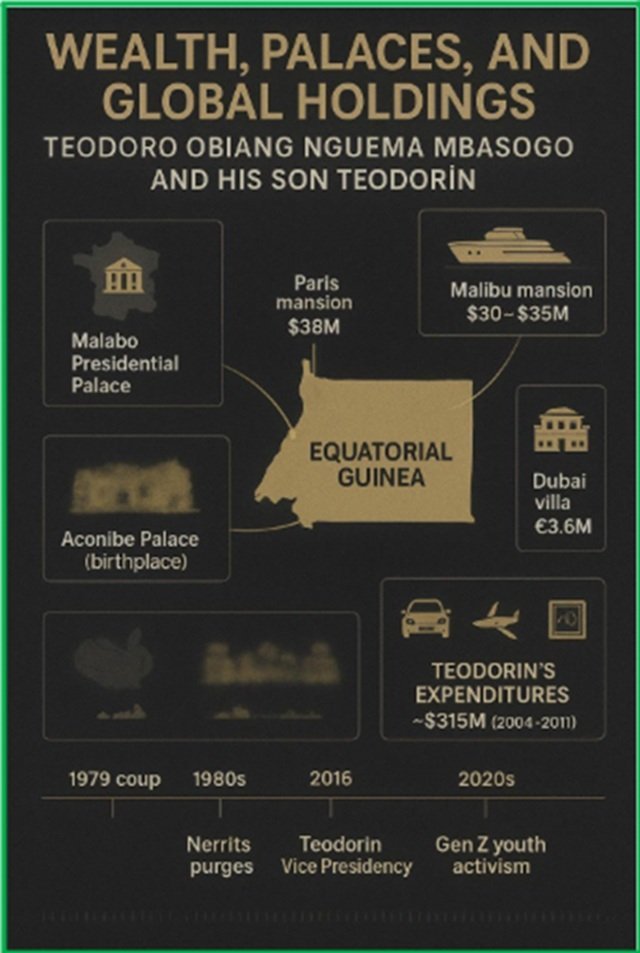
Obiang and his son have amassed extraordinary wealth over decades, both domestically and internationally, illustrating the intertwining of political authority and personal enrichment. Teodorín’s expenditures alone between 2004 and 2011 are documented at approximately US$315 million, covering luxury residences, high-end vehicles, private jets, and rare art collections (Human Rights Watch, n.d.). Notable acquisitions include a mansion in Malibu, California, valued at roughly US$30–35 million, along with extensive collections of luxury vehicles, yachts, and memorabilia, including items related to global pop culture figures such as Michael Jackson (TIME, n.d.).
President Obiang himself maintains substantial international holdings, including a six-story Parisian property on Avenue Foch reportedly purchased for more than £15 million (~US$20–30 million) and other real estate investments in Madrid, the Canary Islands, and Dubai (The Times of India, n.d.; Wikipedia, n.d.). Additional contracts highlight the domestic concentration of wealth, such as the US$77 million agreement with SsangYong Engineering & Construction to build a high-end “Leader’s Club” guesthouse in Equatorial Guinea (Foreign Policy, n.d.).
Wealth Accumulation: Palaces, Investments, and Luxury
The Obiang family exemplifies the transnational accumulation of wealth by authoritarian elites:
Teodorín’s Expenditures
- Documented spending of US$315 million between 2004–2011 on properties, luxury vehicles, private jets, yachts, and art (Human Rights Watch).
- Malibu mansion, California (~US$30–35 million) with luxury cars and art, including Michael Jackson memorabilia (TIME).
- Annual lifestyle expenditures are estimated in multi-millions of USD.
Obiang’s Personal Assets
- Homes in France, including a six-floor Parisian building on Avenue Foch (~US$20–30 million) (The Times of India).
- Bank accounts in France, Switzerland, and the USA, exact amounts undisclosed (Wikipedia).
- US$77 million contract for the “Leader’s Club” guesthouse in Equatorial Guinea (Foreign Policy).
Domestic Palaces
- Malabo Presidential Palace (political hub)
- Sipopo Palace (~US$830 million luxury complex)
- 5–7 additional palaces, including birthplace Aconibe, for ceremonial/personal use
Foreign Properties and Investments
- Paris, France: Mansion (~US$38 million)
- Malibu, USA: Luxury mansion (~US$30–35 million)
- Madrid / Canary Islands, Spain: Multiple estates
- Dubai, UAE: Villa (~€3.6 million)
These holdings illustrate how political authority has been converted into vast personal wealth, both domestically and transnationally (Mediapart, 2014).
Socioeconomic and Institutional Impacts
Despite oil wealth, the majority of Equatorial Guinea’s population remains marginalized:
- ~70% live below the poverty line
- 35% lack access to clean water
- Education infrastructure is limited
- Leisure goods, such as alcohol, reportedly more accessible than essential services, reinforcing loyalty through consumption
Prolonged rule has entrenched a patronage state, weakened institutions, and marginalized opposition. Youth, including emerging Gen Z activists, are largely excluded from political decision-making, fostering alienation and frustration.
Comparative Observations: Paul Biya
- Means of Accession: Biya ascended constitutionally (1982); Obiang seized power militarily (1979).
- Cult of Personality: Macías proclaimed quasi-divinity; Obiang cultivates a personalist mythos.
- Succession/Dynasty: Obiang institutionalized a father-son succession; Biya’s succession remains uncertain.
- Generational Effects: Both regimes have produced generations familiar with only one leader, fostering political apathy.
- Institutional Consequences: Weak institutions, limited pluralism, and repression are common to both.
Timeline of Major Repressive Events (1979–Present)
| Year | Event |
| 1979 | Coup against Macías; execution of former president |
| 1980–1990 | Purges of military and government officials; arbitrary killings |
| 1990 | Introduction of limited multiparty politics; opposition suppressed |
| 2003 | State media promotes Obiang as divine; continued political killings |
| 2016 | Teodorín appointed Vice President; dynastic succession solidified |
| 2020s | Gen Z youth activism emerges; repression continues |
Conclusion
Teodoro Obiang’s regime exemplifies how authoritarian longevity is maintained through:
- Ruthless political violence and suppression
- Cultivation of a personalist image
- Dynastic succession with family embedded in power
- Accumulation of wealth domestically and internationally
The combination of fear, patronage, and dynastic continuity has entrenched power, undermined institutions, and alienated generations of citizens. Comparisons with Paul Biya reveal a broader Central African pattern: leaders consolidate political immortality at tremendous human and societal cost, stifling political renewal and youth engagement.
Editor’s Note : Views in the article do not necessarily reflect the views of borkena.com
__
Support Borkena : https://borkena.com/subscribe-borkena/
Borkena Ethiopian News Youtube Channel
Join our Telegram Channel : t.me/borkena
Like borkena on Facebook
To submit Press Release, send submission to info@borkena.com
Add your business to Ethiopian Business Listing / Ethiopian Business Directory
Join the conversation. Follow us on X (Formerly Twitter) @zborkena to get the latest Ethiopian News updates regularly.