
Author: Caleb Ta., (Dr.)
Independent Researcher in African Political Affairs; Human Rights Advocate
Abstract
Sudan’s ongoing civil war has become one of the most devastating yet underreported humanitarian crises in the modern world. Since its outbreak in April 2023, the conflict between the Sudanese Armed Forces (SAF) and the Rapid Support Forces (RSF) has evolved from a domestic power struggle into a full-scale proxy war drawing in regional and global powers. This paper explores the war’s multifaceted dynamics—its ideological roots, sectarian dimensions, and geopolitical entanglements—through a critical analysis of international media reports, humanitarian data, and expert assessments. Both the SAF, backed by Islamist and authoritarian states such as Egypt, Iran, and Turkey, and the RSF, supported by the United Arab Emirates and Libyan networks, have turned Sudan into a chessboard for competing regional ambitions. The conflict’s humanitarian consequences are catastrophic: more than 150,000 people have been killed, 12 million displaced, and famine has gripped large swaths of the population. Civilians, particularly Christians and ethnic minorities, continue to suffer atrocities amid international silence and selective media coverage. The article argues that Sudan’s war symbolizes the shifting landscape of modern proxy warfare—where ideological, economic, and strategic rivalries intersect in fragile states, creating endless cycles of violence. Ultimately, it calls for a paradigm shift in global engagement—one that prioritizes local empowerment, transparent trade, and non-exploitative diplomacy—over traditional interventions that have historically exacerbated instability across the Horn of Africa.
Introduction
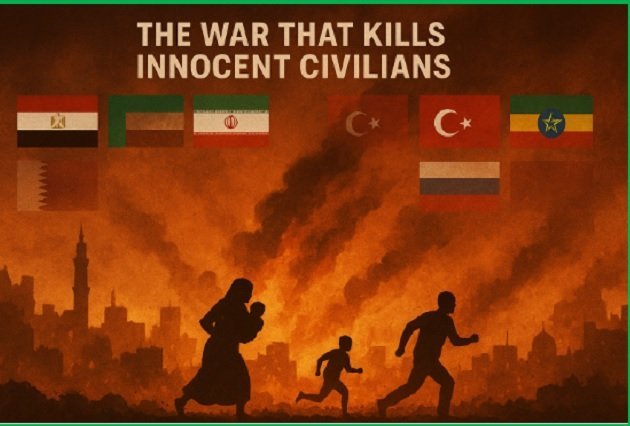
Sudan’s civil war, which erupted in April 2023, has escalated dramatically over the past two years, with the latest intensification in recent days. Civilians—particularly Christians—have been specifically targeted, and reports indicate over 150,000 people killed and 12 million displaced, making this the largest ongoing humanitarian crisis globally (Center for Preventive Action, 2025; Human Rights Watch, 2025). Despite the scale of the catastrophe, international response from the United Nations (UN), the International Criminal Court (ICC), the International Court of Justice (ICJ), and even prominent activists has been minimal. Analysts note that liberal progressive media and activist communities in the Western world have largely remained silent, a phenomenon attributed to the absence of Western interests or high-profile victims (Atlantic Council, 2024; Wilson Center, 2024).
The Warring Factions: SAF and RSF
The conflict centers around two primary factions: the Sudanese Armed Forces (SAF) and the Rapid Support Forces (RSF). The SAF, Sudan’s formal national army, has dominated since the 2019 coup. Linked to the Muslim Brotherhood, the SAF is accused of war crimes, obstructing democratic transition, and maintaining Islamist militias. It also faces potential accountability for its role in the 2003 Darfur genocide (Center for Preventive Action, 2025).
The RSF, a paramilitary organization evolved from the Janjaweed militias, portrays itself as anti-Islamist but has been implicated in ethnic cleansing and mass killings, particularly against non-Arab populations. Both factions trace their origins to Sudan’s early-2000s security apparatus but diverged approximately two decades ago. Their rivalry is driven by competition over control of land, resources, and state legitimacy (Human Rights Watch, 2025).
Humanitarian Catastrophe and Civilian Targeting
Satellite evidence and independent monitoring, including analysis by Yale University’s Humanitarian Research Lab (2025), confirm systematic killings, ethnic targeting, and the use of sexual violence, particularly in El-Fasher. The RSF has been accused of besieging cities—cutting off food, water, medicine, and internet access—before conducting mass attacks. Testimonies from Médecins Sans Frontières (MSF, 2025) and BBC Arabic (2025) describe separation of men from women and children at checkpoints, followed by executions and village burnings.
Both SAF and RSF forces have engaged in ethnically and politically motivated violence in regions under their control, including Sennar, Gezira, and parts of North Kordofan (Protection Approaches, 2025). These acts may constitute war crimes under international humanitarian law. Despite overwhelming evidence, global responses remain muted, reflecting a broader pattern of selective humanitarianism.
Foreign Involvement and Proxy Dynamics
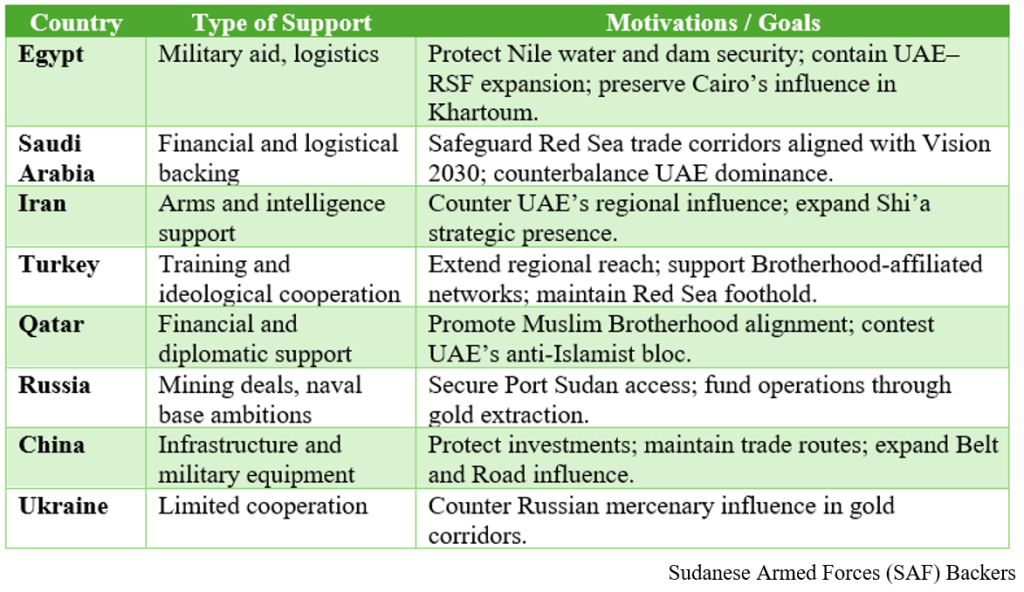
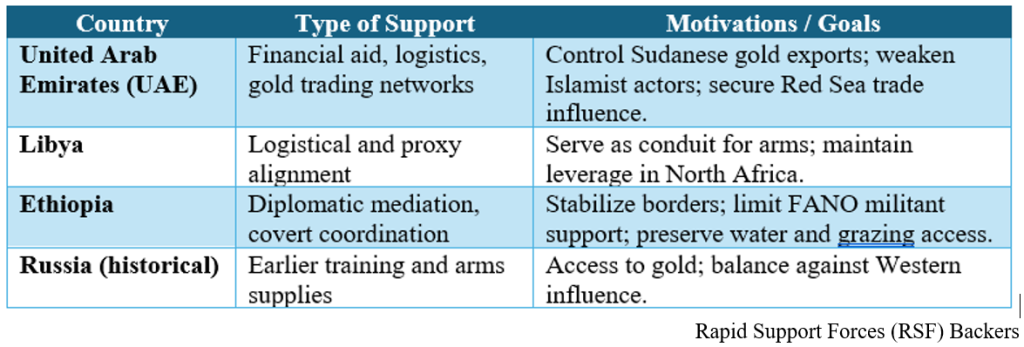
Sudan’s civil war has evolved into a regional proxy conflict, with both factions receiving backing from rival foreign powers.
Sudanese Armed Forces (SAF) Backers
Rapid Support Forces (RSF) Backers
Geopolitical and Economic Dimensions
Sudan’s location makes it a pivotal arena for global and regional power projection. Three resources underpin the conflict’s internationalization: gold, the Red Sea, and the Nile.
- Gold: Sudan is Africa’s third-largest producer, and control of its trade has become central to funding both factions (Atlantic Council, 2024).
- Red Sea Ports: The Red Sea corridor, critical to global shipping, attracts Saudi, Emirati, Turkish, and Russian competition.
- Nile Water Politics: Egypt’s dependence on Nile waters drives its unwavering commitment to an SAF-aligned Sudanese regime.
This economic geography ensures that peace is unlikely without external realignment. Sudan thus functions as a microcosm of 21st-century proxy warfare, where overlapping ideological, economic, and military interests perpetuate instability.
The Silence of Western Progressives
Despite the scale of suffering, progressive political movements and Western media have remained largely indifferent. Analysts attribute this silence to the absence of Western victims, ideological complexity (both sides committing atrocities), and fear of contradicting dominant narratives about imperialism and intervention (Atlantic Council, 2024; Wilson Center, 2024). This selective moral outrage reveals deeper structural biases in humanitarian attention—where conflicts involving African or Christian victims without Western ties receive limited advocacy or funding.
Historical Continuities
Sudan’s fragmentation is not new. Prior to British colonial rule, tribal warlords dominated, and post-independence politics failed to create cohesive governance. Omar al-Bashir’s Islamist dictatorship (1989–2019) institutionalized ethnic and religious hierarchies, paving the way for groups like the Janjaweed to thrive. Scholars emphasize that jihadist and ethnically motivated violence predates colonialism, underscoring that Sudan’s modern crises are the outcome of indigenous militarization amplified by foreign intervention (Memri, 2025; Culture Custodian, 2025).
Policy and Humanitarian Implications
Traditional humanitarian interventions—foreign aid, sanctions, and UN peacekeeping—have failed to stabilize Sudan. Analysts advocate for pragmatic solutions emphasizing local empowerment, transparent trade, and non-exploitative diplomacy (Protection Approaches, 2025). Strengthening community-based governance and allowing regional trade without warlord mediation may offer a sustainable alternative to cyclical international interventionism.
Conclusion
Sudan’s civil war epitomizes the convergence of ideology, economics, and geopolitics in contemporary conflict. The SAF and RSF, while domestic actors, operate within a global network of proxy alliances linking the Middle East, Africa, and Eurasia. Civilians—especially Christians and ethnic minorities—bear the brunt of this war, while international responses remain muted. The conflict highlights the transformation of warfare in the 21st century: decentralized, profit-driven, and politically deniable. To prevent Sudan’s total collapse, the international community must abandon the performative humanitarianism of past decades and instead engage in transparent, locally anchored diplomacy focused on rebuilding sovereignty from the ground up.
Editor’s Note : Views in the article do not necessarily reflect the views of borkena.com
__
Support Borkena : https://borkena.com/subscribe-borkena/
Borkena Ethiopian News Youtube Channel
Join our Telegram Channel : t.me/borkena
Like borkena on Facebook
To submit Press Release, send submission to info@borkena.com
Add your business to Ethiopian Business Listing / Ethiopian Business Directory
Join the conversation. Follow us on X (Formerly Twitter) @zborkena to get the latest Ethiopian News updates regularly.