
Mikael Wossen, PHd.
“We shall measure our progress by the improvement in the health of our people; by the number of children in school, and by the quality of their education”- Nkrumah
Introduction
Indeed, the public education systems in different societies are different organizationally, and in content. But they all seek to prepare young people for active participation in their respective society’s future developments. They achieve this inter-generational challenge, by distilling and transmitting, the accumulated knowledge and wisdom of their society’s forefathers. Educational sociologists probe the decision point of policy making, and explore how a curriculum is constructed and evaluated in each case.
Everywhere, schools are positioned as the main agents in the reproduction of the dominant perceptions, values and practices of life in a given society. To recall Dewey, a just society begins in the classroom of nations. The classroom is known for being the “cell” of schools and, ipso facto, of society. That is because, aside from being disciplinary, schools are hegemonic. Public schools also have the institutional authority to rate citizens’ abilities and intellectual worth accordingly. Hence, they select and stratify students. The intentions, methods, standards and outcomes of each educational system varies, of course. Ultimately, however, for every society, progress is premised on the provision of relevant education to its citizens.
In the case of Ethiopia’s 2025 school living certificates, the immediate objective of the policy-makers was straightforward. Namely, to judge who can continue into higher education, and join one of the country’s 47 state universities. Last year’s data suggest that only 0.6% of the population had this privilege.The intentions of the policy-executioners of this year’s school living exams were clear. We have the Minister’s words. Personally, I’d prefer an independent external expert analyst to evaluate the overall results, rather than the policy-maker himself. There is a truism, that ownership and attachment to a policy, tends to impede correct discernment and evaluation.
Policy Conceptualization
At any rate, the official announcement of the policy maker’s stated objective was clear. It was to reduce the epidemic of cheating, and to streamline the deteriorating educational landscape. This is necessary, apparently to increase access to the higher educational opportunities of the land. The Minister mentioned a corrective policy of teaching English sooner in schools, and of differentiating the universities. He admitted that his ministry was dealing with long-standing problems. At the same time, he showed a smug comfort in his current achievements.
The Minister talked a great deal about the elite 20 schools of particularly high achievers, and especially the seven schools that passed all candidates. He mused about what distinguished them. They were mostly located in urbanizing centers, and the best of them were Catholic affiliated. Whether through stricter invigilation of candidates, or dumbing down of the curriculum, there is no denying that more people have passed this year than last year. This was the presentation’s key point of success.
The increase reported, however, cannot be called significant. In both years, national failure rates were in the 90s percentile. It is also reported that no more than 120 students were caught cheating. Also, the schools that produced no candidates have been reduced. The fact that such schools still exist at all, raises more questions about the declining meaning and quality of education in Ethiopia.
An Unequal Ethnocratic Society
Let us now briefly turn to the wider picture. Seen macro-structurally, the Ethiopian state is a one-party autocratic, and an evangelized crusading state. It has an estimated population of approximately 135 million. Ethiopia is a highly polarized and unequal society. The gap between different communities, ethnicities, classes, and between the rich and poor is widening. The country’s gini-coefficient must rank among the highest in the world. The population is divided into eleven ethnic groups, hammered out of over eighty ethnic groups, “people” and nations. Citizenship, knowledge and schools in Ethiopia, are organized around the category of “ethnicity.” Sovereignty belongs to ethnic groups. As long as the autocratic regime’s cognitive and organizational categories remain stuck in “ethnicity,” the schools and staff cannot be immune. The labour market itself discriminates ethnically in Ethiopia. Amaras are the last to be hired and the first to be fired. Ethnocentric hiring practices/entitlements, and ethno-redemptive pedagogy, rather than a contextual problem solving one, is the norm.
Everywhere, schools are ideal sites of individual learning and personal achievement. They exist to empower the individual’s thinking capacity, and constitute the means to engineering the framework for a unifying national consensus. Yet, constitutionally and practically, there is nothing shared historically and by heritage. In fact, no common citizenship exists in Ethiopia. The country’s historiography and cultural wealth has been tampered with ideologically, and upended by the ruling ideology of the Oromumma regime. Lies and fables are delivered as relevant schooling. The Minister of Education has revealed that Abiy is an Ethiopianist, in public discourse only, but that he is Ormumma in heart and in his statecraft. He is, after all, a product of the OPDO-Eprdf, a party that re-invented a fascist anti-Ethiopia apartheid state, in the 1990s.
Ethiopia invests roughly 3.74% of its GDP on public education, well below the global benchmark. According to MPI or Multidimensional Poverty Index, some 72% of Ethiopia’s populace is impoverished. Schools function amidst genocidal wars, mounting social injustices, and growing inequalities. Lawlessness is on the rise, and corruption has become a way of life -“wage supplementation” as it is known! Public safety is not guaranteed to anyone. Dissent and freedom of expression are not tolerated, not even from members of parliament and journalists.
The Policy’s Outcome
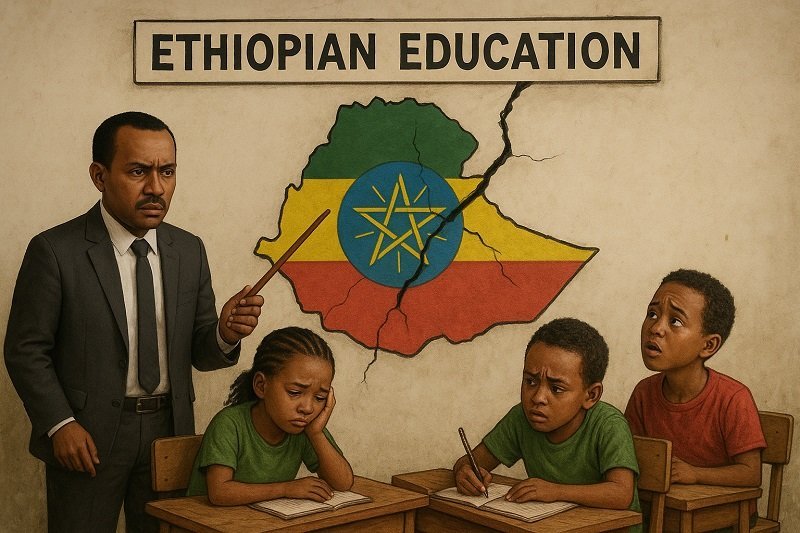
Now, we move to the specifics of the results, as revealed by the Minister. Over the last four years, out of the 2.8 million students examined for school leaving certificates, only 4.7% have passed. In contrast, 8.4% of the candidates have scored over 50% in this year’s examinations. Thus, compared to last year, 12,500 more students will pass in 2025. This year examined a total of 585.879 candidates. In raw numbers, a mere 48.929 passed, and some 536.950 failed. Among the passers, 30.451 were men, and 18,478 women. The reliability of this data is questionable. Namely, UNICEF has reported that nine million children were out of school last year nationally, due to displacements by war, and other economic and environmental hardships. Many schools in the Amhara Kilil were not operative for the last two years, leaving some 4million Amaras unschooled. In Tigrai, only 40% of the students had registered to attend. Consequently, the Minister’s pronouncements have to be accepted with a grain of salt.
For Education Minister Berhanu, this outcome spells success, mission accomplished. Sadly, however, the figures suggest that a vast majority of students have not benefited from the current structures and educational practices, as transmitted by the dispensers of “official knowledge.” Worse still, some schools have not graduated a single candidate, in a country of millions of kids, thirsting for literacy and knowledge .Where is the success in this sorry outcome?
Instead, results suggest that the huge majority have responded poorly to the curriculum. We must, therefore, switch the analytic gaze to them. What of the 91,6% who failed to gain admission, we ask? What’s their fate without further education? They are left without any useful (marketable) skills for the economy. They provide no social or economic capital, so to speak, either for the service industries or agriculture. Most are forced to face unemployment, lumpenhood or to immigrate, at a great risk. Those staying home, their career option is either to become part of the reserve army of labor, or joining Jula’s army. We must consider whether the education system is underfunded, and too overdetermined by the ruling ethnocentric ideology. We know that education is both a product of, and shaped by political ideology. Indoctrination, however subtly or hidden, gives orientation to the curricula and the school’s age-graded ecosystem. What if the schools may not be teaching to the existential and ontological needs of the over 90% of the student body? The latter’s living circumstances and home values do not align with the school’s expectations. As the adage has it, failing students are partially the products of failing schools.
The Urban-Rural Divide
The Minister’s suggestion to improve the school’s organizational setup, and its leadership bodies is commendable.But more needs to be explained. For instance, the socio-economic conditions of underprivileged rural students, and their families, needs to be addressed. A credible policy outcome must look at its impact on clients’, and their circumstances as well. In short, their impoverished living conditions must be accounted for, and alleviated to close the nation’s obvious achievement gap, and the glaring urban – rural disparity.
The rural majority of students are plagued by poverty. They attend under-resourced schools, and labour without access to proper libraries. Even a proper diet or internet access.Water and electricity are a luxury too. Equipped schools and qualified teachers are a rarity. The country’s education system seems to be stacked against the rural compatriots.They are unable to realize their individual possibilities, because of socio-economic circumstances.The World Bank suggests there is a “learning poverty” crisis in the making. UNESCO’s study informs us that 90% of ten year olds cannot read a simple text. This is a euphemism for illiteracy, and a damning verdict on the existing quality of education.
These underprivileged kids are competing against students from well-fed families, going to well resourced, well led, and equipped educational facilities. Unsatisfactory living conditions compound the problem of the underprivileged poor, by affecting student performance. Improvements in their quality of life, would improve both their school attendance and performance, while helping to bridge the urban-rural gap.
Conclusion
Finally, a constitutional and structural transformation is long overdue in Ethiopia. The foundational purpose of education in Ethiopia has to be scrutinized and interrogated further. Schooling has to be disentangled from the toxic ideology of “ethnicity.” A social and intellectual capital development project that excludes over 90% of its candidates is not sustainable. This mode of schooling is, in fact, better deployed for servitude purposes. Aspiring dictatorships are known to abhor an educated population. It is beyond any argument that if Ethiopia is to overcome the current trends, it must seek and apply an alternative educational paradigm. Ethiopian educators and students should not be intimidated and silenced any longer. They must partake in the spirit of the country’s health professionals. We live in a world, where education has become the mirror of a nation’s economic and social performance. It is also the only path to social equality and citizenship. The country’s future, and its children’s freedom are in danger.
Editor’s Note : Views in the article do not necessarily reflect the views of borkena.com
__
Support Borkena : https://borkena.com/subscribe-borkena/
Join our Telegram Channel : t.me/borkena
Like borkena on Facebook
To submit Press Release, send submission to info@borkena.com
Add your business to Ethiopian Business Listing / Ethiopian Business Directory
Join the conversation. Follow us on X (Formerly Twitter) @zborkena to get the latest Ethiopian News updates regularly.
The dysfunctional of educational systems in Ethiopia is disturbing to analyze. In imperial ruling period, there was a an educational radio program of transmission through short wave to accommodate rural schools. Ethio-Telcom bosting that it has several millions as online customers , why not online educational cannot be offered throughout the nation. Abey Ahmed call himself as man of internet wizard. The total educational failer in Amhara and Tigray regions should one blamed both actors. An armed resistance have a huge cost for rural population unless it ends with peace deal or urban insurrection supported by a rural armed resistance within short period. Your Fano has no political skills to lead an urban insurrection until the end of the world