
Eyassu Epheraim G Hanna
Ethiopian politics has always been more than administration. It is theatre, ritual, and the careful staging of memory. Leaders rise not simply as managers of state but as prophets, messiahs, or fathers of the nation. They consecrate themselves through spectacle while erasing those who might rival their symbolic authority. Two events in recent Ethiopian history illustrate this dual logic: the unexplained death of Simegnew Bekele, chief engineer of the Grand Ethiopian Renaissance Dam (GERD), and the theatrical launch of Prime Minister Abiy Ahmed’s book YeMedemer Mengist (“The Government of Synergy/Unity”). One marked the sacrifice of memory; the other, the consecration of scripture. Together they show how power in Ethiopia is sustained not only through institutions and policies but through ritual acts of forgetting and canonization.
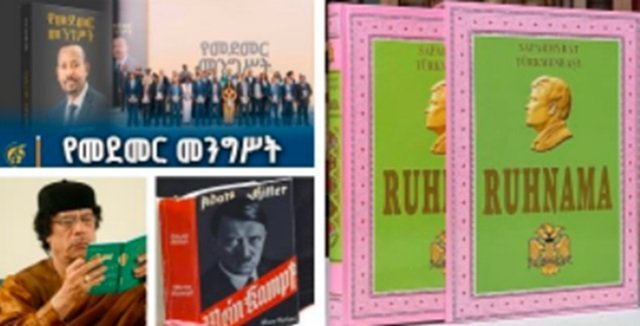
When a sitting leader publishes a book, the performance often matters more than the text itself. Abiy’s book launch was a grand spectacle, staged with lights, music, and testimonies from intellectuals and politicians. The message was unmistakable: the Prime Minister was not only a politician but a philosopher-king, a visionary capable of guiding the nation with theory as well as policy. Organizers compared his work to Hegel and Marx. Prosperity Party members—now numbering some 17 million—were required to own the book, and advancement within the party was tied to tests based on its contents. There were even suggestions that it be included in the national curriculum. In other words, the book was transformed from an individual’s writing into a collective doctrine.
The book is not only a tool of indoctrination but also an instrument of extraction. Priced at 1,000 birr and made obligatory for all 17 million Prosperity Party members, the sales translate into a staggering 17 billion birr in forced contributions. If the alleged author, Prime Minister Abiy Ahmed himself, receives even a standard royalty of 10 percent, this would amount to 1.7 billion birrs in personal wealth. That is not merely a best-seller; it is the most lucrative publishing project in Ethiopian history, engineered not by market demand but by party decree.
This practice collapses the boundary between political loyalty and financial obligation. Party members are not simply expected to embrace Abiy’s vision intellectually; they must also underwrite it materially, purchasing what is effectively a political scripture at great personal cost. For many Ethiopians, 1,000 birr is no trivial sum—it represents weeks of income, the price of survival for households already strained by inflation and instability. Yet refusal is not an option. To rise within the party, to keep one’s position, or even to avoid suspicion, members must buy and study the book.
Here, indoctrination and corruption intertwine. The state and party machinery have been mobilized not only to disseminate an ideology but to extract wealth from millions of citizens under the guise of education and loyalty. Political theorists have long warned of the dangers of personal rule where the leader, the party, and the state merge into a single apparatus. Abiy’s book project is a textbook case: the leader writes, the party enforces, the people pay, and the wealth accumulates at the top.
This is the highest form of corruption—one that does not rely on hidden contracts, offshore accounts, or stolen aid, but rather on the open conversion of political obedience into personal revenue. In this sense, YeMedemer Mengist is not only a manifesto of power but also a business
model. It exemplifies a new kind of political economy where loyalty is monetized, dissent is impoverished, and the leader profits both spiritually and materially from the faith of his followers.
Just as Mein Kampf became unavoidable in Nazi Germany, Abiy’s book is less a choice than an obligation. Refusal to buy it risks political stagnation or suspicion. For ordinary members— many struggling with the cost of living—this is no symbolic gesture. It is weeks of wages sacrificed for the leader’s scripture.
The comparison highlights how authoritarian regimes use books not merely as tools of indoctrination but as mechanisms of extraction. The book becomes both Bible and tax, scripture and revenue stream. It binds political loyalty with economic obligation, transforming followers into financial contributors to the leader’s personal wealth. In Ethiopia’s case, the irony is stark: while the Prime Minister frames his book as a vision of “unity” and “synergy,” its actual practice deepens inequality by forcing the poor to subsidize the leader’s elevation.
This phenomenon is hardly unique to Ethiopia. Across authoritarian regimes, the leader’s book has functioned as both a tool of control and a stream of personal enrichment.
• Adolf Hitler – Mein Kampf: In Nazi Germany, the book became an obligatory possession. Newlyweds were gifted copies, Christmas editions were distributed, and public institutions were encouraged to buy in bulk. The revenues flowed directly into Hitler’s accounts, making him one of Germany’s richest men. What was marketed as ideology was simultaneously a mass taxation mechanism under the guise of cultural gift giving.
• Muammar Gaddafi – The Green Book: In Libya, the text was positioned as a third way between capitalism and communism. Schools and workplaces were compelled to adopt it, and copies were sold through state channels. Like Abiy’s project, the Green Book was both scripture and instrument of bureaucratic control, blurring ideology with material obligation.
• Saparmurat Niyazov – Ruhnama: The Turkmen (the president of Turkmenistan from 1990 to 2006) dictator’s book became the most extreme case of sacralised text. It was required for school exams, professional promotions, and even driver’s licenses. Mosques were pressured to place it alongside the Qur’an. Its omnipresence turned daily life into a constant act of financial and symbolic tribute to the leader’s authorship.
Placed within this tradition, Abiy’s YeMedemer Mengist appears as both continuation and adaptation. Like Mein Kampf, it generates direct revenue for the leader. Like Mao’s Little Red Book, it demands symbolic submission through mandatory study. Like Gaddafi’s Green Book, it proposes itself as a roadmap for national and international policy. Like Niyazov’s Ruhnama, it edges toward sacralization, blurring the boundary between religion and politics.
The most striking feature of the launch, however, was not the book itself but the testimonies. Those who once ridiculed Abiy now appeared as his disciples. Getachew Reda, once a central committee member of the TPLF and Minister of Government Communication, had mocked Abiy as “an apolitical dwarf,” even suggesting he belonged in a mental institution or under holy water treatment. Yet at the book launch, the same Getachew reversed himself, praising the book as “outstanding” and regretting that he had not read Abiy’s earlier works. This was not simply an intellectual reconsideration. It was a ritual of submission, a public conversion from enemy to disciple.
Other figures played their part in this liturgy. Dr. Dagnachew Assefa, a long-time philosophy lecturer at Addis Ababa University, framed the book in quasi-academic terms, placing it within the canon of philosophy. His words gave the performance a veneer of intellectual legitimacy. Zerihun Teshome—once removed from his post as a philosophy lecturer and later a controversial media personality—also testified at the book launch. His presence carried symbolic weight: it suggested that even fractured intellectuals could be rehabilitated and redeemed by aligning with Abiy’s vision. Yet the irony was hard to miss. In the past, Zerihun had scathingly described Abiy as “disillusioned,” going so far as to say that Ethiopia “begins and ends with Abiy’s mind”—a statement meant less as praise than as a warning about dangerous self absorption.
At the launch, however, Zerihun performed a dramatic reversal. He likened Abiy to an eagle, retelling the fable in which the eagle, harassed by crows, simply flies higher into the sky until the crow cannot breathe. In another flourish, he recalled that during stormy weather, eagles rise above the clouds, transcending the storm. Abiy, Zerihun declared, lives and embodies the life of an eagle.
This testimony exemplifies pseudo-intellectuality in its pure form: the substitution of unscientific allegory for critical analysis, the elevation of a political leader into a creature of natural supremacy. Rather than interrogating power, Zerihun’s narrative naturalized it, recasting Abiy as a figure destined to soar above conflict, beyond critique, above the storm itself. The eagle, in this case, is less a metaphor than a mask—designed to obscure fallibility and sanctify authority.
The launch, then, was not an intellectual discussion but a ritual of canonization. Critics became disciples, professors sanctified the text, and controversial figures were folded into the new order. For the audience, the effect was powerful. If even enemies like Getachew now praised the Prime Minister, who could withhold their own loyalty? Politics was staged as faith, and the book as scripture.
At the book launch, the testimonies of Ethiopia’s intellectual figures—Dr. Dagnachew Assefa, Zerihun Teshome, and Getachew Reda—illustrated an old Ethiopian proverb: “To fool a chicken, they throw a thong.” (ዶሮን ሲያታልሏት በመጫኛ ጣሏት). Abiy, once derided as a shallow thinker, was here treated as though he were a towering philosopher. Dagnachew wrapped him in academic jargon, Zerihun likened him to an eagle flying above storms, and Getachew—once his fiercest critic—hailed him as a profound author.
The irony is striking. The more elaborate their praise, the more disproportionate it becomes, like restraining a chicken with a rope meant for an ox. In this sense, the launch was not a celebration of intellectual discovery but a theatrical exaggeration, designed to elevate the ordinary into the extraordinary. Yet it raises a question: in treating Abiy this way, were these figures truly exalting him—or simply fooling him?
The question arises: why such disproportionate exaltation? Several motives can be discerned:
1. Fear and Survival: In Ethiopia’s polarized political climate, to remain silent can be interpreted as dissent. Testimony at such an event is less a choice than a survival tactic. Exaggeration serves as insurance: the louder the praise, the safer the position.
2. Opportunism: For some, aligning with Abiy’s intellectual project is a path back into influence. Zerihun, once sidelined from academia, reemerges as a useful voice precisely by adorning the leader with allegories. What he loses in credibility, he gains in visibility.
3. Desire for Rehabilitation: Former critics like Getachew Reda use the stage not just to praise but to rewrite their own role in the national narrative. By praising the book, he reframes his submission not as defeat, but as intellectual awakening. It is a way to re enter the fold without humiliation.
4. Self-Deception: Over time, intellectuals who repeat exaggerated claims may come to half-believe them. By treating Abiy as an “ox,” they soothe the dissonance between their past critiques and their present compliance.
In all of this, the proverb comes alive. The intellectuals may appear to elevate Abiy, but their very exaggeration carries a trace of mockery—restraining a chicken with a rope meant for an ox reveals more about the absurdity of the rope than the strength of the chicken. Are they truly exalting him, or are they, perhaps unconsciously, fooling him? In their attempt to display loyalty, they expose the emptiness of the performance.
If the book consecrated the leader, the death of Simegnew Bekele showed the opposite ritual: the sacrifice of memory. Simegnew was not just an engineer. He was the face of the GERD, Ethiopia’s most ambitious project, a man who embodied the dam’s promise. His sudden death in July 2018, in Meskel Square, shocked the nation. Police quickly ruled it suicide, but the public doubted the official story. The Prime Minister, abroad at the time, responded coldly, referring only to “a man called Simegnew.” At the dam’s inauguration, Simegnew’s name was not mentioned, nor was his family honored. The man who had symbolized Ethiopia’s development was erased from the project’s official memory.
This erasure is not unique. Ethiopian politics has long practiced what might be called a “ritual of forgetting.” Haile Selassie removed rivals from imperial history. The Derg obliterated the legacy of the monarchy. The EPRDF rewrote revolutionary history to center itself. In each case, power was secured not only through control of the present but through control of memory. Abiy continues this cycle: inconvenient figures are not only removed but erased.
Taken together, Simegnew’s erasure and Abiy’s book launch reflect the dual logic of Ethiopian power. On the one hand, the leader consecrates himself through scripture, elevating his words into doctrine. On the other, rivals are erased, their memory sacrificed so that the leader stands alone as visionary and savior. One is the ritual of sanctification; the other, the ritual of forgetting.
This duality is dangerous. It transforms politics into a quasi-religious theater where the leader is messiah, the book is scripture, and the people are an audience receiving blessings. Truth becomes secondary, memory expendable. Ethiopia is not the first nation to sacralize politics in this way, but it may be among the most vulnerable, for its institutions are weak, its public inquiries absent, and its history already scarred by cycles of erasure.
The death of Simegnew Bekele and the launch of YeMedemer Mengist remind us that in Ethiopia, power is not only exercised but performed. It is staged in light and shadow, scripture and silence. And in that performance, memory itself becomes the ultimate sacrifice.
Editor’s Note : Views in the article do not necessarily reflect the views of borkena.com
__
Support Borkena : https://borkena.com/subscribe-borkena/
Join our Telegram Channel : t.me/borkena
Like borkena on Facebook
To submit Press Release, send submission to info@borkena.com
Add your business to Ethiopian Business Listing / Ethiopian Business Directory
Join the conversation. Follow us on X (Formerly Twitter) @zborkena to get the latest Ethiopian News updates regularly.
From the beginning constructing a Mega dam like “GERD ” Under Woyanee’s political leadership was controversial by many Diaspora’s activists ,citing mismanagement , its secrecy of operations, it’s cost of analysis as alternative constructing a small dams in many regions. In light of all these factors l have no stomach to admire an Engenir selected by Woyanee regime as a hero . I was saddened by his sudden death as humanbeing. My speculation for his death was as suicidal or assassinated by elusive competing power struggle between Woyanee and Abey Ahmed regime for political manipulations to create confusion.among public
Mr. Gebrehana’s Ritual and Power in Ethiopia exposes the intellectual bankruptcy of elites who sell their souls to dangerous actors like Abiy. What is most sickening is to watch some Tigrayan elites point fingers at the TPLF while refusing to hold others accountable — men such as Getachew Reda, who once boasted he would “avenge” Amhara elites and “erase Abiy’s army,” yet now turns around to praise the very man who inflicted devastating losses on Tigray. His betrayal runs even deeper: he brushes aside Abiy’s demolition of poor residents’ homes in Addis Ababa with little more than a passing remark, as though such cruelty were tolerable.
Even more disturbing is the silence of Tigrayan elites who refuse to condemn him, while at the same time supporting a so-called “Tigrayan peace army” led by Getachew and his allies — stationed in Afar, absurdly, to fight Tigray in the name of liberation. The pattern is clear: these elites will collaborate with anyone, twist any narrative, and sacrifice any principle to pursue power and reclaim Western Tigray — a land they falsely claim as theirs. In doing so, they not only betray truth and moral responsibility but also prove Gebrehana’s warning: power without integrity reduces even the educated elite to servants of lies.