
Editor’s note : The author published the content first on Medium.
Beneal Walker
Atlanta, Georgia
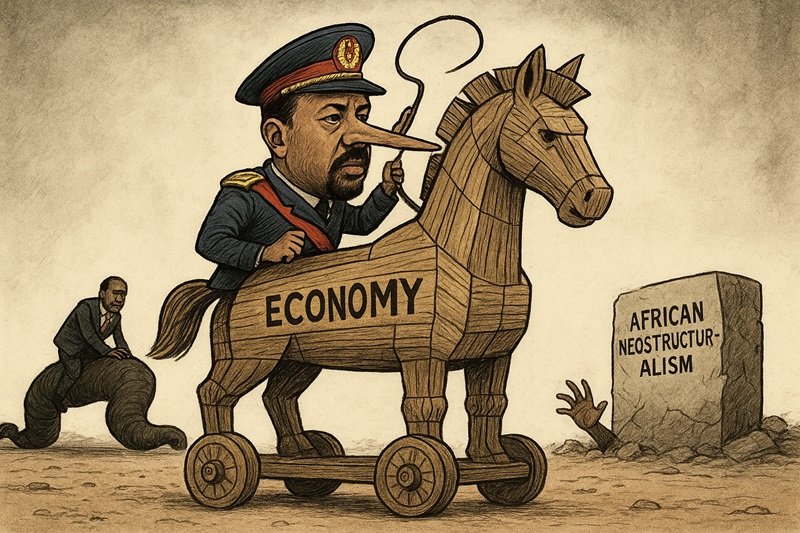
Ethiopia’s unprecedented and untimely financial liberalization transformation has attributed to vast reverberations that harm the nation of its previous developmentalist strategy that once aimed at strengthening domestic and local industries. Abiy Ahmed’s administration’s economic plan has yet to provide Ethiopian laborers with the much-needed guard-rails in protections needed in consequence with the neoliberal dogmatism that has been the economic pathway of choice as evident by the Ethiopian health worker’s strike, high costs of living, recent civil servant wage increase set by the government, and recent resignation by the Central Bank’s chief. With neoliberal policies enacted, Ethiopia’s capture of its own economic surplus in its production, allocation, and distribution cycle of its laboring class exposes it to the staunch and stubborn realities of transnational capital, predatory rent-seeking investors, and its geopolitical armed force. What Ethiopia’s economy is enduring, with this neoliberal fervor, is the same path put forth and followed by much of Latin America, specifically Chile, in the later half of the 20th century. In this article, we will highlight these similarities between the Latin American neoliberal and neostructural projects, its roots, aims, and results with that of Ethiopia’s recent economic transformations to find what is best needed to reinstill confidence, happiness, resiliency, and liberty back to the citizenry of Ethiopia.
I. Social Capital & Dichotomous Economic Thinking
“Just as any revolution eats its children, unchecked market fundamentalism can devour the social capital essential for the long-term dynamism of capitalism itself.”
– Mark Caney, Economist & Prime Minister of the State of Canada
In an attempt to modernize and advance industry, economy, and society, Ethiopia’s dauntless entrance towards an era of export-oriented economic growth has seen its fair share of direct and indirect consequences – and it comes with even more unwarranted challenges and turbulence.
Based on data pulled from the World Bank (2023), Ethiopia had imported a total sum of $23.35B and had exported only $10.93B. The trade deficit is heavily attributed to Ethiopia’s need in paying for fuel and food shortages to not only meet the country’s current demand but also its growing demand. In sight of this, Ethiopia aimed, then, to develop its self-sufficiency and has developed its self-sufficiency capacity with the final construction of GERD, the Grand Ethiopian Renaissance Dam, the development of its own manufacturing sector, its injection of trans-national corporation agreements, and expansion of its industry markets to close the trade deficit gap.
However, as things have progressed since Ethiopia’s decision to adopt a floating currency, an IMF/WB loan to ease up shocks from the COVID pandemic, and multiple multi-year agreements with foreign trans-national corporations, the average Ethiopian citizenry is left to wonder how long until their financial hardships will begin to wane as they experience an increase in the cost of living as well as a slow increase in rent prices (Ethiopia, for the first time, has enabled foreigners to buy and invest in the domestic housing market (2025)).
Since Ethiopia’s drastic reformations, Ethiopia’s financial governance has improved but that is as far as we can say in terms of any positive reverberations. Ethiopia still witnesses a shortage of foreign capital and the deterioration of its people’s standard of living – which is the sole and main concern, or should be, of any and all governmental institutions.
When market fundamentalism and or the pursuit of a free-market begins to take social capital away from a society, there needs to be a checking dynamic that reassures that this element does not supersede and succeed in inflicting withstanding damage to the citizenry. There needs to be guardrails and protections. Ethiopia recently announced that it would increase wages for civil servants from a monthly ETB 4.500 to ETB 6.000 to keep up with the growing cost of living. Although this is indeed a great reform, if not managed properly, could reignite inflationary principles and pressures due to the potential that firms may increase prices that could wipe out the wage increase given to the civil servants of Ethiopia. It is a quite complex relationship and dynamic but nonetheless the main point is that Ethiopia must evaluate its current phase in its reformation project with similar policies with stronger checks and balances. Ethiopia has messaged to firms to not pass along price hikes but we shall see. From this, we must introduce domestic-led projects and development. Invest in social capital, first, to reinstill confidence and motivation.
Latin America, specifically Chile’s economic evolution, has seen its fair share of the trials and tribulations of adopting an export-oriented economy from an industrial-led one. Similarly to Ethiopia’s current economic transformation, it faces the harsh realities of staunch trans-national capital and inflation despite having the blessings of a rather peaceful geo-political arena.
II. Latin American & African Neoliberalism or Dogmatism?
“Democracy carries within its breast the seed of its own destruction. There is a saying that ‘democracy has to be bathed occasionally in blood so that it can continue to be democracy.’ Fortunately this is not our case. There have been only a few drops.”
– Former Military Junta Leader of Chile, Augusto Pinochet
General Augusto Pinochet would come to seize power in a military coup on September 11th, 1973 from then leader Salvador Allende, who barely defeated his political opposition, Alessandri, at the time. Allende’s economic mission was aimed at nationalizing much of Chile’s
natural minerals as well as other major domestic industries, reform land distributions back to the people, and overall, increase the standard of living for Chileans alike. However, the 70s were anything but peaceful growth for Chile’s economy despite ambitious efforts. Chile witnessed inflation that had surpassed 200 percent, the fiscal deficit surpassed 13 percent of GDP, and international reserves dipped below US$77 million. Real wages fell 25 percent in 1972. By 1973, the economy was in recession and saw the rise of General Pinochet, backed by the Chilean congress and judiciary, by the end of year.
After taking power, Pinochet immediately introduced anti-communist rhetoric, introducing and instilling a market-oriented economic modeling plan with the aim to increase Chile’s international competitiveness. Advised by the Chicago Boys, a group of Chilean economists who studied under prominent Milton Freidman at the University of Chicago, privatized state-owned enterprises, deregulated markets, and aimed at reducing the involvement of the state in the general economy. As a result, inflation that once stood at nearly 500 percent under Allende, was mitigated to between 10-20 percent by 1981 thanks in large part to strict monetary controls and financial austerity.
Chile became one of Latin America’s fastest-growing economies by the late 1980s. Structural reforms consisted of liberalizing trade and finance, and eliminating tariffs and foreign exchange controls, giving employers flexibility. Chile was all-in in fully transitioning from an import-industrialization substitution economic model to an export-oriented economic growth model. Foreign investment increased significantly after liberalization and Chile’s exports diversified and grew rapidly over time. Does this sound intriguing? It should, because these are all results that Ethiopia currently aims at accomplishing!
Pinochet’s neoliberal transformation countered the economic turmoil that Allende’s administration was indirectly feeding, unbeknownst to him. However, this economic transition came with a cost that still hinders Chileans to this day and consequently emphasizes the fault in dichotomous economic thinking. The type of thinking that only limits populations or governments to choose one or the other. Abiy Ahmed and Augusto Pinochet’s administration are quite similar. Both display similar strategies with similar aims and tendencies, both fail to foresee the eminent importance in reshaping economic reformations alongside societal structure and collective well-being.
III. An Epigone League
“Engineers do engineering, i.e. they build bridges. So engineering needs engineers. The economy does NOT need economists. Economists do not make economy, but they try it and that is why we have so much problems with some financial models”
– Steven Keen, Australian Economist
As a consequence of Pinochet’s neoliberal transformation, industries without safety nets for workers as informal labor increased in Chile, and job insecurity became widespread. My exact call for concern for Ethiopians as we witness a widespread increase in informal labor continue to persist in Ethiopia. Coined the “digital age generation”, many of our youth have been fooled to strive towards an online digital career, whether it be through content creation (which is a highly oversaturated market entirely dependent on algorithmic I/O’s ) or a niche digital specialist career (where more times than not rent seek and or are either false postings to steal digital information), nonetheless, it reflects the growing number of informal labor within Ethiopia as youth unemployment stands at a meager 27 percent. Labor protections as it relates to the implications of Ethiopia’s economic transformation must be introduced. Earlier this year, public health workers and doctors went on a strike in demand of better pay, protections, and quality of work. Further highlighting the necessity to provide such guardrails to Ethiopia’s laboring class.
The Gini coefficient (a measure of inequality) increased significantly during the early Pinochet years. While GDP grew, wealth became concentrated in the hands of a few, poverty, overall, increased. By 1987, about 45% of the Chilean population lived below the poverty line (up from 17 percent in 1970). Overall, this led to the 1982 Chilean Economic Crisis due to the overreliance of foreign trans-national capital, debt, and poor fiscal management. GDP fell, once more, and the unemployment rate soared high again.
In conclusion, Pinochet’s economic reign saw poverty worsen and inequality rise despite growing the economy because Pinochet disregarded labor protections and failed to develop domestic industry, Chile continued in exporting mineral resources rather than manufactured goods that would have increased the country’s standing in the international competitiveness scene. The reason why Chile failed to do so was because as it enabled trans-national foreign capital into its domestic market, the international global market predicated and influenced Chile to continue to be dependent on solely producing mineral resources.
Pinochet crushed labor unions, privatized the pension system, and did so with an iron first. Ahmed’s administration, so far, has seen inequality rise in urban areas (mostly notably in Addis Ababa) despite seeing poverty reduced slightly. Pinochet’s economic transformation was rapid, Ahmed’s has been gradual with some state intervention. However, despite the speed of the transformation, its principles reveal a similar blueprint and gameplan. That gameplan is a neoliberal playbook that runs the risks of Ethiopia’s laboring class’ profit and capture of its own economic surplus to be shipped overseas to rent-seeking investors.
IV. Neo
“General Motors is alive and kicking today, it is because in 2009 President Obama’s administration wrote off 90 percent of its debt.”
– Yannis Varoufakis, former Greek Finance Minister
As a direct result of Latin America’s neoliberal experiment, especially with the case of Chile, much of the region developed a neo-structural economic agenda that aimed to keep markets free but ensure state coordination for development (similar to Ethiopia’s approach), in addition to, focusing on social inclusion, poverty reduction, and institution-building, using export-led growth with value-added technological upgrading, and promote macroeconomic stability.
Although macroeconomic stability improved with reduced inflation and fiscal deficits in Chile and Brazil, most economies failed to diversify their exports (stuck with being resource-led as opposed to manufacturing high technology products), saw rising inequality, and the vulnerability of weak political institutions.
These use cases of Latin America’s economic transformation from the 1950s to the current day, signal to Ethiopian officials that they must introduce and strongly implement protections in favor of the Ethiopian working class, create a tight-knit political institution class to ensure that the risk of failing to capture the laboring class’ economic surplus is not taken advantage of and or exposed, and that Ethiopia must furthermore, imperatively, rebuild its social capital and local/domestic industries with investment in education, trade skills, social capital, and high tech at the forefront.
The inability to solve inequality despite “economic growth”, and the degradation of environmental landscapes despite investments and, again, economic growth are persistent challenges much of the world endures yet having seen the world create an enormous space-pool of unimaginable wealth. It is this dichotomous economic thinking that has shaped much of the global south and it is this type of thinking that persists in limiting the global south’s development. The conversations about a nation’s economy should not be restricted to just the economists and a certain few, it concerns all. If these conversations are limited to a few ‘meritocrats’, then the ordinary citizenry runs the risk of having their quality of life shaped by those who are further influenced by foreign trans-national capital. There needs to be checks of balance.
Editor’s Note : Views in the article do not necessarily reflect the views of borkena.com
__
Support Borkena : https://borkena.com/subscribe-borkena/
Join our Telegram Channel : t.me/borkena
Like borkena on Facebook
To submit Press Release, send submission to info@borkena.com
Add your business to Ethiopian Business Listing / Ethiopian Business Directory
Join the conversation. Follow us on X (Formerly Twitter) @zborkena to get the latest Ethiopian News updates regularly.
This author is about right. I teleported myself to Addis/Finfinne yesterday and went to see sites around town when I saw to wooden horses parked just outside the Ministry of Finance and National Bank of Ethiopia. I found out they were Trojan horses and when I opened them, guess who was in them? Who else? It was Abiy doing ‘neo-liberal capitalism’ with the ‘Chicago Boys’. He can’t dispute this because a ‘hood communist’ was right there when I opened the door.
Reading thru this article, it reminds me the old days of the 1960’s and 70’s where I and many others were told again and again during student gatherings and rallies that capitalism will be replaced by socialism and classless society will emerge soon. Then the state and government institution would wither away by now. Here we are now and capitalism is till vibrant including in the so-called socialist countries where free enterprise has taken millions out of abject poverty. So what happened to ‘classless’ and ‘stateless’ societies? I think a ‘hood communist’ should be able to tell us why. All I know is Hitler was a hood socialist who created an industrial complex just to exterminate millions groups of people he hated with passion. Stalin was a committed socialist that sniffed the life out of 25 million of his own people. Mao was a dedicated socialist(peoples) that sent more than 50 million citizens to after life.
Did one of you guys start with me about commies?