
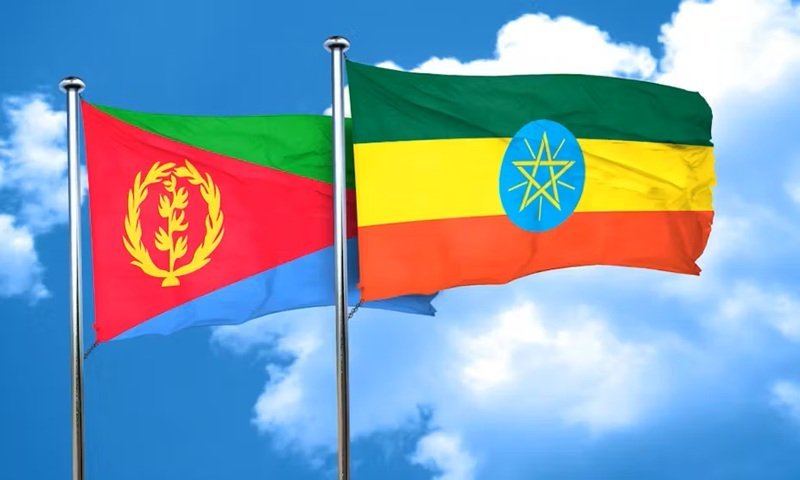
By Addissu Admas
To deny that there is an “Eritrean Problem” that needs resolving is not only to ignore a fact, but also to choose to continue to live under the constant possibility of war. However, before exploring how this possibility can become a reality, we need to define what the problem is in the first place.
Thanks to Italian brazen colonial greed, Eritrea finds herself today in the possession of a coastal line that completely seals off Ethiopia from any access to the Red Sea. This has been the case since Eritrea gained her independence in 1993, and before that, during the Italian and British Military Administration (BMA) between 1890 and 1951. Before the Italian occupation there is no evidence that the coastal line stretching from Sudan in the North to Djibouti in the South was under any one single power. However, there is plenty of evidence that the two main coastal cities, Massawa and Assab, were under various powers, such as the Ottoman, Egyptian and Afar Sultanates for centuries. There has indeed been a kingdom called Baher Negash occupying mainly the regions of Hamasien, Seraye, and Akale Guzay in the highlands of Eritrea, but it appears that it never expanded to include the low lands, let alone the Red Sea coastline. Thus Eritrea, whether as a colony or thereafter, inherited the coastline by foreign imposition, ruse, acquisition or however one wants to view it. Moreover, the Red Sea coastline has never been a subject for any serious formal/official discussion or negotiation to this day. The contention of this piece is that there needs to be one as soon as possible, not only to avoid a disastrous war between Ethiopia and Eritrea, but simply as a matter of principle. In fact, there are several strong reasons why the two countries must come to the negotiating table instead of engaging in futile saber rattling.
First of all, it is perfectly within Ethiopia’s right to request the U.N. and the African Union to provide a platform for a negotiated outcome if these organizations stand indeed by their respective missions. The reason for this is quite simple: Eritrea was part of Ethiopia for most of her history. When she became independent, the then ruling party, the TPLF, rather than standing for the interests of Ethiopia, allowed the EPLF, its ally in overthrowing the Derg and its head Col. Mengistu H. Mariam, to virtually do whatever it pleased with Ethiopia. It did not appear that the TPLF had the interests of Ethiopia at heart, but only of Tigray alone. In fact, it never ceased to call itself TPLF, i.e. Tigray’s People’s Liberation Front. Rather than fighting, literally or figuratively, to gain access to the Red Sea for Ethiopia, it did not hesitate to sacrifice tens of thousands of Ethiopian lives to “liberate” Badme, a sliver of arid land which did not even belong to Tigray.
When two countries that are historically, politically, geographically and culturally as interwoven as Ethiopia and Eritrea part ways, it is but natural and inevitable that they should sit to negotiate on issues that could be the source of problems down the line. Yet, the TPLF, as far as we know, never made any official attempt to plead Ethiopia’s case, but chose to simply go along with Eritrea’s wishes. It is of course not even worth mentioning the Derg’s attempt at negotiation to salvage Assab in 1991 when it was glaringly losing the war in Eritrea, since it was only doing so to buy more time than arriving at a lasting solution.
PM Abiy’s current engagement with Eritrea regarding not only access to the Red Sea, but the establishment of a permanent commercial and military base on the Red Sea coastline is both timely and justified. He indeed is doing what the Woyane regime was supposed to do and never had the gumption of even trying. The problem is not that he is raising the question, but the way he is going about achieving Ethiopia’s expectations. As I have written a couple of times on this forum before, war is not and should not be the only alternative. War with Eritrea for access to the Red Sea, is tantamount to condemning both countries to become failed states. It took generations to come to this point, it would be madness to start another war that will ignite generational cycles of war.
The second reason why Ethiopia and Eritrea must come to the table to hammer out a negotiated outcome is because the eventuality of war is real at any point in the future, near or far. We need only revisit history to find confirmation for this assumption.
Apart from the historical, economic, cultural, etc…. ties that would in themselves justify a negotiated settlement, there is also the principle of justice that demands it. Is it morally justified that Eritrea, being the beneficiary of a historical error, colonial greed or autocratic intransigence gets to decide the economic and security destiny of a country having more than 35 times her population? Yet, as absurd as this situation is, it is the reality Ethiopia is living now. Not to put a fine point on it, Ethiopians have de facto become hostages to Eritrea’s ruling cadre’s whims!
The third reason is that there can never be any serious cooperation between the two countries in the absence of an equitable solution to the question. Eritrea may wish to continue to ignore the problem, but Ethiopia cannot! Ignoring the elephant in the room, as the saying goes, does not lead to a solution on its own. Ethiopia, being clearly the injured party and the one suffering the limitations of the status quo, cannot continue to “just hope” that things will work out somehow. The unsustainability of the situation demands a solution, most preferably a negotiated one. Thus, Eritrea must come to the table.
The fourth reason is that Ethiopia needs to oversee her own security. Ownership of the seacoast line does not come with benefits only, it does come with very serious responsibilities, such as protecting it against powers that may not have the best interests not only of Eritrea, but of Ethiopia as well. Eritrea and Ethiopia do not have any kind of military alliance. Their brief joint campaign against the TPLF militia does not qualify as such. Given the current hostility between the two countries, there is little hope that they will form any form of military alliance now or in the future. On the presumption, therefore, that they will not foster each other’s security for the foreseeable future, it is a matter of necessity that Ethiopia should have a maritime base for her own defense on the Red Sea coastline.
As I will continue to reiterate, PM Abiy must never resort to military force to solve the Eritrean problem. He needs to remember that no one has the desire to revert to what Ethiopia has endured during the Imperial and Derg regimes of Atse Haile Selassie I and Col. Mengistu H. Mariam in the pursuit of subjugating by force the Eritrean people and taking possessions of the port cities of Massawa and Assab. PM Abiy needs to focus solely on peacefully negotiated accommodations. The only question that needs to be asked is what these would look like, and nothing more.
We can ideate several possible outcomes regarding the Eritrean question. But just to be clear, Ethiopia’s demand is securing not only access to the Red Sea, but to own a strip of land on its coastline for both commercial and military (i.e. naval base) purposes. Realistically speaking, this means a small territory on the Red Sea coast belonging entirely to Ethiopia. One way of achieving this is for PM Abiy to repropose to Eritrea what he offered to Somaliland in his Memorandum of Understanding (MU) of January 2024. However, since Eritrea is already a UN recognized country, maybe she can be offered other additional economic incentives, or even a comparable territory on her Western borders with Ethiopia.
Nevertheless, a more realistic and durable solution would be for Ethiopia to lease Assab and the road leading to it in perpetuity, making the city not only her maritime but also her naval base. This is not a far-fetched idea, since a similar but not identical solution was devised for Poland between the two World Wars. What I am alluding to is of course the famous Danzig or Polish Corridor. It was a solution that was proposed first by US President Woodrow Wilson in 1918 and implemented by the Treaty of Versailles in 1919.
The Danzig corridor was designed to cut through what was then Eastern Prussia that for about two centuries had taken possession of the entire length of Poland’s Baltic coastline and had left her without any access to the sea. It was designed not only to end German and Russian dominance in the region, but primarily to foster Poland’s “economic viability”. Unlike what I am suggesting here, the corridor was more than 150 km long and sometimes as wide as a 100 km, and it was given to Poland free and clear. The end of the Second World War led, of course, to Germany losing her entire Eastern Prussian territory and Poland regaining her entire Baltic coastline. My proposal here, as anyone can see, is far more generous to Eritrea than the one imposed on Germany by the allies with the Treaty. Eritrea will not be required to cede as much land and will be compensated in one form or another additionally.
Presently, Assab is generating less revenue than perhaps it is needed for its own maintenance. It is not all too clear why Saudi Arabia is negotiating with Eritrea to modernize its port since 90% of Ethiopia’s foreign trade passes through the port of Djibouti, generating for her more than 2B USD, i.e. 75% of her GDP. If Ethiopia directed just half of her foreign trade through Assab, Eritrea could be earning an additional 1B USD which could substantially help her economy. It is obvious that Eritrea has much to gain from such a deal. The question is, is there a political will on the part of her ruling cadre?
The reality is that Eritrea does not need to depend on Assab very much since she has already a very well connected and established port in Massawa. In fact, it would have been more than fair that, at the time of the separation of Ethiopia and Eritrea, Assab and all the territory below the road line leading to it should have been handed over to Ethiopia free and clear. Alas, that ship has already sailed long ago. We must now focus on achieving a peaceful accommodation rather than begrudging what might have been.
Editor’s Note : Views in the article do not necessarily reflect the views of borkena.com
__
Support Borkena : https://borkena.com/subscribe-borkena/
Join our Telegram Channel : t.me/borkena
Like borkena on Facebook
Add your business to Ethiopian Business Listing / Ethiopian Business Directory Business Listing Toronto
Join the conversation. Follow us on X (Formerly Twitter) @zborkena to get the latest Ethiopian News updates regularly. Subscribe to YouTube channel To share information or for submission, send e-mail to info@borkena.com
1). Ethiopia’s Access to Red Sea: Ethiopia should RECLAIM Djibouti & the Affar Region.
i). Djibouti: Ethiopia leased Djibouti to France for 99 years. That lease expired long ago.
ii). Affar Region [Mitsiwa to Djibouti]: Eritrea annexed that Red Sea Coast in 1991/1993.
iii). Asseb: Seyoum Teshome once presented a document showing how Meles signed & handed over Asseb to Eritrea months before ever presenting the Asseb case to parliament.
2). Clapping with One Hand: Any treaty with Isayas is like trying to clap with one hand. It’s not worth the paper it is signed on. Eritrea is the Property of Isayas Afewerqi [PIA].
3). Disinformation-Poisoned Eritreans: Isayas celebrated his 34th year of presidency just recently. He preached evil about Ethiopia(ns) from his guerrilla days thru his presidency. His son controls the Army [logistics] & his daughter controls the Media [chief editor].
4). Isayas & Egypt: Why has Isayas been serving Egypt so earnestly for >50 years? Does Egypt have damaging evidence to blackmail him with? It can’t only be due to the ምፅዋት እና ፍርፋሪ he has been receiving from Egypt & Arab League since the founding of EPLF.
5). The Enemy Within: Egypt’s MO is funding/training/arming proxies to destabilize Ethiopia, drain Ethiopia’s economy, and render Ethiopia paralyzed to fight back. Example: Zemene Kasse operates with Eritrean passport [Ask Abebech Kahsay & Seyoum Teshome to see it].
Isaias can’t live peaceably with Ethiopia, or without Ethiopia. He had to virtually lockup two generations of Eritreans to as to maintain his power. And for that he had to threaten war and paint Ethiopia as archenemy. Ethiopia’s diversity as public policy and its demographic size and resources also magnified Eritrea’s relatively lowly stature. Isaias’s one constant perception hinged on the possibility of creating enough instability in Ethiopia for him to take advantage of. Thus, you see him at every turn allying himself with Somalia, Egypt, Sudan, Saudi–always with the goal of undermining Ethiopia’s security. At least in three occasions in the past three decades Isaias and his enablers-cum-populace have chanted short-lived chants of “one people, one blood!” One thing is certain about Eritrea’s elite: they have a destructive image of themselves and incapable of building conditions that resulted in working toward mutually beneficial goals.
In the present scenario, we see Abiy’s self-aggrandizing and stupid “personal diplomacy” costing the nation a great deal. In other words, Abiy’s lack of skills in governance/diplomacy and good advisers has contributed to a stalemate and war-mongering. Isaias, of course, is more vulnerable than Abiy; the former is nearing 80. And with him gone, there is a chance that someone with an actual brain on their shoulders would want to discontinue locking up the youth in military camps. But instead would liberalize the heartless policy in search of new opportunities. I may be wrong, but there might just be such a possibility. I base my judgment on the manner in which the populace erupted with joy every single time there was some sort of a thaw in relations with Ethiopia!
In short, I agree with the assumption that there is the possibility for Ethiopia to reclaim a sea port without resorting to war. Unfortunately, Abiy is not helping matters.
I agree that we do not have real statesmen at he helm of neither Ethiopia nor of Eritrea to genuinely seek a viable relationship between the two countries. The idea is that future leaders are better off reframing the problem of Eritrea along the lines I described.
It is clear that Abiy Ahmed is raising the issue of access to the sea to blunt the Amhara uprising against his misrule. He is not serious and does not have the military power to confront the regional power Eritrea. Ethiopia is splitting and Tigray is on the way to declare independence as per the demands of Tigrayans.The Amharas will not stop short of retaking Oromia which is the gift of Tigray to the Oromo people. The regional powers Tigray and Eritrea will play a dominant role in the horn of Africa.
I don’t know if you or Abiy or Isaias are the better liars. Keep wallowing in your deceptions and you will reap more ruin.
Addissu Admas’ article “Building a Durable Accommodation with Eritrea,” presents a compelling and urgent argument for diplomatic negotiations between Ethiopia and Eritrea over access to the Red Sea. The strength of this piece lies in its historical depth, logical reasoning, and pragmatic approach to a contentious geopolitical issue that threatens regional stability
The author meticulously traces the colonial origins of Eritrea’s coastline, highlighting how arbitrary borders imposed by Italy have left Ethiopia landlocked. This framing is crucial because it underscores that Ethiopia’s demand is not expansionist but rooted in historical continuity, economic necessity, and sovereign rights.
Admas firmly opposes war as a solution, recognizing that conflict would be catastrophic for both nations. Instead, he advocates for negotiation under international mediation (UN/AU), which demonstrates a rational and ethical stance. His comparison to the Danzig Corridor is particularly insightful, offering a historical precedent for peaceful territorial accommodations.
The article convincingly argues that Eritrea stands to gain economically from leasing Assab to Ethiopia, given Djibouti’s current dominance in handling Ethiopian trade. The proposal is not one-sided but suggests mutual benefits—something Eritrea’s leadership should consider if economic growth is a priority.
The author rightly points out the injustice of a nation of 120+ million people being held hostage by Eritrea’s refusal to negotiate. Ethiopia’s security concerns, particularly regarding naval defense, are legitimate in an era of increasing Red Sea militarization (e.g., UAE, Turkey, and Saudi bases in the region).
While the article is persuasive, it could address Eritrea’s perspective more thoroughly. President Isaias Afwerki’s regime thrives on isolationism and distrust of Ethiopia, shaped by decades of war. A durable solution must also consider Eritrea’s security paranoia—how can Ethiopia assure Asmara that leased territory won’t become a Trojan horse?
Additionally, the Somaliland MoU reference is risky—Eritrea may view this as Ethiopia’s “expansionist blueprint,” undermining trust. Instead, the focus should be on exclusive economic incentives, such as joint port management, infrastructure investments, or even shared naval facilities under AU oversight.
The final verdict …a Necessary Call for Diplomacy
Admas’ article is a timely, well-reasoned appeal to avoid another catastrophic Horn of Africa war. His arguments are rooted in historical fairness, economic logic, and strategic necessity, making a strong case for why Eritrea must come to the table. However, success will require confidence-building measures, international guarantees, and creative compromises—not just historical analogies.
The alternative—continued stalemate—only fuels instability. As the Red Sea becomes a global flashpoint, Ethiopia cannot afford indefinite dependency on Djibouti, and Eritrea cannot afford perpetual hostility with its largest neighbor. Negotiation is not a choice; it is an inevitability. The only question is whether both nations will act before or after another avoidable war.
Adding Insult to the Injury: It is a huge travesty of justice to let Eritrea’s EPLF get away with Broad Day Light Robbery of the Ethiopian Affars’ Homeland [the Red Sea Coast from Mitsiwa to Djibouti]. Should we reward Eritrea’s Injustice at Ethiopia’s expense?
Ethiopia’s Economic Security: Egypt’s Secessionist Proxy Dogs [EPLF & TPLF] took advantage of the 1991 Power Vacuum to land-lock Ethiopia. Why should Ethiopia ever reward the EPLF Petty Thieves by Leasing Ethiopia’s own Asseb or offering Quid Pro Quo?
Ethiopia’s National Security: Ethiopians SHOULD live in peace! EPLF turned Eritrea in to a Pro-Egypt, Ethiopia-Destabilizing Banda Launch Pad. Shouldn’t Ethiopia put an end to that? What’s next? Egypt’s Army Base, Air Force Base, Naval Base, etc. in Eritrea?