
By Samuel Estefanous
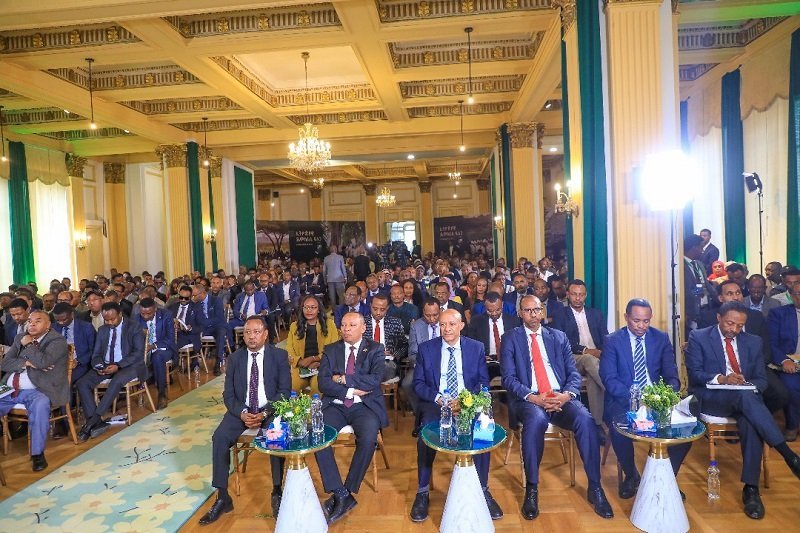
It certainly looks like it. I mean judging by the number of dignitaries that had crowded the book launching event hosted by AAU a few days ago. The proud author of the book titled ‘In Search of Ethiopian Democracy’ is the reigning government whip at the House of People’s Representative, MP Tesfaye Belijige. The entire ‘Who is Who’, shakers and movers and PP luminaries were in attendance and of course some who have ostensibly come to play second fiddle while keeping the officials warm company.
I hate to belittle the efforts of authors. One can always find a sparkling jewel even in the least celebrated books. Besides, it takes great dedication and courage to take the time to write one. Here is the thing- an illustrious scholar who had done two separate reviews of Jawar Mohamed’s book had made our days back in 2024. You know how? He had a disclaimer noting he didn’t actually read the book and he might be liable to commit some kind of unintended faux pas. I hate committing any kind of similar voluntary faux pas, thus I refrain from doing any semblance of book review here. My observation is limited to the ‘synopsis’ of the book I was able to trace online and of course the reflections of the distinguished ‘Shum-Scholars’ who had done such an adorable job of ‘book veneration’.
Can you believe it? Apparently the book is beyond reproach. It kinda reminded me of what Dr.Abiy had said in a rare moment of candid reflection while addressing the business community in the country.
‘The cost for reconstruction and rejuvenation of the Aware locality is entirely covered by my own money, yes from proceeds of the sale of my books. I know you wouldn’t have bought a single copy if I weren’t the Premier hence I chose to give it back to the community.’
You know what they say about Tocqueville? The French government commissioned him to study the prison system in the United States and file a report complete with recommendation for the government of France. Instead the man spent a whole year studying the American system of government and the social capital that had enabled it to function the way it did, that was how the famous book ‘Democracy in America’ had come into being. Tocqueville believed that democracy in Europe was stifled and rendered impractical in the face of the actual Sovereignty of the Aristocracy while in the United States the Sovereignty of the People had necessitated democracy. In a system where sovereignty is bestowed on the people, democracy is imperative. Thus, the United States had no other viable alternative to democracy. He was right, too, eventually it was the collapse of the aristocracy that had declared the dawn of European democracy.
Urbanization and industrialization are the other two social capitals that necessitate democracy. One may talk of rural tribal councils but however hard one tries to stretch the concept to accommodate anything that is settled by ‘majority tyranny’ as democracy, the system is alien to the farmstead. A few years ago there was this interview the Emperor Haile Silassie had given to Orianna Fallaci that used to make the rounds online. I believe it invoked huge interest among African scholars on account of the Emperor’s unapologetic dismissal of Democracy as a Western fad that was liable to wreak havoc in the rest of the World. You see, the Emperor didn’t try to make any pretense of being friendly to democracy. He didn’t suggest that there was some kind of native democracy in local forms; that he was trying to experiment with the idea by willingly limiting his God given power. Nah, he rejected it out of hand as an alien concept that is certain to induce anarchy in Africa.
Apparently የፈረደበት Samuel Huntington and his Third Wave of Democracy are relied up on as the holy grail of any discourse on any given African democracy. Tesfaye dwelt on his writings at great length as evidenced in an article published online and recounted by EBC. No wonder the late scholar is the most quoted scholar in academia studying political science. However I think in the near future Huntington is sure to fall out of favor among 21th century students of democracy. It is like the digital native millennials are more into Joe Rogan and Tucker Carlson than Fareed Zakaria or Francis Fukuyama. Incidentally the latter two were Huntington’s prized protégés. What I am trying to say is that I don’t think Huntington will remain a valid intellectual patriarch consecrating third world democracy.
Bottom line democracy in its contemporary manifestation is forced down the throats of African Nations by the liberal West. It has never been a native institution and the grafting has miserably failed. It has been peeling off year after year. If the book is all about the age grade tribal councils that had maintained viable political communities in almost all Sub-Saharan Nations for centuries, this isn’t part of the Third Wave. I hate the reckless unqualified sentimental assimilation of the two systems. Modern democracy is the antithesis of the arbitrary caprices of the wandering spirit of the ancestors. Question-which democracy is the book trying to search for?
Among others, I am afraid Tesfaye’s attempt to define five mini waves of democracy in Ethiopia beginning from the 1953 E.C coup is going to haunt him every time the book is discussed by students of democracy in Africa. The ‘1953 wave’ was an attempted bloody coup instigated by a military junta and it had more affinity to an economic freedom movement or class struggle than a parching thirst for regeneration of a lost Native democracy. The 1974 Wave was a radical revolution which had redefined the distribution of Sovereign Wealth in the country ; post 1991 ‘Waves’ had little to do with democracy but on the contrary defined the era of National liberation movements and factionalism movements which had zero appetite for democracy in the classical sense of the term.
Just curious, though…where did it come from? I mean this epic quest for democracy in Ethiopia by a revolutionary democrat? I mean no disrespect but what were the noble factors that had kept the author going? I have read Dr. Berhanu’s book of similar interest and I have got a pretty good idea of the driving factors that were pushing him to ‘get up and write a few more pages’ in the service of democracy back in 2007 or Lidetu’s for that matter…but it beats me to figure out the motives in this particular instance.
I just couldn’t fathom the compelling factors that had bent the will of Tesfaye to explore ‘the lost native democracy in the annals of Ethiopian society.
God Bless.
The writer can be reached at : estefanoussamuel@yahoo.com
Editor’s Note : Views in the article do not necessarily reflect the views of borkena.com
__
Support Borkena : https://borkena.com/subscribe-borkena/
Join our Telegram Channel : t.me/borkena
Like borkena on Facebook
Add your business to Ethiopian Business Listing / Ethiopian Business Directory Business Listing Toronto
Join the conversation. Follow us on X (Formerly Twitter) @zborkena to get the latest Ethiopian News updates regularly. Subscribe to YouTube channel To share information or for submission, send e-mail to info@borkena.com