
By Adam Denekew Mekonnen
When I was a student at Erasmus University Rotterdam in the Netherlands, one day back in January 2024, I was studying at the University’s main library. A librarian, originally from Suriname, came over to assist and casually asked me where I was from.
“Ethiopia,” I replied, instinctively proud.
She smiled, half-smiled, and paused. “Ethiopia… is it still at war?”
I nodded, trying to explain the situation in my broken Habesha English, all the complexities underpinning the politics of Ethiopia. But before I finished, she said something that pierced me:
“I think you Ethiopians like war.”
She said it softly with a tired honesty of someone who had seen too many headlines in the media. I smiled politely. But inside, I froze.
Her words have stayed with me ever since.
The Return of Familiar Shadows
Today, July 2, 2025, the report I read from the Amharic Section of Reporter brought that Rotterdam memory crashing back. The article presented credible evidence that another war is looming in Northern Ethiopia, even after the signing of the Pretoria peace agreement, the deal that ended one of the most costly wars in the world.
According to the report, the Tigray People’s Liberation Front (TPLF) is repositioning itself militarily, preparing to encircle Wolkite from four directions: from Shiraro, Waldiba, Dedebit, and Shererina. There is also movement of heavy weapons along with the military. The report also cited a speech by Amanuel Assefa, vice president of the Tigray Interim Administration, who declared: “If the Tigray territories are not going to be returned by peace, we Tigrayans will be forced to overtake those territories by force.”
This is that kind of talk that precedes tragedy. We have enough wounds to treat. We are a nation bleeding from every corner. Ethiopia now has no oxygen left for another war. The Ethiopian soil is soaked with the blood of over 600,000 people in the Tigray war alone. This figure is not a statistic but a constellation of names, faces, and futures never realized. In a war where brothers killed one another, we lost nearly 30 billion dollars. This is a sum that could have built thousands of schools, clinics, and roads. Instead, it built graves.
There has been war in Oromia for almost 7 years. The war in Amhara surpassed two years. Yet here we are once again bracing for a fourth round of war involving the federal government and the TPLF — and, most dangerously, with the involvement of another sovereign nation, Eritrea. Once again hearing the drums, the speeches, the coded messages that say: “prepare.”
But prepare for what?
Another generation of orphans?
Another wave of massive displacement?
Another round of destruction of hospitals, schools and public offices?
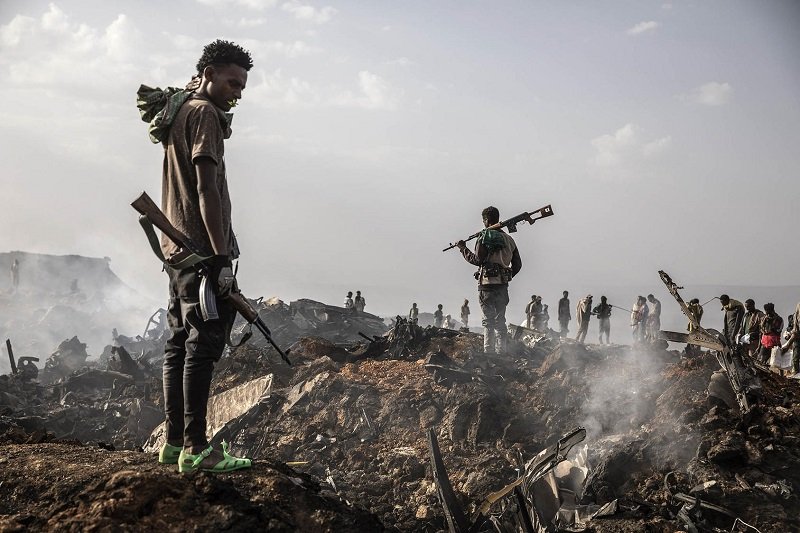
In October and November 2021, I was part of the team that traveled to the Afar and Amhara regions of Ethiopia to investigate human rights violations stemming from the war between the national defense force and the TPLF fighters. We visited all parts of the North Wollo Zone affected by the conflict, especially the areas in and around Gashena, extending all the way to Lalibela in the Amhara region. In Afar, we focused on the two zones hit hardest by the war: Zone 2 (Kilbet Rasu) and Zone 4 (Fanti Rasu).
During our weeks long stay, I witnessed firsthand the devastating nature of war. I saw how it strips people of their humanity. Beyond the incalculable loss of property and sacred human life, I learned a painful truth: war in Ethiopia is waged without any regard for basic principles.
We hear, for instance, about the war in Ukraine, where Russia and Ukraine exchange prisoners of war. This, in some sense, acknowledges that even war has rules, a kind of grim science with sacred principles. One such principle is the principle of distinction, the cornerstone of the laws of war, which requires that parties to a conflict always distinguish between civilians and combatants, as well as between civilian objects and military targets. But in the Amhara and Afar regions, across the areas we covered, I saw this principle completely disregarded, which led me to conclude that war in Ethiopia lacks an iota of principles. It mostly seemed that civilians were being targeted more deliberately than combatants, and civilian infrastructure more than military assets.
The pattern was disturbingly consistent. Hospitals were ransacked, and any medical equipment, even equipment used for childbirth, that could not be carried away was deliberately destroyed. Medicines were not spared either: apart from a few antibiotics looted for immediate use, most pharmaceutical supplies were set on fire. I personally witnessed piles of medicine burning at a health facility in Gashena and again at a primary hospital in Keluwan, the administrative center of Zone 4 in the Afar Region. I can understand, though not condone, why someone might loot medicines out of desperation. But what possible justification is there for setting fire to the medications you choose not to steal? What explains the deliberate smashing of medical equipment used by mothers to bring life into the world? There is no logic, no excuse, and no strategy that can explain such cruelty, except, of course, deep-rooted hatred.
The same senseless destruction applied to education. Schools were used as stations by combatants, and once vacated, the facilities were systematically destroyed, computers smashed, documents and books burned. I saw with my own eyes, at a certain high school in Gashena, newly distributed books torn apart and scattered all over the school compound. These were not political documents. Just textbooks, tools for learning. Is there any logic, any justification, for destroying them? None. Only deep hatred could justify this act too.
In Hamusit, a small village near Gashena, I witnessed entire farming neighborhoods destroyed. Amid this destruction, one encounter has never left me. In another village not far from Gashena, we met a grieving mother. Her two young sons and her husband had been killed right before her eyes. The pain was etched into her face. When we told her we were there to investigate what had happened, she looked at us through her tears and said: “I don’t care about your investigation. Your investigation will not bring back my beloveds.” Her words still echo in my mind.
Ethiopia cannot carry another war, not morally, and not economically. And it cannot carry the burden of more mothers like her, mothers left behind in the ruins, holding memories instead of children. No nation can endure the broken backs of its grieving citizens. And yet, war keeps arriving like a recurring illness we refuse to treat at the root. Not because we love it. But because we have not yet learned how to live without it.
A Culture that Romanticizes Conflict
We Ethiopians usually boast as a nation of having thousands of years of statehood, yet the fact is Ethiopia has a history soaked in war. In fact, some of it we are proud of like resisting colonialism at Adwa. But much of it is self-inflicted: kings against kings, regimes against people, ethnic groups against each other, governments against citizens.
Even in peacetime, we glorify the warrior. Our songs praise battle and battlefield. Our heroes are generals. Our monuments carry rifles. We write poems not about peace, but about triumph in war. Is it then any wonder that someone looking from the outside might say: “Maybe you like war”?
War has become part of our identity, which is very dangerous. We confuse resilience with militarism. We call destruction “patriotism.” We accept famine, displacement, and death as the price of defending pride, flag, or territory.
But war is not a rite of passage.
War is not holy.
War is evil.
It is death, trauma, broken families, lost futures.
It is schools turned into military camps and graves.
It is farmers without fields.
It is mothers without children.
What kind of legacy are we building if every generation inherits another battlefield? If there is a war Ethiopia must fight today, it is the war against the idea of war itself. Against the normalization of bloodshed as a political tool. We must start in our communities: in schools, families, religious places, and yes, even songs. We must teach that peace is not weakness. If we want to move forward, we must unlearn the myth that our nation was built by war alone. It was also built by scholars, saints, farmers, mothers, musicians.
Final Reflection
That librarian in Rotterdam may never remember what she said to me. But I do. And I now understand why it hurt because she was saying out loud what many of us are too afraid to admit. I wanted to tell her she was wrong. That her words were simplistic. That she did not understand our history, our pain, our pride. But now, I think what pierced me most was that she was being honest. Her question was not an accusation. It was a mirror instead.
Because when a country goes from war to war to war and still prepares for another, what else is the world supposed to think? And here is the harder truth: maybe we do not love war. But we have lived in it for so long, we have mistaken its rhythm for our heartbeat. We have baptized our pain into culture. We have named our trauma patriotism.
So, here is the answer I wish I had given her: “No, we don’t love war. But we have forgotten what peace feels like. And now, the silence of peace frightens us more than the noise of war ever did.”
That — that — must change.
Adam Denekew Mekonnen is a graduate of Erasmus University Rotterdam in the Netherlands and a former law lecturer at Bahir Dar University and Aksum University. He currently serves as a senior human rights researcher at the Amhara Association of America. Adam writes regularly on law and politics in Ethiopia, drawing on his academic and research background to provide informed analysis on pressing national issues.
Editor’s Note : Views in the article do not necessarily reflect the views of borkena.com
__
Subscribe : https://borkena.com/subscribe-borkena/
Join our Telegram Channel : t.me/borkena
Like borkena on Facebook
Add your business to Ethiopian Business Listing / Ethiopian Business Directory Business Listing Toronto
Join the conversation. Follow us on X (Formerly Twitter) @zborkena to get the latest Ethiopian News updates regularly. Subscribe to YouTube channel To share information or for submission, send e-mail to info@borkena.com
You could have written something better.
Yes, we do like and love war. War is not about liking or loving. War is about imposing somebody’s will on others. War is about resisting subjugation. We fought war against foreign invaders. War was fought between separatist groups (OLF and TPLF) and the governing Derg regime. Certain people refuse to live under subjugation and go to war. The EPRDF – PP political architects are responsible for all wars fought among and between ourselves. You didn’t win or lose a war because of the size of your force. In our case, large size doesn’t determine the outcome of a war, because most people are big mouth propagandists loyal to their Clan leadership.