
By: Getahun Tsegaye
Staff Reporter
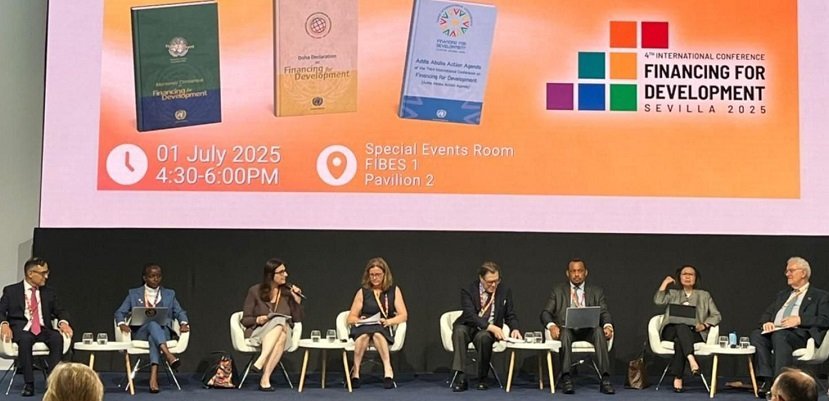
Addis Ababa, Ethiopia – At a high-level special event during the Fourth International Conference on Financing for Development (FfD4) in Sevilla, Spain, Ethiopia called for urgent action to reform global economic governance. Ambassador Samuel Isa, Ethiopia’s Deputy Permanent Representative to the UN, stressed that the “Sevilla Commitment” must mark a turning point in addressing global challenges like debt distress, inequality, and climate vulnerability.
Ambassador Samuel highlighted the rare convergence of political will among the G77, African Group, LDCs, and what he described as “reform-minded Northern partners”, urging that this unity be translated into concrete action. He identified three key opportunities: a unified reform narrative, stronger Global South leadership, and momentum behind reform coalitions. He called for timelines, accountability, and a permanent UN-led process to drive change, warning that failure to act would have global consequences. Ethiopia’s message echoed a growing demand from developing nations for a fair and inclusive financial system to advance the 2030 Sustainable Development Goals.
Ethiopia is currently experiencing severe financial hardship, which explains how urgent its demands for reform are. Ethiopia’s total public debt, including both domestic and foreign debt, was estimated to be $68.9 billion as of June 2024. About $28.9 billion of this is external debt. The nation, which has been categorized as having a high risk of debt distress, missed a $33 million coupon payment on it’s only $1 billion Eurobond in December 2023.
Since joining the process in 2021, Ethiopia has been aggressively pursuing debt restructuring under the G20’s Common Framework. In these continuing talks, the country is requesting an estimated $3.5 billion in debt relief. The path to comprehensive relief entails intricate negotiations with a variety of creditors, including official bilateral creditors (such as China, Ethiopia’s largest creditor) and private bondholders, even though the International Monetary Fund (IMF) has approved a $3.4 billion Extended Credit Facility (ECF) arrangement to support Ethiopia’s economic reforms and debt sustainability efforts. The objective is to stabilize its economy in the face of both domestic and international uncertainties and to free up funds for necessary public spending.
Emerging economies have attempted to establish alternative platforms in response to these perceived imbalances and the predominance of conventional financial institutions led by Westerners. One of the best examples is the formation of BRICS (Brazil, Russia, India, China, and South Africa). BRICS was established in 2009 with the goal of challenging the current global financial and political order while fostering greater economic cooperation. South Africa joined the group in 2010. Its members support a more multipolar world and give developing nations a bigger say in international affairs. On January 1, 2024, Ethiopia was one of six nations invited to join the BRICS bloc, demonstrating the growing unity of Global South countries in their pursuit of global power rebalancing and collective solutions.
Subscribe : https://borkena.com/subscribe-borkena/
Join our Telegram Channel : t.me/borkena
Like borkena on Facebook
Add your business to Ethiopian Business Listing / Ethiopian Business Directory Business Listing Toronto
Join the conversation. Follow us on X (Formerly Twitter) @zborkena to get the latest Ethiopian News updates regularly. Subscribe to YouTube channel To share information or for submission, send e-mail to info@borkena.com