
By Melekte Solomon
Introduction
When Abiy Ahmed came to power in April 2018, he promised a new era of reform and democratization in Ethiopia. He released political prisoners, welcomed back exiled opposition leaders, and initiated reforms aimed at increasing freedom of speech and assembly. However, as time has passed, it has become clear that these promises were largely unfulfilled. The government has continued to suppress dissent, arrest journalists and opposition leaders, and restrict civil liberties. The promised reforms have been slow to materialize and, in some cases, have been reversed altogether. The reality on the ground is far removed from the promise of a more democratic and open Ethiopia.
Human rights and Civil Liberties
Despite initial hopes for improvement, Abiy Ahmed’s administration has been criticized for its handling of human rights and civil liberties. The government has been accused of using excessive force against protesters, arresting journalists and opposition figures, and restricting freedom of speech. Reports of human rights abuses, including arbitrary detention and torture, have continued to emerge. Furthermore, the government’s response to dissent has been increasingly authoritarian, with critics being silenced and marginalized. This has led to widespread concerns about the erosion of civil liberties and the shrinking of democratic space in Ethiopia.
The tensions between the Amhara people and the government have deep-rooted background and contemporary grievances. Many Amharas living outside of their regional state, particularly in the Oromia region, have faced persecution, including killings, imprisonment, abductions, and forced displacement from their lands. These individuals, who have lived in these areas for generations, have been subjected to systemic marginalization, including denial of political and economic rights. Furthermore, restrictions on their movement, including limitations on entering the capital city Addis Ababa, have exacerbated feelings of disenfranchisement. The Amhara people’s sense of injustice and exclusion has contributed to the emergence of Fano as a militant force seeking to protect Amhara interests and rights.
The final straw came when the government ordered the disarmament of Fano, who had played a crucial role in defending the Amhara region and its people against the agression of the Tigray People’s Liberation Front (TPLF). And it was perceived as a betrayal and a threat to the Amhara people’s security and autonomy. Many Amharas saw this as an attempt to dismantle their self-defense forces and leave them vulnerable to attacks. The disarmament directive sparked widespread outrage and resistance among the Amhara people, further straining relations between the community and the government.
Economic development and Inequality
Abiy Ahmed’s administration has been marked by promises of economic reform and development. However, the reality on the ground has been different. Ethiopia’s economy continues to face significant challenges, including high inflation, unemployment, and poverty. The government’s economic policies have been criticized for favoring certain groups based on their ethnocentric attitude or a chain of corruption, exacerbating existing inequalities.
The ongoing conflicts in the Amhara region and parts of Oromia have further devastated the economy. The war has disrupted agricultural production, trade, and commerce, leading to widespread poverty and hunger. Schools have been converted into military camps, depriving children of their right to education. Clinics and hospitals have been severely damaged or destroyed, leaving communities without access to essential healthcare services. The humanitarian crisis resulting from the conflict has pushed millions of Ethiopians to the brink of disaster, with many relying on emergency aid to survive.
The recent financial and economic reforms agreed upon with the International Monetary Fund (IMF), including the floating of the currency exchange rate, have had devastating consequences for ordinary Ethiopians. The reforms have led to a surge in inflation, eroding the purchasing power of citizens, including middle-class professionals. Many people are struggling to make ends meet, with the cost of living increasing exponentially. The economic strain has had far-reaching consequences; as a shie case, it’s worth mentioning the recent strike by healthcare professionals, including doctors, who are demanding better working conditions and salaries that keep pace with the rising cost of living.
Governance and Accountability
Governance and accountability have been significant concerns during Abiy Ahmed’s administration. Critics argue that the government has increasingly concentrated power, restricted civil society, and limited press freedom. The ruling party’s dominance has raised questions about the independence of institutions and the space for opposition voices. Moreover, allegations of corruption and abuse of power have persisted, with some high-profile cases seemingly swept under the rug.
Ethiopia’s diverse ethnic landscape has long been a source of both strength and tension. Abiy Ahmed’s administration has faced criticism for its handling of ethnic relations, with some arguing that public speeches by the prime minister and his high rank officials from Oromo-PP political party (the tone-setter and core member of Prosperity party) have exacerbated tensions rather than promoting national unity.
In conclusion, Abiy Ahmed’s administration has faced numerous challenges and criticisms, from human rights abuses and ethnic tensions to economic woes and governance issues. The ongoing conflicts, particularly in the Amhara region, have had far-reaching consequences for civilians and the economy. The government’s response to dissent and opposition has raised concerns about the state of democracy and human rights in Ethiopia. Furthermore, the Prime Minister’s recent interview highlighted a concerning disconnect from reality, raising questions about his understanding of the country’s situation and his ability to effectively lead the country. As Ethiopia navigates these complex issues, the prime minister is adamant to change the course, but to continue down a path of repression and marginalization.
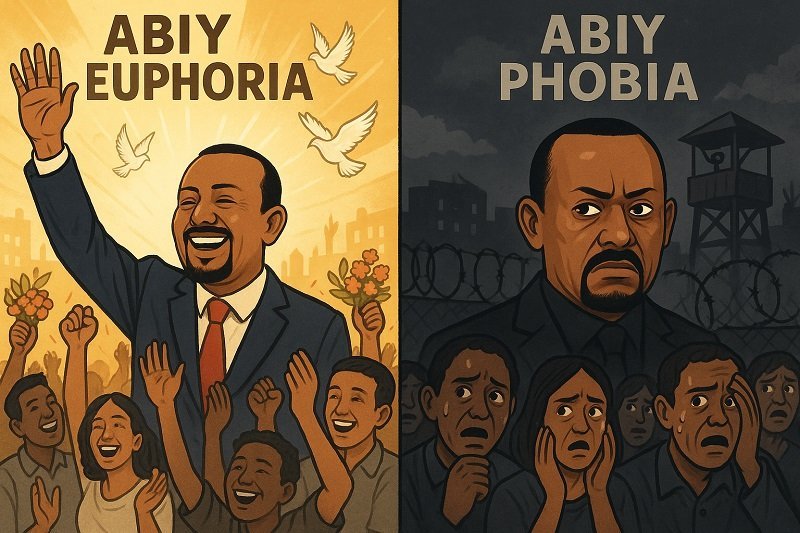
Unfortunate to the people, Abiy Ahmed’s priorities remain skewed, favouring lavish projects, including a $10 billion palace, over the needs and rights of his citizens. This blatant disregard for the welfare of Ethiopians has led to widespread repression and marginalization. Consequently, the public’s initial enthusiasm has given way to fear and distrust, transforming Abiy from a celebrated leader to a figure of phobia. The rapid erosion of public trust underscores the government’s failure to deliver on its promises, instead opting for frivolous projects that aggravate the country’s woes.
Editor’s Note : Views in the article do not necessarily reflect the views of borkena.com
__
Subscribe : https://borkena.com/subscribe-borkena/
Join our Telegram Channel : t.me/borkena
Like borkena on Facebook
Add your business to Ethiopian Business Listing / Ethiopian Business Directory Business Listing Toronto
Join the conversation. Follow us on X (Formerly Twitter) @zborkena to get the latest Ethiopian News updates regularly. Subscribe to YouTube channel To share information or for submission, send e-mail to info@borkena.com
While I agree with the central theme of the article, “From Euphoria to Phobia,” and appreciate its attempt to critique the government, I find the assessment to be strikingly superficial and overly lenient. The piece barely scratches the surface of the dire realities facing the country. It fails to confront the total collapse of security, government-sponsored mass killings, the indiscriminate use of drones and heavy artillery against civilians, deliberate economic sabotage, attacks on statehood, and the rise of an unprecedented dictatorship. These are not minor oversights—they are the core of the current crisis and must be addressed with the seriousness they deserve.
1). ‘በጣም ሠበር Solution’: Let’s Clone Abiy! God finally answered Ethiopia’s prayer! If Abiy transformed Ethiopia so much in such a short time, imagine many Abiys at work!
2). The ‘Opposition’ Abiy welcomed home with open arms igniting war all over Ethiopia is like a homeless man you sheltered returning your favor by setting your home on fire!
3). Abiy kept Ethiopia afloat despite Debt at 59% of GDP, no money even for salary, etc. He is a millionaire [Nobel Prize] & could have quit! [ youtu.be/upKEL9wQvrY?t=1201 ]
4). Abiy catapulted Ethiopia from Wheat Beggar to Africa’s #1 Wheat Producer! Egypt & its Dogs couldn’t stop GERD & Wheat! [The Good News: youtu.be/f8Ou-fTqoyw ].
5). Abiy’s regime helps ≥10 million kids [free meals/uniforms/supplies/etc.]. Kindergartens, nurseries, etc. also flourished. Imagine the peace of mind for families!
6). Gives free fully-furnished new apartments for those who have been living in squalor for ages! Never heard of G-7 Nations doing that! [Check it out: youtu.be/KJD0Tmysfyc ]
7). Keeps Ethiopia safe from Egypt’s Dogs [TPLF/TDF (Tigray), OLF-IFLO (Oromia), Fake Fanno (Amara), EPLF-ELF (‘Eritrea’)]. [Watch: youtu.be/cD7r-c6ZHzg?t=124 ]
8). Pro-Egypt Fanno’s War in Amara Zone [AZ]: The AZ war started to “Protect Egypt’s Historical Nile Water Quota” right after this report: youtu.be/_ejBczkTHlA?t=300
9). The ‘$10 Billion Palace’ Misinformation Spree: youtu.be/6ov2XB2YLNo?t=222