
Nesanet Lukas
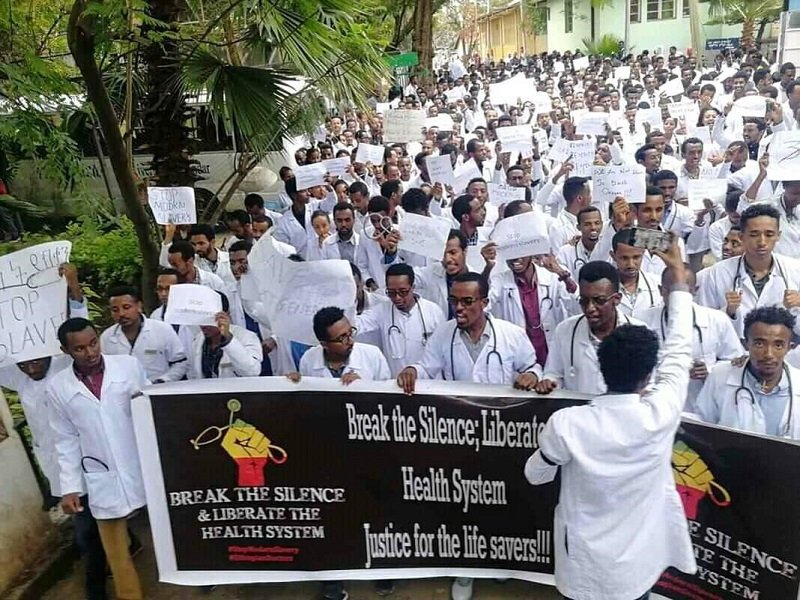
In contemporary Ethiopia, a critical misunderstanding threatens the civic fabric of the nation: the conflation of legitimate, apolitical demands for rights and dignity with political subversion. This mischaracterization—particularly visible in the government’s response to recent demands by clinical professionals for dignified employment and fair remuneration—undermines democratic governance and stifles civic engagement.
The recent outcry from Ethiopia’s clinical professionals is not an act of political rebellion but a pursuit of economic and social justice. Healthcare workers are advocating for adequate salaries, decent working conditions, and professional respect. These demands are grounded in the Universal Declaration of Human Rights (Article 23 and 25), which asserts the right to fair working conditions and a standard of living adequate for health and well-being.
Yet the Ethiopian government has reacted with suspicion, accusing these professionals of being politically manipulated or aligned. This approach is not only counterproductive but reveals a deeper institutional fragility—a reluctance to distinguish between civic expression and political agitation.
Theoretical Foundation: Democratic Citizenship and the Public Sphere
Political theorists such as Jürgen Habermas emphasize the role of the public sphere—a space where citizens engage in discourse on matters of collective interest. This discourse, by its nature, often overlaps with political themes, but is not inherently partisan. Democratic citizenship, as articulated by scholars like Seyla Benhabib and John Rawls, includes the right to voice grievances and demand justice, irrespective of political affiliations.
Furthermore, civil resistance theory, advanced by Gene Sharp, asserts that nonviolent civic actions—even if politically consequential—are legitimate expressions of societal will. The existence of civil society, a key pillar in modern democratic theory, presupposes that citizens and professional groups can organize and mobilize for collective action without being accused of sedition.
Practical Benchmarks: International Comparisons
1. United Kingdom – National Health Service (NHS) Strikes:
In 2022–2023, NHS nurses and ambulance staff in the UK conducted multiple strikes demanding fair pay and safe staffing levels. Though their actions had political consequences and were supported by opposition parties and unions, the UK government recognized their demands as legitimate labor actions. The public debate remained focused on policy solutions, not political conspiracies.
2. India – Doctors’ Protest for Safety and Pay (2019):
Thousands of doctors across India went on strike following violent attacks on health workers and poor working conditions. Though the protests gained attention from various political parties, the Indian government largely treated the issue as a sectoral concern, not a political threat. Dialogues were initiated and partial agreements reached without criminalizing the protest.
3. South Africa – Essential Workers and Labor Rights:
Post-apartheid South Africa provides a robust constitutional framework for civic demands. In 2010, public sector health workers protested low wages. Despite political overtones, the state acknowledged the protests under the constitutional right to assemble and organize. Mechanisms were in place to negotiate with unions representing these workers.
The Ethiopian Context: Rights-Based Engagement over Partisan Labeling
In Ethiopia, where the political landscape is fraught with historical sensitivities, it is especially critical to differentiate between rights-based advocacy and political contestation for power. When health professionals demand fairness, they are not campaigning for office—they are seeking justice in their field of expertise.
Labeling every civic action as politically subversive set a dangerous precedent. It:
- Delegitimizes genuine societal grievances.
- Silences essential professional voices.
- Erodes public trust in institutions.
- Violates Ethiopia’s own constitutional provisions (Article 31, 38, and 41) that guarantee freedom of association, expression, and labor rights.
Recommendations for a Rights-Conscious Governance Approach
- Institutionalize Social Dialogue Platforms: Establish mechanisms for professional sectors to regularly engage with the government on employment and sectoral reform.
- Depoliticize Civic Advocacy: Adopt a clear distinction in state discourse and legal interpretation between civic demands and political propaganda.
- Strengthen Legal Protection for Civil Rights: Enforce and expand protections for freedom of assembly, expression, and collective bargaining in accordance with Ethiopia’s Constitution and international commitments (e.g., ILO Conventions).
- Promote Civic Education and Government Accountability: Educate the public and state officials about democratic rights and the importance of civil society in nation-building.
Conclusion
A democratic society thrives not by suppressing dissent, but by listening to it. The demands of Ethiopia’s clinical professionals are not political threats but opportunities for policy improvement and societal healing. Support from unions, advocacy groups, or even political actors does not delegitimize a cause; it strengthens the voice of the unheard.
Governments must remember that citizens are not mere voters—they are stakeholders in governance. Whether grievances arise from clinics, classrooms, or marketplaces, they deserve thoughtful engagement, not ideological suspicion. Ethiopia’s future depends not only on political stability but on cultivating a civic culture that honors every citizen’s right to speak, organize, and demand justice.
Editor’s Note : Views in the article do not necessarily reflect the views of borkena.com
__
Subscribe : https://borkena.com/subscribe-borkena/
Join our Telegram Channel : t.me/borkena
Like borkena on Facebook
Add your business to Ethiopian Business Listing / Ethiopian Business Directory Business Listing Toronto
Join the conversation. Follow us on X (Formerly Twitter) @zborkena to get the latest Ethiopian News updates regularly. Subscribe to YouTube channel To share information or for submission, send e-mail to info@borkena.com