
Editor’s Note : Views in the article do not necessarily reflect the views of borkena.com
By Zemene Mesafint
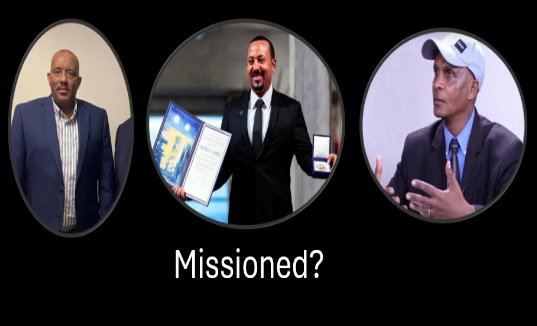
Abiy Ahmed, from the Oromia region, rose from nowhere and surprised everyone by becoming the first Ethiopian Nobel Prize winner. Getachew Reda, originally from Raya, became the TPLF central command leader and rose to power until he became the President of the Tigray region. Eskinder Nega first tried to represent Addis Ababa, and later he moved to the Amhara region, positioning himself as a forerunner of the Fano forces, which rose to become one of East Africa’s formidable forces in a very short time. These three seem to have something in common after all. In the two-year Tigray war, Getachew and Abiy led the conflict on opposite sides, and later they reached a peace agreement; now they are on the same side again. In the ongoing two-year war in the Amhara region, it seems Abiy and Eskinder represent opposite sides fighting in the country. In all these wars and conflicts, millions have died, economic growth has weakened, and the country is on the verge of disintegration. What are the goals and missions of these people? Let us examine it from a broader perspective.
Back ground: Critical observation of patterns of development.
Why is Ethiopia in trouble now? Those who continuously study patterns of events across the world, particularly how nations and societies are weakened and destroyed by forces that work against them, can identify a pattern of reasons, strategies, tactics, events, and individuals involved, in general. There are plenty of examples to consider: Iraq, Afghanistan, Somalia, Syria, Yemen, and Libya were weakened (destroyed) by Global forces, as they were dismantling terrorism across the Middle East. Right now, Sudan and Ethiopia are in turmoil. Sudan’s troubles fit into the picture of the aforementioned nations, while Ethiopia’s case seems different. As evidenced, Ethiopia used to be a stable nation in East Africa, registering steady growth for about two decades under the late Meles Zenawi of the TPLF-EPRDF leadership, as Meles was a staunch agent and supporter of the Western forces that dominate other nations. Some say (conspire) that Meles lost his position among those who empowered him and ultimately lost his life when he aligned with the forces in the Eastern world. To be specific, he opened Africa wide open to the dominance of China. It is enough to note that the African Union headquarters in the Ethiopian capital, Addis Ababa, is a $200 million (£127 million) project funded by China as a gift to the AU, as Beijing intends to strengthen its influence in Africa. In addition, Ethiopia was on an economic trajectory that would help the nation become one of the main economic forces, setting a precedent for other African nations. That put the country to be targeted. Global forces are already engaged in economic disparities. The late Henry Kissinger, an American diplomat and political scientist who served as the 56th United States Secretary of State and a powerful globalist, stated that since 2018, it has been official that the world is in a new second Cold War due to economic competition between the USA and China. This is also evidenced by how the Trump administration shook the world in a very short time after he came to power.
Ethiopia like Syria?
In Syria, there were different factions fighting when Bashar al-Assad was in power. He stayed in power from 2000 to 2024. He became a doctor and later joined a military academy, where he served as the commander-in-chief of the Syrian Arab Armed Forces and the secretary-general of the Central Command of the Arab Socialist Ba’ath Party. His leadership style was characterized by a highly personalist dictatorship. He committed war crimes and systemic human rights violations. In 2011, the Syrian revolution occurred, and Assad cracked down on the protests, which led to the outbreak of the Syrian civil war. He was asked to resign by global forces, but he refused. Since then, there have been many factions in Syria supported by different stakeholders. These forces fought with each other until they destroyed the country. However, Assad maintained his power with assistance from Iran and Russia by fortifying Damascus. The rest of the country was not under his leadership until Iran acted by launching a military intervention in support of his government by 2021. Then Assad’s regime regained control over most of the country. However, in November 2024, a coalition of Syrian rebels came together and forced him to flee to Moscow, and now he is a political refugee in Russia.
Reading the patterns of events in the above short story about Syria fits into what’s ongoing in Ethiopia. We have a person who claims that he is educated, with a doctoral degree, who held a military position of Lt. Colonel, and who is the head commander-in-chief of the Ethiopian Armed Forces, and who is involved in deadly wars in Oromia, Tigray, and Amhara. He is only fortifying Addis Ababa while the rest of the country is divided by factions that are not yet united against him. Like Assad, he has stunned foreign nations supporting him, such as the UAE and Turkey, providing him with cutting-edge drones to annihilate hundreds of thousands of civilians and opposition forces. The forces opposing Abiy are further divided. In Tigray, two main factions have emerged: one led by Debretsion and the other led by Getachew Reda. Mostly the youth, the educated, and those in the southern part of Tigray support Getachew. In Amhara, Eskinder is claiming to lead the faction called Amhara Fano People’s Force (AFPF) against the other new formidable faction called Amhara Fano National Force (AFNF). There are factions in Oromia, Somalia, and other regions too. Due to all these forces acting in different ways and directions, there is no synergy to oust Abiy Ahmed. But the country is weakening day by day.
Call for Unity
Back to the title, reading the global, regional, and local events, Abiy, Getachew, and Eskinder are representations. They might have different missions, but somebody might have designed this and put them together in order to weaken and destroy the nation. The role of these three people is significant in dismantling and destroying a beautiful nation of 130 million people. Many are not certain if the country can sustain its unity. And there are talks of the Zemene Mesafint (ዘመነ መሳፍንት), variously translated as “Era of Judges/Princes,” a period in Ethiopian history between the mid-18th and mid-19th centuries when the country was de facto divided into several regions with no effective central authority. The country and the people should come first, not individuals. Of course, individuals must have a place and role, but they should not be the center of everything at the expense of everyone else. Strong, wise, and selfless leaders are key in nation-building, but when they are obsessed with their legacy and name, they cease to be a positive force in building a beautiful nation. Unless the majority starts to say enough is enough and declares, “United we stand, divided we fall,” the current trend shows the fate of Ethiopia like the other nations who were destroyed (weakened) by global forces. Wake up people!
Editor’s Note : Views in the article do not necessarily reflect the views of borkena.com
__
Subscribe : https://borkena.com/subscribe-borkena/
Join our Telegram Channel : t.me/borkena
Like borkena on Facebook
Add your business to Ethiopian Business Listing / Ethiopian Business Directory Business Listing Toronto
Join the conversation. Follow us on X (Formerly Twitter) @zborkena to get the latest Ethiopian News updates regularly. Subscribe to YouTube channel To share information or for submission, send e-mail to info@borkena.com