
By: Habte H.
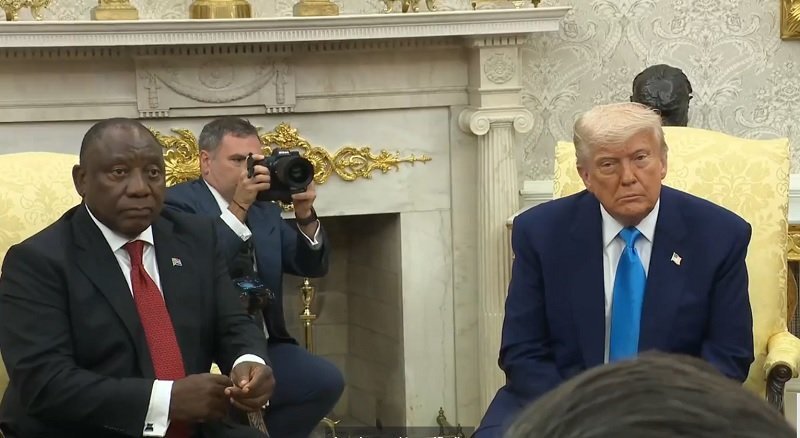
Yesterday, the headline-grabbing moment was U.S. President Donald Trump summoning South African President Cyril Ramaphosa to the White House. The purpose? To press him on alleged killings and mistreatment of white farmers in South Africa. Whether one agrees with Trump’s methods or motives, one thing was undeniable: he used the weight of his office to demand accountability for violence against a vulnerable population – his perceived constituency.
As an Ethiopian born watching this, I could not help but ask: what if the Amharas had their own “Trump”?
The Amharas, one of Ethiopia’s largest and most historically significant ethnic groups, are suffering widespread violence, displacement, and discrimination – and yet have no global ally or forceful figure speaking on their behalf.
Across regions like Oromia, Benishangul-Gumuz, and parts of the Southern and Somali regions – not to mention even Addis Ababa – Amharas have been subject to targeted killings, forced evictions, and systemic marginalization. Villages in West Oromia’s Wollega zone have seen horrifying massacres, often with entire communities wiped out. Videos and reports emerge of people killed for no crime other than their identity.
And yet, there is no summit, no public outcry from a world leader, no stern summoning of Ethiopia’s leaders to answer why this is happening.
When Trump confronted Ramaphosa, the South African leader, was cornered into an uncomfortable reckoning. He was forced, at least for a moment, to acknowledge violence in his country. Now imagine a world where someone of similar stature summoned Shimalis Abdisa, the President of Oromia Region, and asked: “Why are Amharas being massacred under your administration? Why are they not safe in the land they were born?” But unlike Ramaphosa, who faced global cameras, Shimalis governs without the burden of scrutiny. If Ramaphosa is a man cornered by international outrage, Abdisa is a man cloaked in domestic silence – an enforcer whose power flows not from accountability, but from impunity. The contrast is painful: one was shamed into speaking; the other remains untouched by questions, despite rivers of blood flowing under his watch.
So far, the Amhara people have had no such advocate. No powerful leader has stood for them – not domestically, and certainly not internationally. Their suffering is politicized or dismissed, often portrayed as exaggerated or imagined. Even local elites are split, hesitant to speak forcefully for fear of political backlash.
But perhaps that is what the Amharas need now – not another silent intellectual or neutral observer, but a voice with audacity. Someone unafraid to call out injustice wherever it happens, someone who will not wait for permission to speak, and someone who sees Amhara suffering as a moral, not political, crisis.
This is not a call for extremism. It is a cry for visibility. When people are murdered because of their identity, it is not a regional issue – it is a national emergency.
The fact that the world remains mostly silent while this continues only deepens the wound. But the moment one leader, one figure of influence, stands and declares that Amhara lives matter, the silence will begin to crack.
And maybe – just maybe – that will be the moment Ethiopia is forced to confront what it has tried so hard to deny.
Until then, the question will remain: What if the Amharas had their own Trump? Who would dare summon justice on their behalf?
Editor’s Note : Views in the article do not necessarily reflect the views of borkena.com
__
Subscribe : https://borkena.com/subscribe-borkena/
Join our Telegram Channel : t.me/borkena
Like borkena on Facebook
Add your business to Ethiopian Business Listing / Ethiopian Business Directory Business Listing Toronto
Join the conversation. Follow us on X (Formerly Twitter) @zborkena to get the latest Ethiopian News updates regularly. Subscribe to YouTube channel To share information or for submission, send e-mail to info@borkena.com
Amhara “most historically significant ethnic group?” That sounds delusional.