
By: Getahun Tsegaye
Staff Reporter
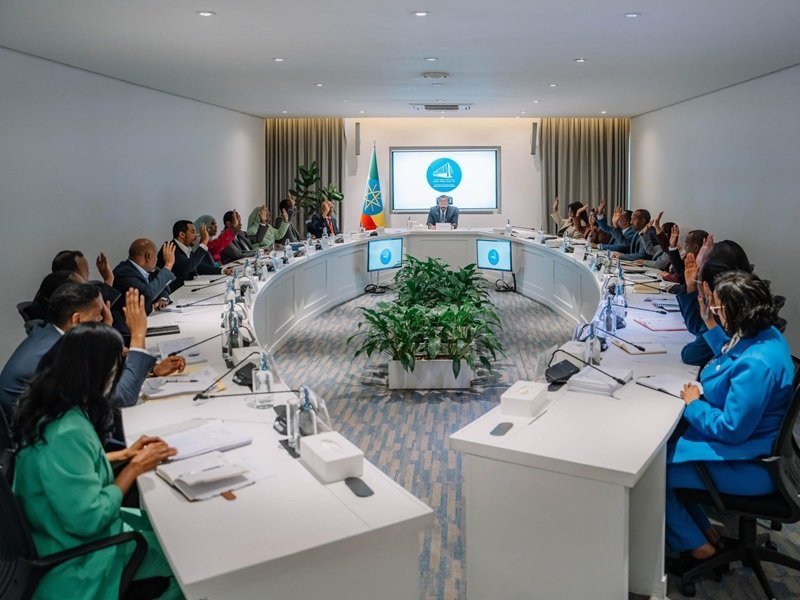
Addis Ababa, Ethiopia – Ethiopia’s Council of Ministers this week approved a draft proclamation allowing foreign property ownership under specific conditions, alongside endorsing key economic and trade measures during its 44th session.
The draft, now headed to the House of Peoples’ Representatives for legislative debate, is framed by the government as a “catalyst” for investment and urban renewal, aimed at addressing chronic housing shortages, attracting diaspora and foreign investment, and stimulating job creation in construction and related sectors.
The Council described the initiative as a carefully balanced step meant to attract foreign investment while preserving citizens’ land rights. It emphasized that the move could “stimulate housing development, improve accessibility, align supply with demand, and create meaningful employment opportunities.”
However, this policy is being introduced against a backdrop of significant macroeconomic challenges, as the Ethiopian birr continues to decline in value against the U.S. dollar. The unofficial market exchange rate is now nearly double the official rate, according to an independent economist based in Addis Ababa—referred to here as Tesfaye for security reasons—who spoke to Borkena.
The government, while acknowledging the difficulties the public is facing, has defended the ongoing devaluation as a necessary economic correction. “We cannot afford to maintain an artificial exchange rate that distorts our economy and drains foreign reserves,” the Ministry of Finance said in a statement following the devaluation. “Gradual adjustment of the exchange rate will help improve export competitiveness, reduce the black market gap, and ultimately stabilize the external sector.”
The economist expressed concern over the policy, warning that devaluing the birr without meaningful improvements in exports or broader economic reforms could end up doing more harm than good. “If we don’t have the export capacity to match this shift, all we’re doing is making everyday goods more expensive for ordinary people,” he said. Citing recent trends, he added, “The cost of living has been rising steeply—annual inflation is now above 28%, and food prices alone have jumped over 30%. For low- and middle-income families, especially in cities, this is becoming unsustainable.”
At the same time, the government’s aggressive urban redevelopment projects, particularly the corridor development initiative in Addis Ababa, have drawn fierce criticism from human rights organizations and local communities. Amnesty International recently issued a call for an immediate halt to the evictions linked to these projects, citing violations of due process and inadequate resettlement provisions. In its response, the government has defended the program as essential for the future of Ethiopia’s capital. “Addis Ababa is growing unsustainably,” the city administration stated. “The corridor development is not about displacing people—it is about transforming outdated urban structures into inclusive, livable, and economically vibrant environments. The beneficiaries will not only be the investors but the city itself and future generations.”
Officials argue that the relocation of residents is conducted under legal frameworks, with compensation and new housing alternatives provided. “We are not ignoring the hardships,” Adanech Abebe, Addis Ababa’s Mayor, said multiple times regarding the matter. “But we must modernize. Infrastructure development, new transport links, and commercial centers require space. We are trying to do this responsibly.”
Nevertheless, some residents and experts remain skeptical. Tesfaye warned that the current approach risks “creating enclaves of prosperity surrounded by poverty,” particularly if foreign investors are allowed access to prime real estate in central urban zones. “We’ve already seen how these developments push people out to peripheral areas with fewer services. Adding foreign buyers could drive prices up further and deepen inequality,” he said.
From the perspective of a political analyst and professor at Addis Ababa University, the Cabinet’s recent approval of tariff reductions under the African Continental Free Trade Area (AfCFTA) Agreement is seen with cautious optimism, but grounded in concern over current geopolitical and structural challenges.
“On paper, Ethiopia’s move signals commitment to economic integration, but policy cannot be divorced from geopolitics. The conflicts in the Horn of Africa, particularly in Sudan and parts of northern Ethiopia, create an unstable foundation for free trade,” the analyst notes.
Though the Ethiopian government presents the tariff reduction as a path toward “self-reliance,” skepticism persists regarding the country’s capacity to leverage this policy given its limited infrastructure and persistent regional insecurity.
“It’s paradoxical to talk about self-reliance through external trade integration when our road and rail networks to key markets are underdeveloped or disrupted by insecurity,” the expert argues.
In addition to internal barriers, there is concern over regional market dynamics.
“The AfCFTA is built on the idea of complementarity, but the current export portfolios of Ethiopia, Kenya, and Uganda suggest competition rather than synergy. Without diversification and value addition, integration could just mean intensified rivalry,” the analyst cautions.
The Council also ratified an €11.5 million grant from the Italian government for green economy programs and a 38.1 million SDR concessional loan from the World Bank for educational reform. In addition, the government endorsed Ethiopia’s membership in the Africa Finance Corporation and approved an Air Transport Agreement with Austria aimed at boosting Ethiopian Airlines’ reach and stimulating tourism and trade.
These actions signal a government intent on overhauling its economic model, despite facing significant pressures both at home and abroad. A sociologist, identified here as Meron, described the current situation as “a high-stakes gamble on modernization,” noting, “the real question is whether this transformation will be inclusive or end up marginalizing the very people it claims to uplift.”
__
Subscribe : https://borkena.com/subscribe-borkena/
Join our Telegram Channel : t.me/borkena
Like borkena on Facebook
Add your business to Ethiopian Business Listing / Ethiopian Business Directory Business Listing Toronto
Join the conversation. Follow us on X (Formerly Twitter) @zborkena to get the latest Ethiopian News updates regularly. Subscribe to YouTube channel To share information or for submission, send e-mail to info@borkena.com
This is wrong, wrong & wrong!
Wrong timing!
The current geopolitical and economic environment is not IN FAVOR OF trivial-‘development activities’, rather it is a time that needs all the focus to be directed on ‘maintenance’ and seeking to balance what is essential & necessary vs that which can be postponed to alleviate the existential-problems faced by the wider community.
As stated by the Experts mentioned in the article ( Tesfaye and Meron) this is a very misguided policy, selling Ethiopians interest to foreigners for freshly printed $ for a cost of a penny on the dollar wholesale when the economic environment globally is in decline, this is not to make a difference in the rising living cost of Ethiopians but only designed to make it worse, in the process aimed to preserve power.
With 40.3 million acres of arable land, with ample water resources that has the potential to give up to 4 harvests /year, cost-of-living should not be an issue in Ethiopia, except when urbanization is the major focus of the leadership-bunch.
Vlodomir Zelensky of Ukraine just signed off the total wealth of the people of Ukraine to a foreign power, so that he maintains his grip POWER as the country disintegrates…
Abiy Ahmed seems to be in competition with Zelensky by introducing this move to prove his loyalty to his NEOLIBERAL handlers in the West.
On the other side, African leaders are taking steps nationalizing exploitative projects run by foreigners forever… in Borken Faso, Namibia, and South Africa, but sadly we witness the opposite steps taken by Western planted leadership structures here and elsewhere.
Urbanization is cost intensive, to make it a priority in the current economically challenging time is an oxymoron in the country where 1/5th of the population (more than 20 million citizens) are on the brink of starvation and are recipients of the World Food Program (WFP) & the late /underground USAID.
Every minister has his/her hands up (in the picture), who would risk going out of step with the PM who is aggressively pushing to see his ‘Urbanization’ & ‘Palace beautification’ vision be implemented while millions of citizens need food aid, none, the majority of ministers want to remain ‘relevant’ and do what is asked of them even though they see this strategy is completely wrong in their mind.
The diaspora community though technically ‘foreigners’ can be influenced using various control measures to invest / contribute in alleviating the chronic shortages in the economy so that the growing economic-gap is minimized (by curbing the need to exploit some might have), and their familiarity with the customs and traditions make them less foreigner and flexible in their profit seeking plans than those the term clearly defines.
The Chinese “foreign ownership” model which requires FORMING-LOCAL-PARTNERSHIPS can be used to MAKE SURE the BUSINESS effort employed PROFITS both sides, not the western model where the foreigner takes IT ALL.
They have succeeded in both ECONOMIC GROWTH AND creating EMPLOYMENT opportunities for locals more than anyone on the planet, therefore their evidence-based data & lessons-learnt could be the best development method Ethiopia must mimic, to build a well balanced economy and prosperous society.
Foreign ownership is simply setting oneself up for slavery!
That is not what our ancestors paid the ultimate price for, in Adwa, and in the second Italian invasion of 1936-41.
Our people need FOOD; not urban-jungle, not palaces, FOCUS on what is essential and worthwhile, not ON trinkets!!!
Let the urban communities grow vegetables on the land ‘the demolition-derby’ freed, to alleviate the rising cost of living, & food inflation.
Be well
” … Young Kenyans, the task is yours, choose you now, whether you want to be kambas, and Luos, and kikuyus, or you want to be Kenyans; with the tribe only being for cultural reasons.
Samora Moise Michel said, ‘If the new African nation is to thrive, the tribe must die’.
Not that you cease to identify yourself as such, but it cannot be the basis for decision making.
That I am voting for an individual because he is from my ethnic group, that is the only qualification that they gave me 200 shillings, that is the justification, we must rethink Governance… ”
Prof PLO, supporting Capt. Traore of Burkina Faso
Link = youtube.com/watch?v=WM5Gdmjux74
“When you hear the former colonizers are saying you are good, you must pause and ask yourself what evil are you committing against your people ”
Powerful & timely speech!!!
Be well.
Ethiopia has a lot to offer to foreign-businesses big and small at this particular junction in time where high energy & labor costs are concerned. Ethiopia has ample supply of CLEAN ENERGY & Large numbers of Educated workforce that would give advantages for many industries specially in Europe that are contemplating closing down their operations.
Unless we switch our focus from what we want to have to what we already have, we will not be able to see the advantages we have that would give potential investors an advantage.
Therefore instead of contemplating selling the COW and becoming dependent on others, maybe we should consider focusing on how to sell the MILK / Cheese / Butter, instead.
The GERD will soon start generating more power, industrialists particularly in Europe have been under high energy cost for some time now, some have and others are in the process of closing down their operations for good.
Ethiopia could offer FREE – ENERGY for the first few months / years for Industries that will move their operations to Ethiopia and HIRE local workforce.
The duration for the FREE – ENERGY offer could be expanded based on the number of workforce ( in hundreds or thousands) they plan to employ & train.
As the COST of manufacturing is becoming a major sink or swim matter for industries worldwide to get a competitive edge over their competition, access to cheap renewable Energy, relatively cheap labour cost, and Ethiopia’s central-location to markets in Europe, Asia and Africa makes it an attractive hub for manufacturing and shipping.
But it requires FOCUSED strategic planning and marketing, so that the people of Ethiopia who made all this possible would remain the owners & direct beneficiary of their resources, not the onlookers and bystanders while slick-operators from within and elsewhere eat their lunch.
Be well.
FOREIGN OWNERSHIP made Housing affordability impossible for the LOCAL POPULATION worldwide.
All Nations in the developed world that doubled-down on FOREIGN-OWNERSHIP scheme are experiencing societal problems where LOCALS are increasingly becoming HOMELESS.
“In Vancouver CANADA it takes six-figure earners 17 years of GROSS INCOME to SAVE for a DOWN-PAYMENT to own a home…”
An American in China
“We have a global housing crisis. Chinese factories can solve it.”
Link = youtube.com/watch?v=xO7YU5MOhhQ
Now, imagining where this is going if these schemes by Abiy were allowed to go ahead, 97% to 99% of Ethiopians who couldn’t afford to own their own home today, will be shut out from their basic right of owning their own home in the country they were born in… that would have tragic consequences not only for those living (hand-to-mouth) today but for the NEW generations yet to come… while filling a few corrupt officials pockets here and NOW.
We say NO to Abiy’s NEO-LIBERAL-handlers agenda!
Ethiopia is for Ethiopians ONLY, period!!!
Be well.
“We want Africa without the Africans.”
Link = youtube.com/watch?v=cnLIgynRueo
It is our own corrupt “elite” that are used to take our shirts off our back…
the majority of our “educated” (brainwashed) think they ‘know” WHAT THEY ARE DOING, but those WHO ‘taught’ them know they are idiots who are being USED & GUIDED TO WORK AGAINST THEIR OWN NATIONS & PEOPLES INTERESTS. Simply because the teaching THEY RECEIVED ARE European-CENTRIC in their FINAL OUTCOMES.
This needs to end!!!
Be well.