
Borkena
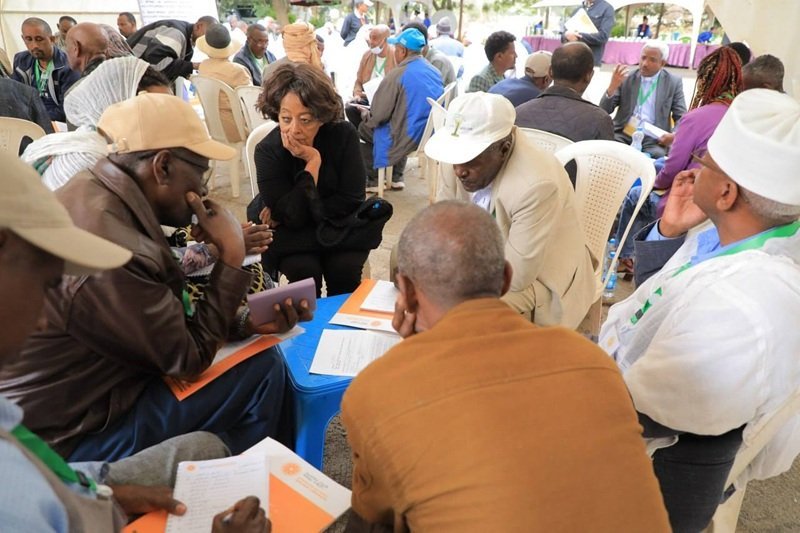
Toronto – Ethiopia’s National Dialogue Commission on Saturday started an agenda gathering in the Amhara region of Ethiopia – where there has been a war between the Abiy Ahmed led Federal government and Fano forces operating in the region.
The process in the region is scheduled to be a weeklong.
The commission has announced that over six thousands “representatives” take part in the process. They are drawn from over 267 districts across the Amhara region. They will be meeting for five days, discussing and identifying agenda items to the commission.
Once the process with “representatives” is completed, the commission, whose chair and board members are currently in Bahir Dar, will hold consultation with prominent figures, government institutions and political parties.
The Commission which was established for a three year term ended its term before completing its work. Its term was extended for one more year after the commission presented a report to the parliament in February this year.
Agenda gathering in Amhara and Tigray regions were among the outstanding tasks which were explained due to the conflict situations in the regions.
Questions over neutrality
While Ethiopian Prime Minister Abiy Ahmed has been painting the commission as the “best chance” to resolve the political problems in the country, major political parties in the country (both national and ethnic based ones) have rejected the commission due to government influence.
Opposition parties like Enat Party, EPRP, Oromo Federalist Congress (OLF), Ogaden National Liberation Front ( this one has recently resumed armed struggle in the South Eastern Parts of Ethiopia) and Oromo Liberation Front – among others – withdrew from the national dialogue process.
Notably the commission is not seen as impartial, inclusive and neutral. There have been complaints that “representatives” were selected using ruling party channels and the agenda items were mostly reflective of ruling party’s political agenda items which impacted the credibility of the commission.
Background and context
The National Dialogue Commission was created with the mission to create “national consensus” on what the Ethiopian government called “most fundamental issues of national significance.”
While the cause of the division and conflict is very much reflected in the way the institutions were restructured with “constitutional” support – mostly based strictly on ethnic identity at the expense of national identity, the commission seems to presume that causes of national censuses problems are unknown. What has been observed under Prime Minister Abiy Ahmed administration over the last seven years unprecedented, recurring and prevalent ethnic based violence and unprecedented wars that are estimated to have claimed over a million people.
Over the past sixty or so years, Ethiopia experienced the proliferation of national liberation movements. Many of them, including what turned out to be a ruling party after the secession of Eritrea in 1993, share the view that the Ethiopian state was a colonial power.
__
Subscribe : https://borkena.com/subscribe-borkena/
Join our Telegram Channel : t.me/borkena
Like borkena on Facebook
Add your business to Ethiopian Business Listing / Ethiopian Business Directory Business Listing Toronto
Join the conversation. Follow us on X (Formerly Twitter) @zborkena to get the latest Ethiopian News updates regularly. Subscribe to YouTube channel To share information or for submission, send e-mail to info@borkena.com