
Editor’s Note : Views in the article do not necessarily reflect the views of borkena.com
By Caleb Ta, Dr.
Abstract
This article critically examines the visit of Franklin Graham, President of Samaritan’s Purse and the Billy Graham Evangelistic Association, to Ethiopia in March 2025. It presents a theological and moral critique of the situation in Ethiopia, focusing on the stark contrast between the appearance of Addis Ababa and the suffering of the rest of the country. The paper utilizes biblical figures, particularly John the Baptist, as a framework to challenge Franklin Graham’s role as an evangelist and his response to the ongoing humanitarian crisis. The critique explores the ethical implications of Graham’s visit, questioning the intersection of evangelism and political influence, and the responsibility of religious leaders to address the moral failures of political leadership in Ethiopia. A significant quote that raises questions about Graham’s role is, “When I return to the United States, I will tell President Trump how Addis Ababa has changed and explain what is happening in Ethiopia.” This statement sheds light on the potential political influence Graham might exert, raising concerns about the extent to which evangelism intersects with international political relations. The article explores whether Graham’s message, focusing on the development of Addis Ababa, overlooks the suffering of the broader Ethiopian population and the moral and political accountability of Ethiopia’s leadership.
Introduction
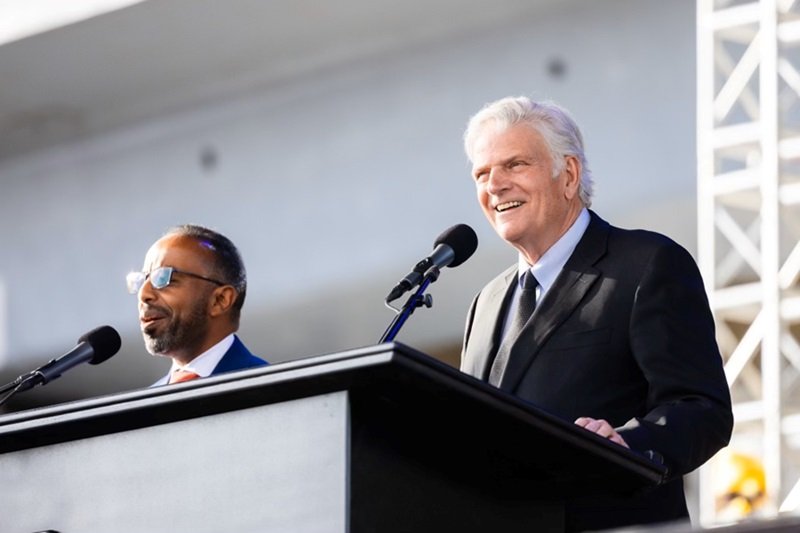
Franklin Graham’s visit to Ethiopia in early 2025, framed as an evangelical mission, raised critical questions regarding the role of spiritual leaders in political affairs. His visit, focused on spreading the gospel, came amidst an ongoing humanitarian crisis in Ethiopia, marked by war, displacement, and famine. This article seeks to provide a theological and moral critique of Franklin Graham’s actions and his response to the Ethiopian crisis. It challenges the appropriateness of his silence on the political issues affecting the Ethiopian people and evaluates his potential role as a political intermediary through his communication with U.S. political leaders, particularly President Donald Trump.
There is no doubt that Ethiopian leaders might have invited Franklin Graham to preach the gospel in Addis Ababa with good intentions, as they aspire to reach out to the people in the city. Historically, this is not a new practice. Prominent evangelists have been invited to Ethiopia on several occasions. One notable example is Reinhard Bonnke, one of the greatest evangelists of our age, who visited Addis Ababa during the TPLF regime, aiming to share the message of faith. Even Franklin Graham’s father, Evangelist Billy Graham, visited Ethiopia during the reign of Emperor Haile Selassie. Such invitations are often motivated by a desire to share the gospel with the people of Ethiopia, particularly in the capital city, Addis Ababa, which is viewed as a central hub for spiritual outreach.
In line with this evangelical tradition, Franklin Graham also emphasizes his mission to preach the gospel. In a post on his social media, he requests prayer from his followers, saying, “As I preach the Gospel in Addis Ababa, Ethiopia, tomorrow and Sunday, would you pray that many will put their faith and trust in Jesus Christ?” This prayer request reflects the spiritual context of his mission. For most evangelicals, this is what they dream and work for—the opportunity to spread the message of Jesus Christ to as many people as possible. The focus on evangelism, on reaching hearts for Christ, remains the central thrust of Graham’s visit.
However, this focus on spiritual matters cannot be separated from the broader context in which Graham’s visit occurs. While his mission to spread the gospel is commendable in the religious sense, it is essential to also critically assess the ethical and moral responsibility of evangelists, especially when their missions take place within politically charged environments. Ethiopia’s ongoing humanitarian crisis, fueled by political turmoil and social upheaval, demands a response not only from spiritual leaders but also from those who hold considerable influence, such as Franklin Graham.
Thus, the article will examine whether Graham’s visit, which seems to prioritize spiritual engagement, overlooks the broader moral and political issues affecting the Ethiopian population. It will also explore the implications of his potential political influence, particularly through his communication with U.S. political figures like President Trump. This critique raises the question of how evangelism, when interwoven with political power, might impact both the message of the gospel and the moral duties of religious leaders in times of crisis.
The Condition of Addis Ababa and Ethiopia’s Suffering
In order to understand the context of the critique, it is crucial to highlight the contrast between Addis Ababa, the capital city, and the suffering experienced by the wider Ethiopian population. Addis Ababa is depicted as a façade, offering a misleading image of prosperity and stability that masks the grave social, economic, and humanitarian crises in the country. Behind the “expensive clothes” and “perfume” of the capital, which symbolize outward wealth, lies the reality of a nation in severe turmoil. The city’s superficial affluence covers up the true extent of Ethiopia’s suffering, where millions are facing the horrors of war, displacement, and starvation.
1. Misery and Agony of the Population
Ethiopia, with a population of approximately 120 million people, is reeling under the consequences of ongoing conflicts. Over two million people have died as a result of these violent conflicts, and millions more have been displaced, leaving their homes and livelihoods behind. Famine and food insecurity have also become widespread, threatening the survival of countless Ethiopians. The majority of the population—estimated at 70-80%—is enduring profound suffering, including the breakdown of social order and the collapse of essential services. These statistics are not mere numbers but represent the lived experiences of individuals whose lives have been shattered by violence and deprivation.
2. Addis Ababa as a Metaphor
The metaphor of comparing Addis Ababa to a prostitute adorned in lavish clothing and perfume serves as a sharp critique of the Ethiopian government’s focus on creating an illusion of prosperity while ignoring the deeper, more pressing issues facing its people. The image highlights the moral decay beneath the polished façade of the capital and calls attention to the government’s preoccupation with external image rather than addressing the pressing needs of the Ethiopian population. This metaphor serves to critique a government more concerned with maintaining its image than with confronting the dire humanitarian crisis that Ethiopia faces.
The Call for Justice and Repentance
The article also emphasizes the need for a theological response to Ethiopia’s current situation. Using John the Baptist as a symbolic figure, it calls for a prophetic response to the leadership of Ethiopia, invoking the moral responsibility of religious leaders to address injustices. John the Baptist, known for his bold confrontation of political powers, serves as a model for the type of moral truth-telling needed in Ethiopia today. His actions—speaking out against the evils of his time, even at the cost of his own life—serve as a guide for how evangelists should respond to the suffering of the Ethiopian people.
1. Moral Responsibility of the Evangelist
The article argues that Franklin Graham, as an evangelist, has a moral duty to go beyond preaching the gospel and to address the moral failures of Ethiopia’s leadership. While evangelism is essential, it is equally important for Graham to speak out against the violence and injustice inflicted by the Ethiopian government. Drawing a parallel to John the Baptist, the article suggests that if Graham were truly committed to justice, he would have used his platform to publicly call on Ethiopia’s leaders to repent for the violence they have caused and to halt the ongoing massacres and oppression of the vulnerable.
2. Repentance and Justice
The city of Addis Ababa and its leaders are described as morally bankrupt, using ethnic identity as a tool to perpetuate division and violence. The article argues that while prosperity is not inherently negative, achieving it at the expense of others’ suffering is unjust and will eventually lead to divine judgment. The article calls for repentance and moral reform, emphasizing that Ethiopia’s leaders must acknowledge their wrongdoings and act justly toward the weak and oppressed. This moral message extends beyond spiritual teachings and has profound implications for how the government should treat its citizens.
Franklin Graham’s Role in Politics: “When I return to the United States, I will tell President Trump how Addis Ababa has changed and explain what is happening in Ethiopia.”
A critical aspect of the article revolves around Franklin Graham’s statement, “When I return to the United States, I will tell President Trump how Addis Ababa has changed and explain what is happening in Ethiopia,” which raises significant questions about the nature and purpose of his communication with President Trump. This statement is not merely a casual remark; it is a revealing insight into Franklin Graham’s perspective on Ethiopia and his potential role in influencing U.S. foreign policy. The phrase itself invites deeper analysis, particularly when considering Graham’s position as a spiritual leader rather than a political or diplomatic figure.
1. Franklin Graham’s Role and Intentions
Franklin Graham, as the president of Samaritan’s Purse and the Billy Graham Evangelistic Association, holds a prominent position within the global evangelical community. His visit to Ethiopia is presented as part of his evangelical mission, focused on spreading the gospel. However, the statement about informing President Trump about Addis Ababa’s changes suggests that Graham’s role may extend beyond spiritual matters and into the political sphere. This brings into question whether Graham views his evangelical mission as purely religious or if he sees himself as an intermediary between the Ethiopian government and U.S. political leadership.
2. What Does “Change” in Addis Ababa Mean?
When Franklin Graham says he will tell President Trump how Addis Ababa has “changed,” it is important to explore what he means by “change.” The term could refer to visible infrastructural growth in Addis Ababa, such as new buildings, roads, or modernization projects. However, these superficial changes may mask the ongoing humanitarian crisis that millions of Ethiopians continue to face. The phrase could imply that Graham is focusing on the external development of the city without addressing the deeper political and social challenges affecting the broader population. This raises the question of whether Graham’s definition of “change” aligns with the reality of the Ethiopian people’s suffering.
3. Explaining “What is Happening in Ethiopia”
Graham’s statement about explaining “what is happening in Ethiopia” raises additional concerns. Given his position as a spiritual leader, it is expected that his explanation would focus on Ethiopia’s religious context and the spiritual needs of its people. However, his comment appears to be less about the spiritual and moral failings of the Ethiopian government and more about promoting the narrative of change and modernization. This presents a potential disconnect between Graham’s role as an evangelist and his actions as a political commentator. If Graham’s communication with President Trump does not adequately address the humanitarian crisis or the ongoing conflict, it could be seen as presenting an incomplete or misleading portrayal of the situation in Ethiopia.
4. Political Implications and Ethical Concerns
The intersection of Franklin Graham’s evangelical mission with his political interactions raises ethical concerns about the role of religious leaders in shaping political discourse. His ties to U.S. political figures, particularly President Trump, suggest that his visit to Ethiopia could have broader political implications. By focusing on Addis Ababa’s development and downplaying the humanitarian crisis, Graham risks becoming part of a political narrative that seeks to legitimize Ethiopia’s government, especially under Prime Minister Abiy Ahmed. This could lead to a distortion of the true situation in Ethiopia and may influence U.S. foreign policy in ways that are not aligned with the ethical responsibility of a spiritual leader to advocate for justice.
Conclusion: A Spiritual Leader or Political Lobbyist?
In conclusion, Franklin Graham’s visit to Ethiopia and his subsequent communication with President Trump raise crucial questions about the role of spiritual leaders in politics. While Graham’s evangelical mission is valuable, his actions suggest that he may have acted as a political intermediary, promoting a narrative that aligns with the Ethiopian government’s interests. By failing to address the humanitarian crisis and the moral failings of Ethiopia’s leadership, Graham risks using his platform to support a government responsible for widespread injustice. This article calls for a more robust moral stance from evangelists, urging them to use their influence not only to spread the gospel but also to advocate for justice, accountability, and repentance in the face of widespread suffering.
Editor’s Note : Views in the article do not necessarily reflect the views of borkena.com
__
Subscribe: https://borkena.com/subscribe-borkena/
Join our Telegram Channel : t.me/borkena
Like borkena on Facebook
Add your business to Ethiopian Business Listing / Ethiopian Business Directory
Join the conversation. Follow us on X (Formerly Twitter) @zborkena to get the latest Ethiopian News updates regularly. Subscribe to YouTube channel To share information or for submission, send e-mail to info@borkena.com
this is an excellent article. very well sourced and presents the ethnic apartheid regime in Ethiopia in it’s true light. Addis Abeba is a screen saver.
Abiy Ahmed Ali and his Oromo extremists have targeted all other ethnicities and Amharas especially. Similar to the Ustasse of Croatia in the 1940s who were supported by the Catholic leadership and committed genocide against Serbian Orthodox Christians. History repeats.