
By Amsal Woreta
Ethiopia’s ethnic federal system, authoritarian governance, and recurring inter-ethnic violence have plunged the nation into a state of perpetual crisis. Ethiopian intellectuals, however, have remained silent, failing to adequately address these challenges. Drawing lessons from historical and contemporary intellectual movements globally and within Ethiopia, this paper explores how Ethiopian intellectuals can rise to the occasion, challenge oppressive systems, and promote unity, peace, and justice.
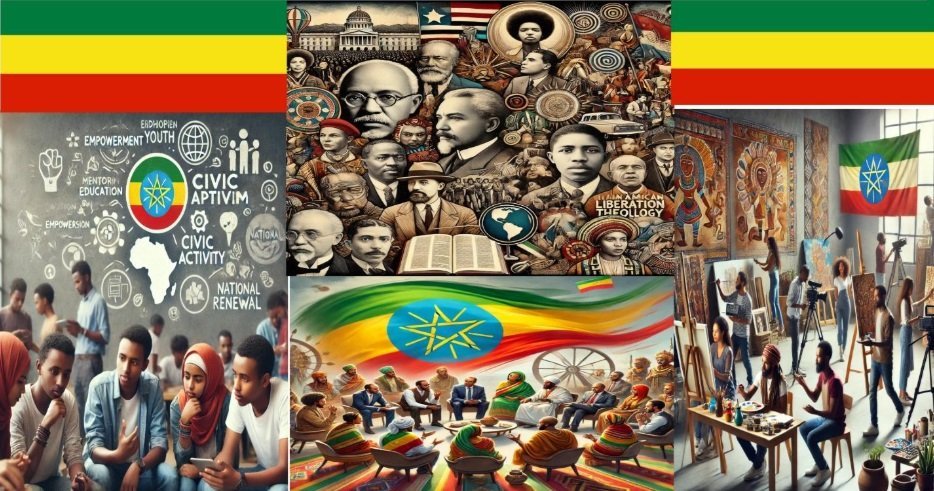
Introduction
Ethiopia’s socio-political crises, rooted in ethnic federalism and authoritarian governance, demand critical engagement from intellectuals. Yet, the silence of Ethiopian academics, artists, and public thinkers is a glaring omission in the struggle for national renewal. By analyzing lessons from other intellectual movements and applying them to Ethiopia’s unique context, this paper seeks to identify pathways for intellectuals to play a transformative role.
The Role of Intellectuals in Society
Historically, intellectuals have served as the conscience of society, challenging oppressive systems and envisioning alternatives. Examples abound:
- The Harlem Renaissance and Pan-Africanism: Intellectuals like W.E.B. Du Bois and Frantz Fanon used their platforms to critique colonialism and racism, inspiring global movements for freedom and equality.
- Latin American Liberation Theology: Scholars and clergy in Latin America advocated for the poor and oppressed, linking academic rigor with activism.
- South African Anti-Apartheid Movement: Intellectuals such as Steve Biko emphasized the power of Black consciousness in dismantling apartheid.
These examples demonstrate that intellectual courage and public engagement can galvanize societal transformation.
The Role of Intellectuals When They Are Silent
In an era of misinformation, partisan deadlock, and ideological hysteria, the silence of intellectuals has profound consequences. As Christopher Z. Mooney argues, public universities and intellectuals are uniquely positioned to promote rational, evidence-based governance. Scholars possess a long-term perspective and a wealth of expertise that policymakers and the public desperately need. However, when intellectuals isolate themselves in their academic silos, they leave a vacuum that is quickly filled by partisan and ideologically driven voices, “If scholars don’t contribute their informed, disinterested perspectives, others will happily fill the gap”.
Mooney identifies several reasons for this silence:
- Scholars are often hesitant to make strong claims due to the complexities of empirical research and the limitations of individual studies. However, intellectuals must recognize that their expertise still offers significant value, even if it is not absolute.
- There is a “translation problem,” where academic jargon and the narrow focus of research make intellectual work inaccessible to the public. Overcoming this requires adapting communication styles for broader audiences.
- The lack of incentives for public engagement discourages intellectuals from stepping outside their academic roles. Institutions must address these barriers by offering support, time, and recognition for scholars who engage with the public.
By failing to participate in public discourse, intellectuals not only undermine the societal value of their work but also risk perpetuating policies and narratives that harm the public good. Ethiopian intellectuals, like their global counterparts, must recognize their moral obligation to contribute to national conversations, especially in times of crisis.
Lessons for Ethiopian Intellectuals
- Embrace Courage and Ethical Responsibility: Ethiopian intellectuals must overcome fear of retribution and recognize their ethical obligation to society. Silence in the face of systemic oppression perpetuates injustice. By speaking out, they can challenge narratives that justify ethnic violence and authoritarianism.
- Bridge Academia and Public Discourse: Intellectuals should make their research and insights accessible to the public. Simplifying complex ideas without sacrificing rigor can foster widespread understanding of issues like ethnic federalism and its consequences. This includes writing op-eds, engaging in public debates, and leveraging social media.
- Collaborate Across Disciplines and Ethnic Lines: Ethiopia’s intellectuals must transcend disciplinary silos and ethnic loyalties to foster inclusive dialogue. Transdisciplinary collaboration can generate holistic solutions to Ethiopia’s challenges, emphasizing unity while respecting diversity.
- Learn from Global Intellectual Movements: By studying successful intellectual movements, Ethiopian thinkers can adopt strategies that align with their context. For instance, they can advocate for policies that balance regional autonomy with national unity, drawing from federal systems in countries like India and Switzerland.
- Promote a Culture of Accountability: Intellectuals must hold leaders accountable for governance failures and human rights abuses. This includes documenting atrocities, critiquing flawed policies, and offering actionable recommendations for reform.
- Create Alternative Platforms: When mainstream institutions are hostile to dissent, intellectuals can establish independent platforms for dialogue and publication. These platforms can amplify marginalized voices and ideas, challenging the dominance of state-sanctioned narratives.
- Engage the Diaspora Community: Ethiopian intellectuals in the diaspora often have greater freedom to speak out without fear of retribution. However, many in the diaspora are shackled by ethnic loyalty, which undermines their ability to function as impartial advocates for national unity. Overcoming these loyalties is essential to leveraging their potential. By promoting cross-ethnic solidarity and prioritizing national over ethnic interests, diaspora intellectuals can play a transformative role. Leveraging their voices can amplify domestic efforts and build international solidarity. Furthermore, the diaspora can support grassroots movements by providing resources, independent platforms, and global advocacy, thus serving as a bridge between Ethiopia and the international community.
- Focus on Youth Engagement: Ethiopia has a young population that is highly affected by the ongoing crises. Intellectuals can engage with youth through workshops, mentorship programs, and accessible publications to inspire civic participation and critical thinking.
- Leverage Art and Media: Artists, writers, and filmmakers have the power to shape public perception. Ethiopian intellectuals could collaborate with creatives to produce documentaries, literature, and art exhibitions that highlight the human cost of ethnic violence and advocate for reconciliation and justice.
- Establish Think Tanks and Research Institutes: Creating independent think tanks dedicated to policy analysis and advocacy can generate solutions to Ethiopia’s challenges. These institutions can focus on issues like constitutional reform, conflict resolution, and economic development.
- Advocate for Transitional Justice: Intellectuals can push for frameworks of transitional justice that address past atrocities, hold perpetrators accountable, and promote reconciliation. Drawing lessons from countries like Rwanda and South Africa could be invaluable.
Application to Ethiopia’s Crises
- Ethnic Federalism: Intellectuals must critically analyze the flaws of Ethiopia’s ethnic federal system, highlighting how it fuels division and conflict. They can propose constitutional reforms that promote inclusivity and shared governance.
- Amhara Crisis: The targeted violence against the Amhara people demands immediate intellectual and artistic attention. Documenting these atrocities, advocating for justice, and promoting reconciliation are crucial steps.
- Authoritarian Governance: By critiquing authoritarian practices and advocating for democratic principles, intellectuals can contribute to a political culture that values transparency, accountability, and participation.
Lessons from Multiethnic Nations
- Switzerland: A Model of Inclusive Federalism:
a. Diversity Profile: Multiethnic and multilingual (German, French, Italian, and Romansh
b. Governance Model: Federalism with significant autonomy for cantons.
c. Lessons for Ethiopia: Decentralize power equitably to allow ethnic groups and regions self-governance while maintaining a strong national identity. Encourage consensus politics to foster compromise and power-sharing among diverse groups.
- India: Balancing Diversity with Unity:
a. Diversity Profile: A federation of diverse ethnic, linguistic, and religious groups.
b. Governance Model: Federal structure with a strong central government accommodating linguistic and cultural diversity.
c. Lessons for Ethiopia: Rethink ethnic federalism: Balancing Diversity with Unity
d. Key Lessons: Federalism based on regions allows cultural autonomy while ensuring central oversight.
e. A commitment to democracy provides peaceful avenues for resolving disputes.
f. Application for Ethiopia: Shift from ethnic-based federalism to governance that celebrates diversity while promoting a keen sense of Ethiopian identity.
g. Foster democratic institutions and cultural pluralism. - Canada: Cultural Accommodation and Autonomy: Canada: Multiculturalism and Regional Autonomy
- Key Lessons:
- Recognize and respect cultural and linguistic diversity through policies that promote inclusion.
- Empower provinces to manage local governance within a strong national framework.
- Application for Ethiopia: Develop policies that integrate diverse communities into the national fabric while empowering regional governments.
- South Africa: Reconciliation and Justice:
a. Diversity Profile: A “rainbow nation” of diverse ethnic groups, languages, and cultures.
b. Governance Model: A unitary state with a constitutional democracy that guarantees equal rights.
c. Lessons for Ethiopia: Implement reconciliation frameworks and constitutional guarantees to protect minority rights and foster equality. - United States: Democratic Pluralism and Civic Nationalism:
a. Diversity Profile: Multiethnic, multiracial society with significant immigration.
b. Governance Model: Federal republic with a strong central government
c. Lessons for Ethiopia: Foster democratic pluralism and a sense of belonging based on shared civic values rather than ethnic identity. - Belgium: Power-Sharing and Conflict Resolution:
a. Diversity Profile: Divided between Dutch-speaking Flanders, French-speaking Wallonia, and a small German-speaking community.
b. Governance Model: Federal system with significant autonomy for linguistic regions.
c. Lessons for Ethiopia: Design systems for power-sharing and address regional tensions through dialogue and negotiation. - Nigeria: Managing Diversity Through Federalism:
a. Diversity Profile: Over 250 ethnic groups with three dominant ones (Hausa, Yoruba, Igbo).
b. Governance Model: Federal republic with states divided along ethnic and regional lines.
c. Lessons for Ethiopia: Balance regional autonomy with national cohesion, address resource inequalities, and avoid excessive ethnic competition for central power. - Malaysia: Economic Inclusion and Cultural Respect:
a.Diversity Profile: Multiethnic (Malays, Chinese, and Indians) with a dominant Malay majority.
b. Governance Model: Federal constitutional monarchy with affirmative action policies.
c. Lessons for Ethiopia: Address economic disparities and promote inclusivity and representation in national policies.
Potential Challenges and Solutions
- Fear of Repercussions:
- Encourage collective action, as authoritarian regimes often struggle to suppress widespread intellectual dissent.
- Use anonymous publications or international platforms to safeguard individuals while voicing concerns.
- Public Distrust of Intellectuals:
- Intellectuals must actively engage with grassroots movements to rebuild trust and demonstrate commitment to the people’s needs rather than abstract theories or elite concerns.
- Ethnic Bias Among Intellectuals:
- Intellectuals must recognize that human rights violations transcend ethnic loyalties. Upholding universal principles of justice and accountability requires transcending narrow ethnic affiliations. This involves actively opposing all forms of oppression, regardless of the identity of the victims or perpetrators.
- Institutional Barriers:
- Work to decentralize the production and dissemination of knowledge, leveraging digital platforms and open-access journals to bypass traditional gatekeeping.
Long-Term Vision
Propose a roadmap for Ethiopian intellectuals to transition from crisis response to building a resilient and inclusive society. This might include educational reforms, nation-building initiatives, and long-term cultural projects that foster unity and coexistence.
Conclusion
Ethiopian intellectuals have a pivotal role to play in addressing the nation’s crises. By learning from global examples and breaking their silence, they can help dismantle oppressive systems, foster unity, and build a future rooted in justice and equity. The time for action is now, as silence only serves to perpetuate the status quo. Ethiopian intellectuals must rise to the challenge, recognizing that their work is not merely academic but deeply consequential for the nation’s survival and renewal.
Very. Great contributions in giving new insights for Ethiopian intellectuals who are so far dead asleep with Very little contribution for the society that expects their support the most.
Great wake up call for Ethiopian intellectuals!!!
What about Rwanda? It has banned ethnic based identification after the genocide and froged a Rwandan nationalism. Now it is prospering and expected to be the first developed nation in the continent. It’s TPLF & Shabia scheme to destroy Ethiopia concocted article 39, but the Oromo ethnic fanatics failed to see the danger, and getting intoxicated with it to the detriment of all Ethiopians.