
By Amsal Woreta
This article examines the complex role of Ethiopian intellectuals in a context marked by ethnic tensions, political polarization, and restrictions on freedom of expression—what Henry Giroux, in his analysis of Noam Chomsky, terms “dark times.” Drawing on Giroux’s interpretation of Chomsky’s work as a public intellectual, the article explores the tensions between ethnic identity and national unity within the Ethiopian intellectual landscape. It argues that while ethnic identity can be a source of empowerment, it can also become a constraint, contributing to intellectual fragmentation. By applying Chomsky’s emphasis on critical thinking, speaking truth to power, and the responsibility of intellectuals, the article suggests pathways for Ethiopian intellectuals to navigate these “dark times” and contribute to a more just and unified society.
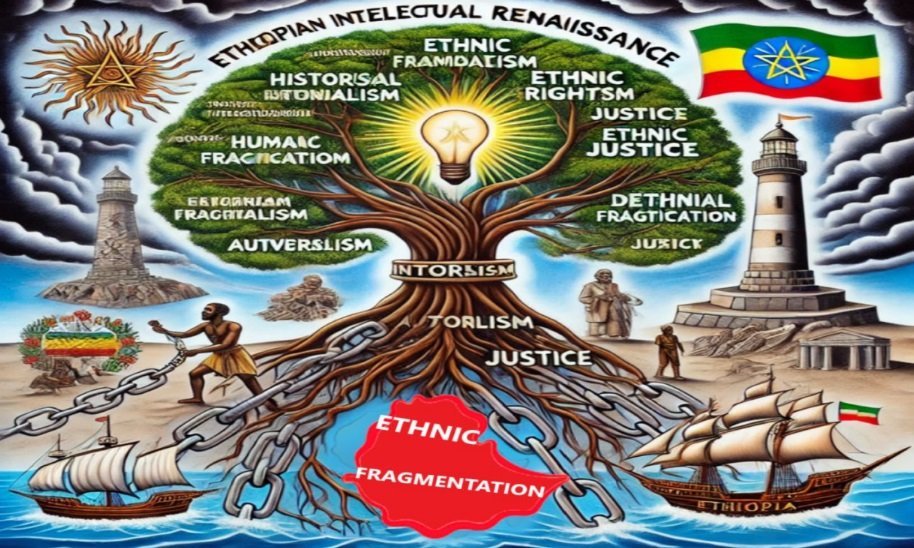
I. Introduction: The Intellectual’s Dilemma in a Divided Society
Intellectuals occupy a unique position in society, tasked with critical analysis, knowledge dissemination, and the pursuit of truth. In nations facing complex challenges, their role becomes even more crucial, demanding both intellectual rigor and moral courage. Ethiopia, with its rich history and diverse ethnic makeup, currently faces a period of significant internal tension, characterized by war ethnic conflicts, political polarization, and limitations on free expression. This context raises critical questions about the role of Ethiopian intellectuals: How do they navigate the complexities of ethnic identity and national unity? How can they contribute to constructive dialogue and reconciliation in a deeply divided society? This paper uses Henry Giroux’s analysis of Noam Chomsky as a public intellectual in “dark times” as a lens to examine these questions, exploring the potential for Ethiopian intellectuals to function as agents of positive change.
II. Chomsky and the Public Intellectual in Dark Times: A Framework for Analysis
Henry Giroux, in “Noam Chomsky and the Public Intellectual in Dark Times,” highlights Chomsky’s unwavering commitment to speaking truth to power, challenging dominant narratives, and engaging with public issues. This framework provides a number of key concepts relevant to the Ethiopian context:
A. The Moral and Social Responsibility of Intellectuals: Chomsky, as interpreted by Giroux, argues that intellectuals have a moral obligation to use their knowledge and expertise to challenge injustice and advocate for a more just world. This responsibility becomes even more critical in “dark times” when democratic values are under threat.
B. Critique of Power and Ideology: Chomsky’s work meticulously dissects how power operates through institutions like media, government, and corporations, often shaping public perception through propaganda and the “manufacturing of consent.” This critique is essential for understanding how ideologies, including those related to ethnic identity, are constructed, and used to maintain or challenge power structures.
C. The Importance of Critical Pedagogy: Chomsky emphasizes the role of education in fostering critical thinking and empowering individuals to challenge dominant narratives. This involves developing analytical skills, encouraging questioning of authority, and promoting a culture of intellectual inquiry.
D. Dissent and the Public Sphere: In “dark times,” dissent becomes a crucial act of resistance against oppressive forces. Chomsky’s unwavering commitment to free speech and the right to dissent serves as a powerful example for intellectuals facing restrictions on their expression.
III. The Ethiopian Context: Ethnic Identity and the Challenges of Intellectual Engagement
Ethiopia’s diverse ethnic makeup, while a source of cultural richness, has also been a source of internal tension. The system of ethnic federalism, intended to address historical grievances and promote self-determination, has inadvertently contributed to ethnic polarization and competition for resources and political power. This context presents unique challenges for Ethiopian intellectuals:
A. Ethnic Identity as Both Empowerment and Constraint: Ethnic identity can provide a keen sense of belonging and a platform for advocating for specific group rights. However, it can also become a constraint, leading to intellectual fragmentation and the prioritization of ethnic interests over national unity. This can manifest in the construction of competing historical narratives, the promotion of divisive rhetoric, and a reluctance to engage in constructive dialogue across ethnic lines.
B. The Influence of Ethnic Federalism on Intellectual Discourse: The ethnic federalist system can reinforce ethnic divisions by institutionalizing ethnic-based political representation and resource allocation. This can create a climate where intellectuals feel pressure to align themselves with their respective ethnic groups, potentially hindering objective analysis and critical engagement with national issues.
C. Limited Space for National Dialogue: The emphasis on ethnic identity can create a scarcity of spaces for genuine national dialogue and the development of shared national narratives. This can hinder efforts to address historical grievances, build consensus on national priorities, and foster a sense of common identity.
IV. “Dark Times” in Ethiopia: A Case Study of Intellectual Engagement
Ethiopia’s current challenges can be characterized as “dark times” in the sense described by Giroux, marked by:
A. Ethnic Conflicts and Violence: The rise in ethnic conflicts and violence has created a climate of fear and mistrust, further polarizing society and limiting space for open dialogue.
B. Political Polarization and Restrictions on Freedom of Expression: Political polarization and restrictions on freedom of expression stifle critical debate and hinder the ability of intellectuals to challenge dominant narratives.
C. Misinformation and Hate Speech: The proliferation of misinformation and hate speech, often spread through social media, further exacerbates ethnic tensions, and undermines efforts to promote reconciliation.
In this context, Ethiopian intellectuals face a difficult choice: to align themselves with their ethnic group, potentially contributing to further division, or to risk criticism and potential reprisal by speaking out against injustice and advocating for national unity.
V. The Responsibility of Ethiopian Intellectuals in Dark Times: A Chomskyan Perspective
Applying Chomsky’s framework, as interpreted by Giroux, suggests that Ethiopian intellectuals have a crucial responsibility in these “dark times”:
A. Speaking Truth to Power: Ethiopian intellectuals must use their knowledge and expertise to challenge divisive narratives, expose misinformation, and hold those in power accountable. This requires courage and a willingness to speak out even in the face of opposition.
B. Promoting Critical Thinking and Dialogue: Intellectuals must play a key role in fostering critical thinking skills among the broader public, empowering citizens to analyze information, question dominant narratives, and engage in constructive dialogue across ethnic and political divides.
C. Building Bridges Across Ethnic Lines: Ethiopian intellectuals have a responsibility to build bridges across ethnic lines, fostering understanding, empathy, and reconciliation. This can involve creating spaces for inter-ethnic dialogue, promoting shared national narratives, and challenging stereotypes and prejudices.
D. Advocating for Inclusive Governance and Social Justice: Intellectuals must advocate for inclusive governance structures that respect the rights of all ethnic groups and promote social justice and equality.
VI. Recommendations and Conclusion: Empowering Ethiopian Intellectuals for a Brighter Future
To empower Ethiopian intellectuals to fulfill their responsibilities in these “dark times,” several steps are necessary:
A. Promoting Academic Freedom and Freedom of Expression: Protecting these fundamental rights is essential for fostering intellectual inquiry and critical debate.
B. Supporting Independent Research and Media: Providing resources for independent research and supporting independent media outlets can help to counter misinformation and promote diverse perspectives.
C. Fostering Inter-Ethnic Dialogue Platforms: Creating spaces for dialogue and collaboration between intellectuals from different ethnic groups can help to build trust and understanding.
D. Reforming the Educational System to Emphasize Critical Thinking: Incorporating critical thinking skills into educational curricula at all levels can empower future generations to challenge injustice and promote positive change.
By engaging with Chomsky’s ideas and adapting them to their specific context, Ethiopian intellectuals can play a vital role in navigating these “dark times” and contributing to a more just, unified, and prosperous future for their nation. They must reclaim the original meaning of “Yetemare Yigdelegn”—the profound respect for knowledge and wisdom—and use their intellectual power to build bridges, promote understanding, and advocate for a better future for all Ethiopians.
Editor’s note : Views in the article do not necessarily reflect the views of borkena.com
__
To Publish an Article On borkena , please send submission to info@borkena.com for consideration.Join our Telegram Channel : t.me/borkena
Like borkena on Facebook
Add your business to Borkena Business Listing/Business Directory Jobs
Join the conversation. Follow us on X (formerly Twitter ) @zborkena to get the latest Ethiopian news updates regularly. Ethiopia To share information or for submission, send e-mail to info@borkena.com
You Amharas and Oromos listen to me! You never listen but listen to me now for a change. Lake Tans, this waterfall and the entire Blue Nile River has never been yours since 1351 BC. During that time there was a kingdom in the area where these three are located now call Oromara Kingdom. Its ruler was named King Amare Garaguracha. I just discovered a document under an ancient limestone quarry located just outside Bahir Dar. The document shows a business transaction in which Lake Tana, The Falls and the entire Blue Nile was sold in 1351 BC to the then Egyptian Pharaoh named Amenhotep IV also known as Akhenaten. I have the document right here in my hand. I am flying to Al-Qahirah first thing tomorrow to my best friend el-Sisi. So stop telling us that Lake Tana and the Blue Nile is yours. It belongs to Egypt. Period. I know this will make el-Sisi very happy and he will line my pockets with millions. I will then come up with a liberation front and army. You are in deep creek now!!! Boy, do I hate Amharas, Oromos and Tigres especially their intellectuals with a passion?
thank you