
By Mohamud A. Ahmed – Cagaweyne
A Nation on the Brink of Transformation

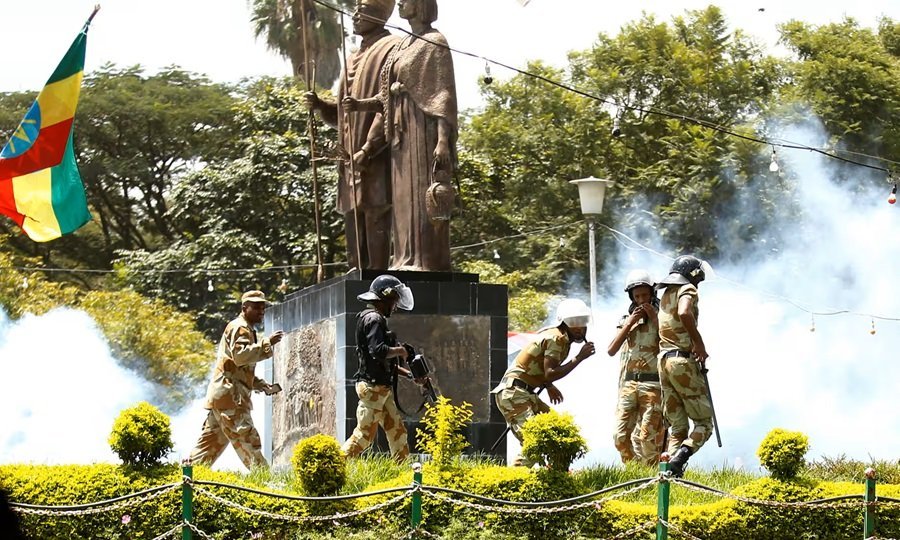
Ethiopia, the cradle of ancient civilizations and the pulse of the Horn of Africa, stands at an inflection point in its modern history. Shrouded by the shadows of recurring conflict, the nation teeters between its potential for renewal and the abyss of fragmentation. The searing tragedies of Salale, the violent awakenings in Amhara and Oromia, and the fragile peace in Tigray underscore a haunting reality: Ethiopia is at war with its own identity. Yet, amid the ashes of despair, embers of hope flicker – a promise of unity through bold reform, accountability, and collective action.
A Symphony of Suffering: The Cycles of Violence
From the harrowing beheading in Salale to the unyielding turbulence in Oromia, the echoes of violence ripple through Ethiopia’s history with a haunting familiarity. These tragic events are not isolated incidents but symptomatic of a profound national malaise – a systemic inability to address and reconcile the scars of its past. The rise of Amhara’s Fano militia, Oromia’s persistent insurgency, and Tigray’s precarious ceasefire collectively expose a singular truth: unresolved grievances, left to fester, inevitably metastasize into cycles of relentless conflict. This is Ethiopia’s reckoning – a karmic crucible that demands not merely palliative measures but a transformative approach to governance, justice, and reconciliation.
At the heart of Ethiopia’s political discourse lies ethnic federalism, a system as polarizing as it is misunderstood. Criticized by some as the architect of national fragmentation and lauded by others as the bulwark of minority rights, its true potential remains unrealized. While its implementation has often been weaponized to serve narrow interests, the system itself is not inherently flawed. Instead, it is the chronic misuse of its principles that has eroded its credibility. Reforming ethnic federalism – by addressing its ambiguities, ensuring equitable representation, and fostering mechanisms of accountability – offers a viable path to sustainable coexistence.
To dismiss ethnic federalism outright as the cancer corroding Ethiopia’s unity is to oversimplify a complex reality. Such claims, often propagated by self-proclaimed experts, ignore the fact that the system has never been tested to its fullest merit. Declaring its abolition without exploring its potential for fostering inclusion is both intellectually lazy and strategically perilous. The fallacy that disintegration stems solely from the framework itself undermines the critical discourse needed to refine it into a tool for unity rather than division. Ethiopia’s challenge, therefore, is not to discard its federal structure but to wield it with wisdom, integrity, and a vision for genuine equality.
The Blame Game: Breaking the Chains of Division
Prime Minister Dr. Abiy Ahmed’s administration has become the lightning rod for Ethiopia’s woes, yet history reveals that no single leader can be solely culpable for such deep-rooted crises. The seeds of discord were sown over decades by successive governments, each complicit in prioritizing power over people. Yet, this moment demands a higher standard of leadership. Abiy’s government must pivot from reactive governance to proactive reform, from rhetoric to tangible action. However, true transformation cannot emanate solely from the top. It requires the awakening of Ethiopia’s collective conscience – elders, intellectuals, civil society, and youth – united in purpose and vision.
Dr. Abiy Ahmed inherited the nation’s crises at their zenith – a point where tensions were already boiling over, and societal fractures ran dangerously deep. Instead of finding collaborative allies to address these challenges, powerful forces emerged to exploit the chaos, igniting violence and division. While his intentions may have been to heal the nation, Abiy inadvertently fell into traps set by actors driven by self-interest, destabilizing agendas, and a thirst for power. These were not crises of his making but long-brewing storms he was thrust into navigating. Yet, the nation cannot afford to linger in the mire of blame. Pointing fingers will not stitch the wounds of Ethiopia’s people. The time has come for solutions that transcend power struggles – solutions that do not carry the stench of bloodshed or the ambition of dominance but embody inclusivity, reconciliation, and justice.
As we stand in 2024, Ethiopia must embrace the reality that the era of exclusivity—where leadership was a privilege granted based on ethnicity or background – is over. Regardless of one’s origin, the only criteria for leadership should be merit, vision, and a proven ability to serve the nation. Ethiopia cannot afford to reject capable leaders or groups based on who they are, nor can it perpetuate notions of supremacy where one segment of the population claims ownership of the nation while others are seen as mere inhabitants. This is a time for equality, where every Ethiopian belongs fully, not just to their ethnic community but to the nation as a whole.
Forged in Fire: Reclaiming the Soul of Institutions
Ethiopia’s institutions have long been prisoners of ethnic and political loyalties, their integrity compromised by those entrusted to uphold them. The parliament envisioned as the bastion of democracy, echoes with empty platitudes and partisan bickering. Yet, these institutions possess the latent power to redefine the nation’s trajectory.
The Ethiopian National Dialogue Commission represents a rare beacon of hope. To succeed, this forum must transcend tokenism, embracing inclusivity and fearlessly addressing systemic inequities. This dialogue is not merely a political exercise; it is a moral imperative – a chance to transform Ethiopia’s fragmented soul into a harmonious collective.
From Dependency to Dignity: The Economic Imperative
Economic disparity remains one of the deepest wounds fueling Ethiopia’s unrest, paralleling the destructive impact of political discord. Generations of neglect have condemned most regions to cycles of poverty and disillusionment, leaving communities grappling with systemic inequities. While reliance on external aid has provided temporary relief, it also underscores a glaring weakness – the absence of a robust, homegrown strategy rooted in sustainability and inclusivity. To break free from this cycle, Ethiopia must prioritize investments in education, healthcare, and infrastructure, with a laser focus on neglected regions, transforming economic despair into the foundation of shared prosperity.
Encouragingly, the last few years have seen notable progress. Ethiopia has tapped into its mining sector, particularly gold, while agriculture continues to show promise. Ambitious mega-projects, such as plans to build Africa’s largest airport, corridor development programs, and major road infrastructure upgrades, signal a determination to modernize. Yet, these strides are overshadowed by the unrelenting echoes of conflict – the persistent sound of gunfire that reverberates across the nation, stalling its progress. Without addressing the root causes of this violence, economic achievements risk becoming fleeting victories rather than lasting transformations.
Ethiopia’s path to renewal lies in fostering innovation and embracing meritocracy. A nation where success is dictated by skill, talent, and dedication – rather than ethnicity or political allegiance – has the power to break free from the chains of dependency. Such a vision can ignite a revolution of dignity, empowering every Ethiopian to contribute to a collective renaissance that transcends division and lifts the nation toward its true potential.
Unity as a Revolutionary Act
Ethiopia’s survival lies in transcending the divisions that have long defined its narrative. Unity is not a platitude but a revolutionary act, one that demands courage and unwavering commitment from all sectors of society. The government must cultivate organic solutions—homegrown strategies born of empathy, equity, and resilience.
The National Dialogue Commission’s success depends on its ability to foster a culture of mutual respect and accountability. Ethiopia’s leaders, intellectuals, and citizens must confront their shared history, not with blame but with an unyielding determination to build a collective future.
Conclusion: Ethiopia’s Call to Destiny
The furnace of Ethiopia’s crises has the potential to forge a stronger, more unified nation. This moment is not merely a test of leadership but a crucible for the Ethiopian people to reclaim their identity. Through bold reforms, equitable governance, and a commitment to collective accountability, Ethiopia can rise as a beacon of hope in an uncertain world.
Knocking on Western doors in search of political solutions has proven to be a fruitless endeavor. It is a well-trodden path pursued by some hermitized intellectuals, tirelessly advocating under the guise of being custodians of Ethiopia’s destiny, yet their true aim often lies in securing power for themselves. These elites must redirect their gaze to the suffering of their own people – people burdened by problems they did not create, enduring hardships they should never have faced. Ethiopia’s salvation will not be found in foreign prescriptions or external interventions; it must arise from within.
Organic solutions, grounded in the wisdom and resilience of Ethiopia’s diverse communities, remain the only viable path forward. Dialogue, rooted in trust and inclusivity, offers the most promising avenue for reconciliation and renewal. The Ethiopian National Dialogue Commission, though imperfect, is a vital first step. If its flaws are acknowledged and addressed with integrity, it can evolve into a cornerstone of Ethiopia’s renaissance. This is a moment for courage, a time for unity, and a call for Ethiopians to embrace their shared destiny with hope and determination. Let this be the dawn of a nation that finds its strength not in division but in its collective will to rise above adversity.
The time for division has passed. The era of unity, courage, and action is here. Ethiopia’s destiny awaits, shaped not by the weight of its history but by the promise of its potential. Let this be the dawn of a nation reborn, a testament to resilience, and a triumph of hope over despair. May Ethiopia rise to claim its rightful place, not as a land defined by perpetual strife, but as a beacon of endurance, strength, and unity in an uncertain world.
The writer can be reached at : +251900644648
Editor’s note : Views in the article do not necessarily reflect the views of borkena.com
__
To Publish an Article On borkena , please send submission to info@borkena.com for consideration.
Join our Telegram Channel : t.me/borkena
Like borkena on Facebook
Add your business to Borkena Business Listing/Business Directory Jobs
Join the conversation. Follow us on X (formerly Twitter ) @zborkena to get the latest Ethiopian news updates regularly. Ethiopia To share information or for submission, send e-mail to info@borkena.com