

By Caleb Tadesse (Dr.)
Abba Kovner, a Jewish resistance leader during World War II and a poet, World War II, and a poet, was deeply committed to justice, resistance, and the survival of his people in the face of unimaginable adversity. His message was one of resilience, courage, and the importance of remembering history so that the horrors of the past do not repeat themselves.
For today’s Amhara people in Ethiopia, Kovner’s message might resonate as a reminder of the strength found in unity, resistance against oppression, and the preservation of identity and culture. His fight against the Nazis, his call for remembrance, and his emphasis on standing against injustice may serve as an inspiration to any people facing struggles or striving for justice and peace.
His words, “We shall not let them kill us without remembering,” could encourage the Amhara people to keep their history alive, stand firm in their beliefs, and push for the protection and dignity of their community, just as Kovner did for the Jewish people during one of history’s darkest times.
Abstract
Abba Kovner, a prominent Jewish resistance leader during the Holocaust, is widely recognized for his efforts to preserve Jewish identity and dignity amidst Nazi persecution. His call for resistance and self-defense became a moral imperative for Jewish survival. Similarly, contemporary activists advocating for the protection of the Amhara people in Ethiopia are engaged in a struggle for survival, identity, and empowerment against systemic ethnic violence and political exclusion. Both movements underscore the importance of resisting oppression to protect cultural heritage and human dignity. This paper explores the core messages of resistance from Abba Kovner during the Holocaust and compares them to the modern-day struggles of the Amhara people, highlighting the shared themes of defiance, survival, and the preservation of identity in the face of existential threats. By examining these parallels, the paper emphasizes the universal relevance of resistance movements in safeguarding human rights and cultural integrity.
Introduction
Abba Kovner, a Jewish resistance leader during the Holocaust, is celebrated for his role in organizing and leading resistance against Nazi persecution and preserving their dignity, culture, and identity. As a leader in the Vilna Ghetto and a prominent figure in the Jewish partisan movement, Kovner understood the Nazi plan for mass extermination and rejected the passive acceptance of death. His famous declaration in 1941—”Do not go like sheep to the slaughter!”—summed up his call for Jews to fight back against their persecutors rather than passively submitting to genocide (Kovner, 1941). Kovner’s message emphasized active resistance, both physical, cultural preservation, and ideological, to protect their humanity and the moral duty to preserve Jewish dignity in the face of overwhelming violence. At its core, Kovner’s message was a moral imperative to resist both physical extermination and cultural erasure. He rejected the concept of passive victimhood and called on Jews to defend not just their lives but also their dignity and identity. Kovner’s legacy remains a powerful reminder of the importance of resistance, the preservation of cultural identity, and the moral duty to stand against oppression and genocide. In parallel, contemporary activists advocating for the Amhara people in Ethiopia also champion the protection of cultural identity and survival in the face of political exclusion and ethnic violence. These modern-day struggles draw on similar themes of resistance, survival, and the preservation of human dignity. This paper will analyze the messages of resistance delivered by Kovner during the Holocaust and compare them to the present-day efforts to protect the Amhara people from systemic oppression and marginalization.
Abba Kovner’s Message of Resistance
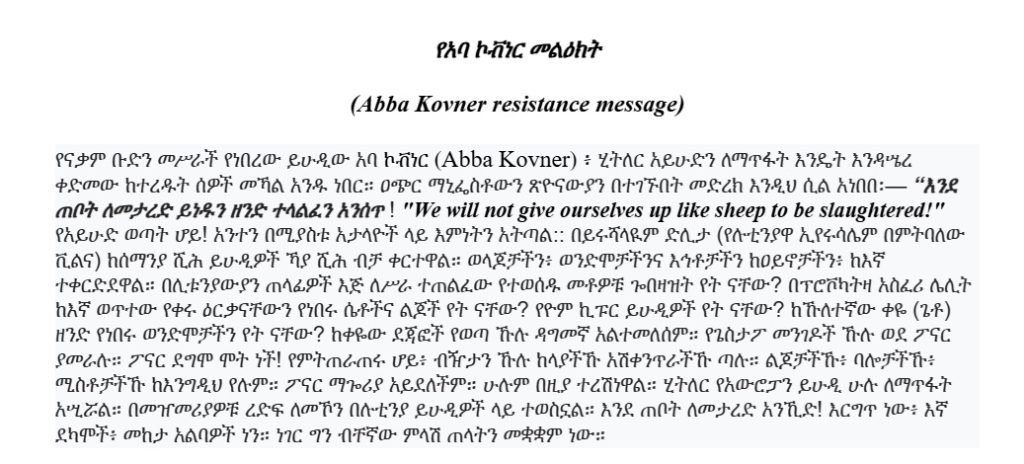
Abba Kovner’s call for resistance during the Holocaust was a response to the existential threat facing Jews in Europe. He famously urged his fellow Jews not to accept their fate as victims of the Nazis and to fight back. Kovner’s rallying cry, “Jews! Do not go like sheep to the slaughter!” was not only a plea for self-defense but a moral statement about the dignity and humanity of Jews, even in the face of systematic genocide (Kaplan, 2008).
As a leader of the Jewish resistance in the Vilna Ghetto, Kovner played a key role in organizing efforts to resist Nazi forces through sabotage and guerrilla warfare. Kovner’s efforts in the partisan movement sought to engage Jews in active defense, whether through armed struggle or sabotage, as a way to preserve their sense of identity and dignity in a time of extreme persecution. Kovner’s work as a poet and writer further reinforced these messages, emphasizing the importance of cultural survival and the moral duty to resist any forces that sought to erase Jewish history and identity (Shmuel, 2001).
Kovner’s resistance was not merely military; it was also a cultural and ideological fight to preserve Jewish memory, identity, and heritage. His emphasis on collective memory and historical documentation after the war demonstrated his deep belief that resistance included the obligation to ensure the history of Jewish suffering and defiance was recorded and remembered (Kaplan, 2008).
The Context of Kovner’s Message
Abba Kovner was deeply aware of the Nazi regime’s systematic extermination of Jews, which he had witnessed first-hand in the Vilna Ghetto (today’s Vilnius, Lithuania). At the time, the Vilna Ghetto housed around 80,000 Jews, but by 1941, Nazi atrocities had already decimated the community, leaving only about 20,000 survivors. Kovner’s call for resistance came at a time when many Jews were still being deceived into believing that deportation meant relocation, not death. He recognized that this misconception was part of a larger Nazi deception to facilitate mass exterminations without resistance. As a poet, leader, and partisan, Kovner made it his mission to warn his fellow Jews of their impending fate and to encourage them to resist.
“Do Not Go Like Sheep to the Slaughter”
One of Kovner’s most iconic moments occurred in 1941 when he made a speech to fellow Zionists in the Vilna Ghetto, urging them to resist Nazi efforts. This speech included his powerful words: “We will not give ourselves up like sheep to be slaughtered!” In this declaration, Kovner expressed the central tenet of his resistance philosophy: Jews must resist passivity in the face of annihilation. Kovner’s words were a rallying cry to the Jewish community to take up arms or other forms of resistance against the Nazi forces rather than submitting meekly to their fate. He was aware that the Jews of Europe were not only facing physical extermination but also a spiritual and cultural annihilation.
Kovner understood that Jewish resistance was not only about fighting back physically but also about asserting Jewish identity, culture, and dignity in the face of complete dehumanization. His call to arms was not just for those who could fight but for everyone to reject victimhood, and to uphold their humanity by defying the Nazis’ brutalizing agenda.
Contemporary Struggle for the Amhara People
The Amhara people in Ethiopia, a historically significant ethnic group, face a modern-day struggle against ethnic violence and political exclusion. Ethiopia’s federal system, designed to grant ethnic-based autonomy, has resulted in rising ethnic tensions, particularly between the Amhara and other regional groups. In recent years, the Amhara have faced significant violence and displacement, particularly from ethnic militias aligned with the Tigray and Oromo groups. Activists within the Amhara community argue that their people are being systematically targeted for violence, forced displacement, and denied political representation (Zerihun, 2020).
Amhara advocates stress the need for the international community to intervene and protect their people from ongoing violence, calling attention to the government’s inability or unwillingness to address Amhara’s grievances. These activists argue that the violence against the Amhara community is a form of ethnic cleansing, aimed at undermining their cultural identity and political rights. As such, the struggle for the Amhara people has become a fight for survival, not just through physical defense but also through efforts to preserve their cultural and historical legacy against forces that threaten to erase it (Mekonnen, 2022).
Similar to Kovner’s resistance, the advocacy for the Amhara people involves defending human dignity and resisting efforts to erase their cultural identity. Activists call for the preservation of Amhara identity and the recognition of their historical significance within Ethiopia’s diverse ethnic landscape. These efforts mirror Kovner’s broader message that survival is not just a matter of physical endurance but also of maintaining one’s heritage and sense of self (Zerihun, 2020).
Parallels Between Kovner’s Resistance and the Amhara Struggle
Both Kovner’s message of resistance and the modern-day struggle for the Amhara people are rooted in a similar moral imperative: the need to resist oppression in order to preserve identity, dignity, and humanity. Kovner’s fight against Nazi oppression was not only about survival but also about ensuring that Jewish culture, memory, and identity were not erased. Similarly, the Amhara activists’ call for the protection and empowerment of their people involves ensuring that their cultural heritage and political rights are not destroyed by external forces. Both movements emphasize that resistance is necessary to maintain human dignity and cultural integrity in the face of genocidal threats or systemic violence.
While Kovner’s resistance was largely a response to external aggression during the Holocaust, the Amhara’s modern struggle involves navigating political and ethnic violence within Ethiopia. However, both struggles share the theme of defiance against forces that seek to undermine or eliminate their respective communities. The call for resistance, whether through armed struggle or political activism, remains central to both movements as they seek to preserve their people’s dignity and future (Shmuel, 2001).
Abba Kovner’s message
Abba Kovner’s message to the Amhara people would likely resonate with the same themes of resilience, resistance, and the preservation of dignity that he emphasized during the Holocaust. As a Jewish resistance leader who fought against Nazi oppression, Kovner’s call to action was clear: it is better to resist, even at great cost, than to submit to the forces seeking to destroy one’s people, culture, and identity.
A message inspired by Kovner’s own words and philosophy might sound like this:
“To the people of Amhara, your courage and resilience echo the defiance of those, like my own people, who faced the darkness of genocide and oppression. In the face of overwhelming forces, we chose to resist, knowing that the cost of freedom is always worth the sacrifice. Better to fall as a free people than to live at the mercy of those who seek to destroy your identity, your history, your culture, your heritage, and your very existence. Stand tall in the face of oppression, for the price of freedom, your identity is worth every sacrifice. Arise, for even in your last breath, your defiance will resonate through history, inspiring generations yet to come. Your struggle for survival is a testament to the strength of the human spirit, and your resistance will be remembered as an act of courage that echoes through the ages.”

Conclusion
Abba Kovner’s resistance against the Nazi regime and the contemporary struggle of the Amhara people highlight the ongoing relevance of resistance in the preservation of identity and dignity. Both Kovner and the Amhara activists underscore the moral necessity of resistance in the face of oppression. Whether through armed partisan movements during the Holocaust or political advocacy in modern Ethiopia, these struggles reflect a universal message: the fight for survival is inseparable from the fight for cultural and human dignity. The parallels between these two movements demonstrate the enduring importance of resistance, not only for survival but also for the preservation of cultural heritage and the moral obligation to confront injustice.
References
Kaplan, L. (2008). Resistance and survival: Abba Kovner’s leadership in the Holocaust. Yad Vashem Studies, 35(2), 45-68.
Kovner, A. (1941). Declaration to the Jews of the Vilna Ghetto.
Mekonnen, S. (2022). Ethnic tensions and political crises: The case of the Amhara in Ethiopia. Journal of African Political Studies, 44(1), 12-29.
Shmuel, S. (2001). The Holocaust resistance: Jewish partisans in Lithuania. Jewish Historical Society, 23(1), 103-118.
Zerihun, K. (2020). Human rights and ethnic violence: The Amhara struggle in Ethiopia. Human Rights Quarterly, 42(3), 358-379.
Editor’s note : Views in the article do not necessarily reflect the views of borkena.com
__
To Publish an Article On borkena , please send submission to info@borkena.com for consideration.
Join our Telegram Channel : t.me/borkena
Like borkena on Facebook
Add your business to Borkena Business Listing/Business Directory Jobs
Join the conversation. Follow us on X (formerly Twitter ) @zborkena to get the latest Ethiopian news updates regularly. Ethiopia To share information or for submission, send e-mail to info@borkena.com