 anxiety but the cruelty, incompetence, and wicked profanity. Ethiopia... Read.)
Getahun Assefa
The 2024 Nobel Prize in economics was discerned to notable academics and researchers for their groundbreaking work on inclusive institutions as conduits of development. The lack of dynamic, sound, responsive, and inclusive institutions constrains Africa’s socioeconomic development. Ethiopia is no exception to this. The country remains busy fostering discriminatory, fragmented, and failed ethnic-based institutions. The underground hit squad established and financed by the regime committed crimes against humanity. It organized and led genocide against Amharas. Yet, the country’s rubber-stamp parliament refused to pay a one-second remembrance. It outrightly rejected the motion calling for offering a heartfelt prayer for the victims and comfort for surviving families. This was repeated when Amharas were exterminated in Mai Kadra (the Mai Kadra Massacres).
The parliament’s refusal to pray for peace and comfort was unheard of in the modern history of mankind. It is not only inhumane and barbaric but also a stark violation of the constitutional rights of citizens to work and live in peace everywhere in Ethiopia. It is a vivid institutionalized discrimination and collective punishment of the second-largest ethnic group in the country [Amharas]. The legislative arm of the government has miserably failed to uphold international human rights conventions and the country’s constitution to protect citizens. Instead, it aggravated atrocities and mass killings. As with the executive branch, the legislative arm of the government sided with the regime. It protected the army and technocrats involved in the killings of innocent civilians. Those who instigated and committed gross human rights violations (amounting to war crimes under international laws) were given legal protection. To date, there has not been a single member of the army or political elite brought to the court of justice. No accountability and responsibility for orchestrating and perpetrating the killings of hundreds of thousands of innocent Amhara civilians including pregnant women, children, and the elderly.
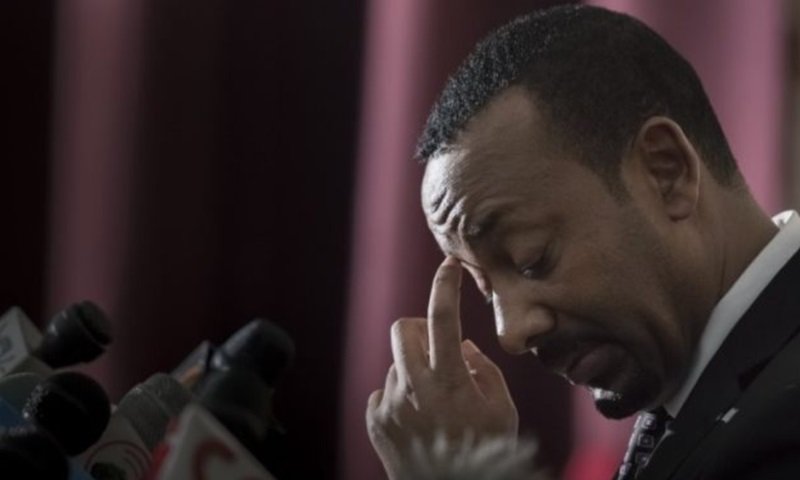
In the last couple of weeks, the government of Abiy Ahmed Ali (henceforth Abiy) has continued spreading its habitual lies and fabrication. He used the same parliament as a tool (machine) for propaganda and a springboard for his hatemongering. The legislative branch of the government has completely abandoned its check and balance role. It has effectively become a stooge for the political maneuver of the dictator. The well-known sham, blindfolding, and veneer characters of the ethnocratic regime exceeded any modicum of normality. Consequently, public conversations in Ethiopia are no longer confined to the usual chuckles for shameful and utter lies as well as the bigotry of the parliament. Instead, Ethiopians are raising serious questions about the mental state of the leadership and the future of the country: is Abiy mentally, okay? Does Ethiopia need discriminatory political institutions such as “parliament”?
Abiy’s regime continued to relentlessly carpet-bomb Amharas’ children, women, and the elderly- including at farm plots, schools, healthcare posts, monasteries, and mosques. It has been massively uprooting Amhra’s from their ancestral land and confiscating their lands and businesses. The gruesome crimes have been well documented by credible national and international media outlets as well as global rights defenders. The sufferings of Amhara’s in the hands of the regime are also corroborated by eyewitness accounts. The parliament remains cruelly cold, silent, or utterly deaf.
At the latest address to an obstinate parliament, Abiy was seen as a copycat of Kim Il Sung (an African Kim Il Sung)! The “Great Leader” could not believe himself while he was showered with accolades “for his transformational leadership”. His heart melted like butter on a hot stove when the usually dull and sleepy parliamentarians spoke about Ethiopia’s “prevailing peace, stability, and prosperity” through pre-prepared and pre-approved statements. Carefully selected parliamentarians (men and women) read statements of recognition of Abiy’s “exceptional qualities, maturity, and God-given leadership abilities”. They shamelessly claim that these unique attributes led to “unprecedented successes in diplomacy, regional stability, interethnic unity, economic prosperity and all-rounded transformation unprecedented in Ethiopia in centuries”. In a country of 130 million people where nearly 60 % are numerically and alphabetically illiterate, it is not surprising to find 547 members of the parliament as insensitive, imperceivable, dumb, and irreverent.
The statements and questions raised were deliberately engineered to camouflage the country’s collapsing state structure and institutions. They were intentionally made to soundly paint the country’s non-existing social, economic, and political progress and achievements. All the speakers were seen struggling to read pre-approved and officially pre-cleared political statements. Just for the record, Ethiopians have seen similar drama and acting by parliaments in the past. They have heard countless statements of honor, knighthood, and exceptional leadership qualities bestowed on the country’s political elites on several occasions under different regimes. However, such benightedness about and blind rejection of the country’s deep-rooted socioeconomic and political malaises have never been observed in the country’s recent history. Nor has there ever been such gross incompetence, inadequacy, and ineptitude to address the plights of more than 80 million people languishing in multidimensional poverty and manmade disasters.
Responding to an avalanche of accolades and pre-cleared questions, the “Great Leader” (an African Kim Il Sung) assured the parliament of Ethiopia’s continued “prosperity and transformation”. At a time when 25-30 million people were food-insecure and depended on food aid, he had no shame in ranting about Ethiopia’s unheard-of progress, wealth, and opulence. He declared “Ethiopia’s bumper harvest of wheat, oilseeds, coffee and tea and the 8.4 percent economic growth expected this year will be unparalleled in the developing world let alone Africa”. He added that “in the next few years, Ethiopia will surpass Vietnam as the second largest coffee exporter in the world”. He boasted that “under his leadership not only Ethiopia but also Africa and the rest of the world will be transformed, developed, and enjoy prosperity”. His objective is “to make Ethiopia among the largest 20 economies in the world in the next few years”, he claimed. Such a monologue reminds me of beautiful coinages in Orwell’s “Animal Farm” or “1984”: Poverty is wealth; destitution is prosperity; hunger and malnutrition are opulent; etc. Ethiopians have been rightly wondering whether they are hearing about another Ethiopia (utopia) or the actual Ethiopia. They don’t know if they can collectively laugh or cry.
What are the facts on the ground?
Humanitarian crises: While the parliament appeases Abiy for ensuring peace and political stability in the country, Ethiopia is being dilapidated by ethnic wars and tribalism. Every day, hundreds of innocent civilians are being killed in drone attacks and bomber jets deployed by the regime. Since 2018, millions have been killed, uprooted, displaced, and forced to live in Nazi-style concentration camps. Close to 2 million citizens have perished in the Tigray war and the currently ongoing wars in the Amhara region. More than 25 million citizens are made hungry and forced to live on food handouts donated by Western aid agencies. Hundreds of thousands of Amharas are evicted and killed in the Oromia region – Abiy’s ethnic and political base. And close to 6.5 million live in makeshift camps in that region alone.
According to the Oslo Institute of Peace and Conflict Studies 2024 report, 2.9 billion children under the age of 18 (76% of the world’s children) were living in conflict-affected countries in 2023. This shows a sharp increase from the 1.7 billion estimated in 2022. While Asia’s historically conflict-ridden countries such as Afghanistan, Myanmar, and Pakistan saw their respective shares of war-affected children diminishing, in Africa, countries such as Ethiopia, DRC, and Sudan are rare exceptions where the number of children impacted by and living in war zones have skyrocketed since 2022. As a result, in 2023 alone, “approximately 264 million conflict-affected children lived in high-intensity conflict countries, (i.e. countries with more than 1,000 battle-related deaths). From Africa, Ethiopia, and Sudan top this list as well. Moreover, the recent reports of UNICEF and UNESCO raised an alarm bell and serious concern that “more than 11 million Ethiopian children in conflict-affected regions [largely in Amhara region] are out of school”. Most of their schools and related infrastructure were also destroyed by drones and fighter jets of the regime. These devastating conflicts are imposed by an arch-dictator, a ruthless and cowardly individual, leading the ethnocratic regime in Ethiopia under the eyes of the international community.
Ethiopia is one of the few countries in the world that spends more on defense, hateful propaganda, and the latest armaments than on education, health, and development projects combined. Moreover, competing ethnonationalism, corruption, and devastating interethnic conflicts resulted in fast-collapsing state structures, crowning Ethiopia with a failed state status. This situation is what the regime and its rubber stamp parliament declare as “peace, interethnic harmony, and political stability”.
Failed economy and outmoded economic policy: The deliberately orchestrated interethnic conflicts, ethnic bias in scarce resource allocation, nepotism, and ethnic entrepreneurship made the performance of the Ethiopian economy weak and sluggish. Economic growth remains fragile with widespread impoverishment or generalized poverty situation. The country’s overdependence on foreign aid and remittances has significantly increased over the years. Without foreign aid and charities, the Ethiopian economy remains in an “intensive care unit” or a state of permanent coma for years to come. The combination of foreign aid, mismanagement, and irresponsible borrowing of the regime created a vicious circle of liquidity crunches, corruption, and external indebtedness. Ethiopia has already defaulted on private EURO bond repayment obligations and is officially classified as a debt-distressed nation. These politically induced crises, combined with poor macroeconomic management, corruption, and extravagant spending patterns of Abiy’s regime, have led the country’s economy to an eternal quagmire. Hyperinflation, unemployment, devalued national currency vis-à vis international currencies, and the regime’s preoccupation with white-elephant (vanity) projects remain a permanent threat to the country’s economy. War, political instability, and a weak macroeconomic environment continue to undermine the capacity of the Ethiopian economy to generate decent employment opportunities and reduce extreme poverty. If these situations persist, Ethiopia’s survival as a nation will be compromised and the collapse of the regime inevitable.
The recently launched 2024 Multidimensional Poverty Index (MPI), jointly published by UNDP and Oxford University’s Poverty and Human Development Initiative (OPHI), sent a shockwave and troubling message across policymakers, academics, and researchers alike. Unsurprisingly, the MPI shows that “poverty rates in countries affected by conflict such as Ethiopia are nearly three times as high as compared to countries not affected by conflict. “Nearly half a billion people (out of 1.1 billion people in acute multidimensional poverty around the world) live in conflict settings, hindering and even reversing hard-won progress to reduce poverty”. In Africa, with nearly 80 million people (out of the estimated 130 million), Ethiopia tops the list. It is such a disastrous socioeconomic outcome, that the parliament graced Abiy for his “outstanding leadership and astounding economic success”. The parliament’s “act of generosity” reminded me of the famous and widely quoted statement of Martin Luther King: “Nothing in the world is more dangerous than sincere ignorance and conscientious stupidity”, although I do not believe that there is “sincere ignorance” or “conscientious stupidity”. For me, there only exists untaught ignorance and moronic idiocy or stupidity. The Ethiopian parliament is a classic example of how institutions, like human beings, manifest archaic idiocy and moronic stupidity in the face of glaring facts and empirical evidence.
Ethnic allegiances over meritocracy: Abiy’s intrinsic characters explode when he speaks to the Oromo political elites. He tries hard to unnecessarily justify himself that he is the sole champion of Oromos’ rights and privileges. His innermost hate particularly towards Amharas and Tigrayans uncovers when he gets angry or provoked. He laments like a five-year-old spoiled child against the two ethnic groups. He collectively called Tigrayans cancers to the Ethiopian nation. Likewise, he publicly insults Amharas as shroud and barking dogs. Such hate-mongering, uncivilized, and unhinged behaviors have never been heard from a political leadership in recent Ethiopian history. Consequently, Abiy lost all the credibility and trust of citizens at large including his ethnic group. However, the parliament gave him an “A” for his catastrophic leadership which does not even deserve an “F”.
Abiy grew up in and morphed from the Ethiopian People’s Revolutionary Front (EPRDF) led by Meles Zenawi- an architect of ethnic federalism in Ethiopia. Likewise, the national parliament is a mere collection of “ethnic decorations”. As with the case during Zenawi’s regime, Abiy’s and his parliament’s political mainstay is ethnicity and ethnic federalism. Both systems strongly believed in ethnic identities and ethnic allegiances, seriously undervaluing meritocracy and national unity. Trusted and ethnic loyalists crowded government functions, the parliament, and political portfolios. People with no knowledge, expertise, or experience are given senior government positions and political portfolios so long as they belong to a certain ethnic group(s). Incompetence and lack of expertise superseded knowledge, expertise, professionalism, and professional ethics. For the regime and its parliament, it’s a collective ethnicity that builds robust institutions, enhances innovation, and develops a nation (not the knowledge and capabilities of individuals).
The two successive regimes negate all historical, empirical, and scientific evidence that emphasizes the role of individuals, entrepreneurship, and educated societies as the leitmotiv of transformational development. Instead, they stressed ethnicity and ethnic entrepreneurship as the foundation for self-enrichment and maintaining political power. The only difference between the two is that Zenawi’s regime antagonized the Tigrayan ethnic group by painting it as the sole beneficiary of the system. Whereas Abiy’s regime exploited the historical rivalry between the Oromo and other ethnic groups to its advantage. However, such diabolical and selfish power-mongering strategies miserably failed in the past and will fail again. That is, as much as Zenawi’s Machiavellian divide-and-rule strategies failed to sustain ethnic extortions and exploitation that victimized the Tigrayan ethnic group, Abiy’s will face the same fate. Now, the Ethiopian people, notably Amharas, Tigrayans, and (even) Oromos are fighting Abiy’s regime tooth and nail. The regime’s eventual failure and inevitable collapse of state structure will be seen sooner than later.
Conclusions
The worst thing in a dictatorship is not widespread (public) anxiety and apathy against political leadership. Rather it is the cruelty, incompetence, and wicked profanity of the legislative and executive branches alike. How come the two government branches are so naïve, irresponsible, and incapable of saying no to one mindless, unhinged, and born dictator who is also an utter liar? How come they become so insensitive and heartless to vulture on poor people’s hopes and aspirations for freedom, peaceful coexistence, and decent lives? Such failed and discriminatory institutions supporting and preserving political elites that violate the rules of law will only entrench poverty, deprivation, and mass destitution. Making public institutions responsive to the needs of the population above all requires inclusivity, equity, and equality of justice and fairness.
I am increasingly convinced that dictatorship ruined Africa more than slavery and colonialism combined. But for Ethiopia, dictatorship is a real curse. It propagates interethnic conflicts centered on weak and dysfunctional institutions. Without effectively addressing incompetence, ethnic diatribes, and reversing collective punishment of our citizens under naked ethnocratic arch-dictatorship, Ethiopia will continue to languish as a land of the impoverished, sick, and hungry. Nowhere in the world have failed and discriminatory institutions and dictatorships ever brought positive socioeconomic changes. Nor will they ever bring any meaningful change in Ethiopia. Therefore, they must be banished altogether. It is time for Ethiopians to get united to rid our country of failed leadership and dysfunctional institutions.
Editor’s note : Views in the article do not necessarily reflect the views of borkena.com
__
To Publish an Article On borkena , please send submission to info@borkena.com for consideration.
Join our Telegram Channel : t.me/borkena
Like borkena on Facebook
Add your business to Borkena Business Listing/Business Directory Jobs
Join the conversation. Follow us on X (formerly Twitter ) @zborkena to get the latest Ethiopian news updates regularly. Ethiopia To share information or for submission, send e-mail to info@borkena.com