
borkena
Toronto – As Somalia takes its military and diplomatic campaign against Ethiopia to a new level – this time inviting the Egyptian Military to Somalia Soil, Ethiopia responds by formally sending its Ambassador to Somaliland, Ambassador Teshome Shunde.
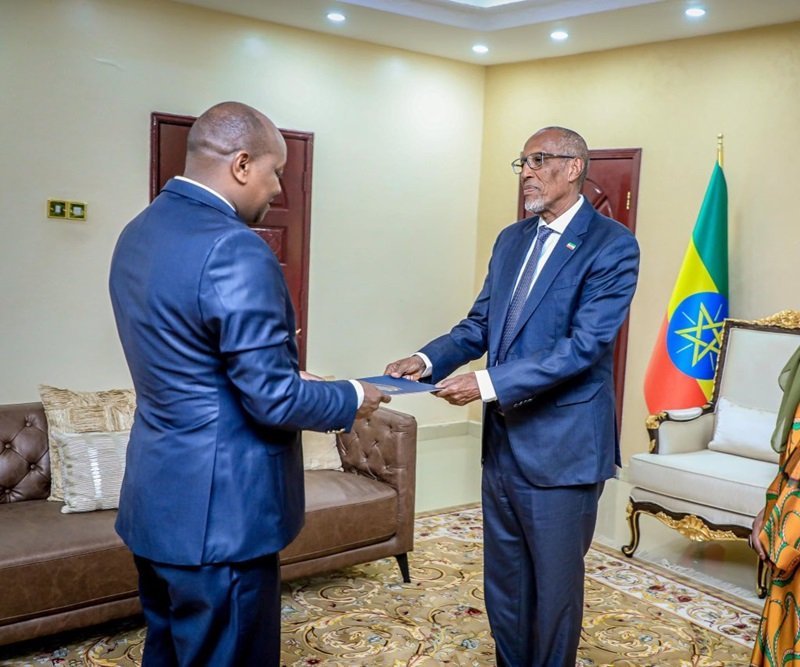
The Office of Somaliland President on Thursday announced that president Muse Bihi received the credentials of newly appointed Ethiopian Ambassador to Somaliland, Ambassador, Teshome Shunde Hamito.
The Deputy Foreign Affairs Minister of Somaliland, Ambassador Rhoda J Elmi, remarked :
“We warmly welcome Ambassador Teshome Shunde to Somaliland. His appointment comes at a pivotal time when the strong bilateral relations between our two sisterly nations continue to grow. We are confident that his tenure will enhance collaboration in areas of shared interest, fostering greater peace, development, and prosperity for both our peoples.”
In reaction to Egyptian military presence in Somalia, Ethiopia’s Ministry of Foreign Affairs on Wednesday released a statement saying that “Ethiopia can not sit idle while other actors are taking measures to destabilize the region.”
Tension between Ethiopia and Somalia developed after the former signed a Memorandum of Understanding (MoU) with Somaliland to pursue what Ethiopia calls reliable access to the sea. Hassan Sheikh Mohammed’s government was outraged, making claims that the deal with the break away region that existed as a de facto state for more than 33 years constitutes “violation of Somalia’s sovereignty.”
Egypt, a country known to have hostile relations with Ethiopia because of the Grand Ethiopian Renaissance Dam (GERD), exploited the tension between Somalia and Ethiopia and signed a defense pact with the former.
The United States and its European allies have not yet remarked about the new development – the deployment of Egyptian troops in Somalia.
__
Join our Telegram Channel : t.me/borkena
Like borkena on Facebook
Add your business to Ethiopian Business Listing / Ethiopian Business Directory
Join the conversation. Follow us on X (Formerly Twitter) @zborkena to get the latest Ethiopian News updates regularly. Subscribe to YouTube channel To share information or for submission, send e-mail to info@borkena.com
Why Ethiopia is so alarmed by an Egypt-Somalia alliance
Ian Wafula BBC 30/08/2024
On New Year’s Day, Mr Abiy signed a controversial deal with the self-declared republic of Somaliland to lease a 20km (12-mile) section of its coastline for 50 years to set up a naval base.
It could also potentially lead to Ethiopia officially recognising the breakaway republic – something Somaliland is pushing hard for.
Somalia fears such a move might set a precedent and encourage other countries to recognise Somaliland’s independence, geopolitical analyst Jonathan Fenton-Harvey told the BBC.
He added that neighbouring Djibouti was also worried it could harm its own port-dependent economy, as Ethiopia has traditionally relied on Djibouti for imports.
In fact in an attempt to deescalate tensions, Djibouti’s foreign minister has told the BBC his country is ready to offer Ethiopia “100%” access to one of its ports.
“It will be in the port of Tadjoura – 100km [62 miles] from the Ethiopia border,” Mahmoud Ali Youssouf told BBC Focus on Africa TV.
Attempts so far to calm tensions – by Turkey – have failed, with Somalia insisting it will not budge until Ethiopia recognises its sovereignty over Somaliland.
Somalia has not only brought its Nile enemy Egypt into the mix, but also announced that Ethiopian troops would not be part of the AU force from next January.
Last week, the Somali prime minister also said Ethiopia would have to withdraw its other 5-7,000 soldiers stationed in several regions under separate bilateral agreements – unless it withdrew from the port deal with Somaliland.
Egypt sees Ethiopia’s Nile dam – in the west of the country – as an existential threat – and has warned in the past that it will take “measures” should its security be threatened.
Experts say neither can afford further warfare – and more unrest would inevitably lead to further migration.
Dr Khannenje told the BBC that if a conflict broke out, it could further complicate the geopolitics of the Red Sea by drawing in other players and further affect global trade.
At least 17,000 ships go through the Suez Canal each year, meaning that 12% of annual global trade passes through the Red Sea, amounting to $1tn (£842bn) worth of goods, according to shipping monitor Lloyd’s List.
For this reason, countries like Saudi Arabia, the United Arab Emirates (UAE) and Turkey have been keen to forge partnerships with African nations like Somalia that border the Red Sea.
Oh Egypt, take heed. You will certainly be hoisted by your own petard
I don’t get it how this could be any change and an added value from former military agents/:spies for the rgime when there is nol official and real change of the wider policy and international relations aspect. This is only child play for Abiy and by himself. I guess
Abiy ahmad who once said he would be happy to work as an american agent is a puppet who would go the length to please his western masters. Without any backing from britain and america he would not attempt such a disasterous journey with somaliland. (formerly known as British somali land). To begin with Somaliland was created by Britain by partitioning somalia along clan/ethnic lines. so that Britain would fulfill its colonial ambition in the horn of africa. which would give it a foothold along one of the main shipping /naval routes along the red sea.
Behind Abiy Ahmad, is the hand of Britain who is encouraging him to give (british)somaliland a full diplomatic recognition, this would then open the way for others to do the same. Britain has some sort of relations with somaliland , and it will be easier for them to give full diplomatic recognition if otherr countries do it. Abiy Ahmad is the wessenger boy for the old colonial master.