
Bruke Lemma, PhD
“When dictatorship is a fact, revolution becomes a right.”
“A revolution is a struggle to the death between the future and the past.”- Victor Hugo
In the nations of Ethiopia and Myanmar, few political commentators or observers had predicted the rise of forces capable of overthrowing the entrenched, degenerative terrorist dictatorial regimes in both countries. The oppressive regimes, inflicting suffering upon their respective populations, were ill-prepared for such a challenge, thus they were caught entirely off guard by these unforeseen events they had failed to anticipate.
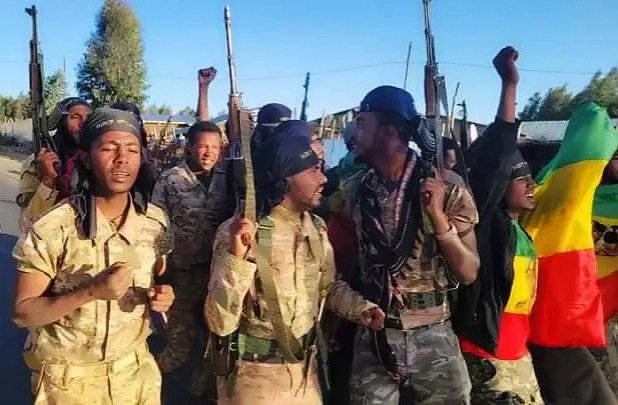
The remarkable ascendance of the Fanos in Ethiopia and the highly effective coalition of resistance forces in Myanmar over recent months has been an extraordinary phenomenon to witness. Both groups have achieved successive victories against their respective dictatorial regimes that have impressed many commentators and observers.
The Fanos confronting Abiy Ahmed’s regime in Ethiopia continue to provoke extreme fear and upheaval within the regime’s hierarchy. While the regime has a well-known history of disregarding the human rights of the population, the emergence of the Fanos has pushed the regime completely over the edge. Now, it has resorted to committing egregious and widespread war crimes and crimes against humanity in a desperate attempt to cling to power and shield itself from the genuine threat posed by the Fanos.
Meanwhile, in Myanmar, the coalition of resistance forces persist in effectively challenging the entrenched military junta—a regime characterised by rather unorthodox belief systems and worldviews. These encompass adherence to conspiracy theories, mystical and occult beliefs, consulting fortune tellers, and performing rituals, among other peculiar beliefs.
In Ethiopia, a nation that has endured the oppressive reign of three successive dictatorial regimes, spanning decades, with each outdoing the other in tyranny, the current epitome of this oppressive history is Abiy Ahmed’s regime, arguably the most incompetent, inept beyond measure, deeply corrupt, arrogant and by far the cruellest.
This regime, similar to its counterpart, the Myanmar Military Junta, adheres to unorthodox beliefs, specifically, a prosperity cult, fortune-telling, and various other peculiar and unconventional beliefs while it has been terrorising and tyrannising the nation for the past five years. The ethno-nationalist regime also mirrors its precursor, the TPLF, both embracing a homemade ‘ethno-nationalist’ ‘ideology’ that exploits ethnic grievances to pillage the country, enriching their own ethnic elites while operating very much in the manner of a mafia gang.
Under Abiy Ahmed’s ethno-mafia regime, the entire nation has been engulfed in unending conflict instigated by the regime, resulting in the tragic loss of more than a million lives, predominantly youth. The conflicts have led to the widespread destruction of vital infrastructure, including health facilities, schools, and others; more than five million people have been internally displaced, while an alarming thirty million people now teeter on the brink of hunger and starvation, with thousands already succumbing to these dire conditions.
The nation’s economy has plummeted into a severe downturn, grappling with uncontrollable inflation and an officially downgraded debt rating that now rests within junk territory. Moreover, the country recently defaulted on its external debt, precipitating far-reaching consequences.
The regime has incarcerated almost all journalists, intellectuals, opinion leaders, and even politicians who dare to express dissent, even in the mildest forms, confining them in disease ridden makeshift prisons all over the country. This appalling situation exposes the country’s best and brightest to disease and hunger, continually subjected to and humiliated by an unjust legal system that truly serves only the dictator, Abiy Ahmed and his cronies.
The emergence of the Fanos came about in a landscape already scarred by widespread death, destruction, and continual turmoil perpetuated by Abiy Ahmed’s regime. While this pervasive oppression targeted anyone not aligned with the regime, the Amhara people, the ethnic group from which the Fanos emerged, faced particularly severe treatment.
This included ethnic cleansing from the Oromia region, characterised by extreme violence including mass murders, the destruction of hundreds of thousands of homes belonging to the Amhara Ethiopians living on the outskirts of the capital, Addis Ababa, and severe restrictions on their movements, among other abuses of their human rights. What’s more, the regime has unleashed its cruelest war against them in the Amhara region, utilising the entire defence army—now effectively functioning as a private military serving only one man, Abiy Ahmed.
Much like the TPLF before it, Abiy Ahmed’s regime perceives the Amhara people, one of the largest ethnic groups, as a direct threat to its ethnic hegemony—the complete takeover of the country by Oromo elites. The deliberate exclusion of the Amharas and other ethnic groups from influential positions, while favouring Oromo elites and their allies, is instrumental in perpetuating the regime’s unchecked corruption—a pervasive culture of theft and lawlessness that defines the Abiy Ahmed’s regime.
Under Abiy Ahmed’s administration, the country has spiralled into a realm where abductions for ransom, assaults, sexual violence, and beatings occur with impunity, devoid of any avenue for legal recourse. Diplomats, typically protected under international protocols, have not been immune to the regime’s aggression and disregard for the rule of the law. Recently, security forces who were working closely with the Prime Minister himself and his finance minister viciously assaulted two high-level diplomats from an African Development Bank, AfDB.
These diplomats, who accidentally uncovered the embezzlement of millions of dollars, were attacked, and their residences vandalised without due legal process, compelling the AfDB to immediately withdraw all its staff from the country due to safety concerns. This starkly demonstrates how Abiy Ahmed has fostered an environment akin to a criminal playground,
devoid of accountability, allowing thieves and robbers, including himself and his associates, to operate without any constraints – the Prime Minister, operating now, as the thug in chief!
The Fanos who stood up against Abiy Ahmed’s army and achieved consecutive victories, have earned widespread respect and appreciation not only from the Amhara people but from all Ethiopians who are disgusted by the thug in chief and his cronies. They stand as the sole force capable of halting the criminal regime of Abiy Ahmed and his corrupt ethno-mafia gang, which relentlessly terrorises the entire populace, pushing the country now toward a complete abyss.
The regime, apathetic to the country’s plight, directs its entire budget solely toward procuring drones and weaponry to suppress its people. In many parts of the country, public servants remain unpaid, and vital services have come to a halt. The regime’s exclusive agenda now is waging war against its own population, aiming to cause as much harm as possible. Unfortunately, much of the world has remained silent amidst these grave atrocities.
In Myanmar, an unfortunate country that has been under the thumb of a military junta since their 1962 coup, a regime much like Abiy Ahmed’s terrorises and tyrannizes the population by weaponizing ethnicity, among other things.
Dominated by the Bamar ethnic group, the junta has fuelled ethnic tensions by promoting Bamar supremacy, both to consolidate power and enrich its members. This approach sowed seeds of resistance across diverse ethnic groups, some seeking autonomy, others separatism, and many simply yearning for democracy. Decades of conflict followed.
Faced with mounting pressure, the junta reluctantly allowed a short-lived experiment with partial democracy, culminating in Aung San Suu Kyi’s electoral success. However, this glimmer of hope was extinguished in 2021 with a brutal coup, sparking nationwide protests and a resilient civil disobedience movement.
2023 witnessed a significant development: existing resistance groups, including the Brotherhood Alliance, joined forces in a unified coalition. Their combined efforts yielded a remarkable feat – the capture of a growing number of towns, over four hundred military outposts and strategic locations from the junta. This unexpected victory shattered the regime’s aura of invincibility and sent shockwaves through the nation.
While the junta remains a potent force, wielding superior firepower and controlling key areas, the coalition of resistance forces including the Brotherhood Alliance’s success demonstrates its vulnerability. Crucially, it underscores that with sustained support and unwavering unity around a shared vision for Myanmar’s future, including the preservation of its territorial integrity, the regime can be further challenged and potentially toppled.
However, while the shared dream of a democratic federal Myanmar unites these diverse groups, the path forward remains fraught with challenges. Meticulous negotiation and compromise are crucial to flesh out the details of this shared vision, ensuring it reflects the aspirations of all Myanmar’s people.
Still, few dared to imagine such a potent alliance emerging, let alone achieving such resounding victories against the entrenched military junta, masters of exploiting ethnic divisions. Yet, these groups have defied expectations, proving that unity and purpose can shatter even the most formidable obstacles.
If they could overcome the junta’s divide-and-conquer tactics and forge this powerful coalition, surely, they can also come together to forge a shared vision for the country, one that embraces the aspirations of all. Let us hope they do.
While reading those and other details in a recent New York Times op-ed discussing Myanmar’s united resistance forces puncturing the military junta’s perceived invincibility, I found myself drawing immediate parallels with Ethiopia’s own valiant Fanos, who more than punctured the aura of invincibility of Abiy Ahmed and his army, scoring victory after victory, just as the Myanmar coalition of forces are continuing to do, sparking the thoughts behind this article.
Both emerged in 2023 as beacons of hope, demonstrating remarkable unity and organisation against formidable regimes. While their ethnic compositions differ – Myanmar’s resistance consisted of a diverse tapestry, whereas the Fanos predominantly represented a single group unified under a single banner across a vast territory – their narratives echo powerful parallels of resistance and victory against deeply entrenched forces.
In Myanmar, the diverse groups united to form the resistance coalition, with the Brotherhood Alliance playing a pivotal role, have delivered significant blows to the junta by seizing towns after towns, including taking control of hundreds of military posts and other strategic locations. Their ongoing success would benefit from sustained international support, both in material aid and moral backing, and, critically, their ability to craft a unified vision for a democratic, federal Myanmar that honours the aspirations of all its people.
Likewise, the Fanos, emerging predominantly from a singular ethnic group, have consistently secured significant victories against Abiy Ahmed’s oppressive regime. Their ongoing progress hinges on preserving robust internal cohesion, establishing a more unified structure, and consistently conveying a coherent political message to counter the regime’s propaganda—areas where they’ve shown remarkable progress but still require further improvement.
Moreover, it is imperative for the Fanos to broaden their alliances beyond their own ethnic boundaries, forging coalitions across diverse ethnic lines. Such coalitions could play a pivotal role in swiftly dismantling Abiy Ahmed’s regime.
Both the Myanmar coalition of democratic resistance forces and the Fanos epitomise vital lessons in the fight against tyranny, demanding urgent global attention. They embody the transformative power of unity, organisation, and a collective vision for a brighter future. Their ongoing struggles underscore the pressing need for international engagement.
In response to the success of the resistance forces, these regimes have resorted to brutal tactics against unarmed civilians, causing widespread destruction and casualties through airstrikes, including the use of bomber jets that indiscriminately devastate vast regions.
Abiy Ahmed’s regime has employed heavy weaponry directly targeting civilians and resulting in countless casualties. The regime continues to perpetrate egregious acts, including widespread drone attacks that indiscriminately kill innocent civilians, particularly in the Amhara region. Despite Abiy Ahmed’s regime’s inability to provide salaries to public servants or adequate services to citizens, it has continued to invest in acquiring drones and other lethal weapons.
The lack of robust global condemnation in the face of these heinous atrocities is deeply concerning. Such silence could be perceived as encouragement by human rights abusers and war criminals like Abiy Ahmed and key members of the Myanmar’s military junta terrorising the populace there. However, silence in the face of such atrocities cannot be tolerated.
The United States and other nations have the capacity to play a crucial role by exerting pressure on these regimes through targeted sanctions, weapon restrictions, advocating condemnation via the United Nations, and employing other diplomatic measures. These actions are vital to curtail severe human rights violations and pave the way for the establishment of inclusive democracies, aligning with the earnest aspirations pursued by these groups.
The New York Times op-ed that sparked this reflection highlights the existing framework for promoting democracy in Myanmar, including the Burma Act. This framework commendably showcases the United States’ commitment to democratic values. However, despite this framework, the pace of tangible support for these democratic groups remains sluggish.
As the op-ed emphasised, Congress, policymakers, and other stakeholders must expedite their efforts to provide crucial support to these resistance forces. This accelerated assistance is essential in bolstering their efforts to secure continued victories against the military junta. It is not only vital for their ongoing successes, but also pivotal in dismantling the oppressive regime and ultimately fostering a democratic transformation in Myanmar.
Myanmar’s coalition of resistance forces challenging the military junta have achieved a remarkable feat that extends beyond their victories. They have transformed the seemingly futile struggles of Myanmar’s diverse ethnic minorities, battling against Bamar ultranationalist dominance, into a unified pursuit for a collective democratic future.
This united front, while upholding the nation’s territorial integrity, seeks equality and justice for all citizens, transcending individual ethnic aspirations. Their shared vision of a prosperous and equitable future serves as a compelling motivation and stands as a crucial component in their quest for freedom—worthy of robust support from the U.S. and its democratic allies.
While Myanmar’s resistance coalition has received some valuable support, there remains a substantial disparity between their needs and the current level of assistance, a gap that demands immediate attention as highlighted in the op-ed. However, the situation faced by the Fanos in Ethiopia necessitates even more urgent action and demonstrates a far greater neglect.
In Ethiopia, the oppressive Abiy Ahmed regime has instigated multiple conflicts, resulting in widespread death and devastation that has pushed the country backward by decades.
Numerous reports from both national and international organisations confirm this dire situation: Almost all opposition figures in the country, including journalists, intellectuals, and even members of parliament who dared to express mild criticism or ask timid questions, have been imprisoned under deplorable conditions in makeshift prisons. Thousands of youths are being apprehended daily and incarcerated in remote locations.
Drones ruthlessly claim countless lives each day in the Amhara region, where the country’s national defence forces, acting as a private army for the dictator, Abiy Ahmed, continue to perpetuate mass murders, robberies, and the deliberate destruction of civilian vital infrastructures including health facilities and schools. There are also disturbing reports of the deliberate burning of crops in the fields in many parts of the Amhara region, an atrocious act aimed at starving the Amhara population.
Millions of displaced Amhara people face immense hardship and uncertainty across the country. Recently, reports have emerged of the regime attempting to relocate some of them back to areas from which they were forcibly displaced by regime-aligned forces. These locations lack any genuine safety guarantees, potentially exposing them to further abuses away from public scrutiny if they are to return. Their desperate pleas for help find little acknowledgement, tragically adding to the litany of injustices inflicted by the Abiy Ahmed regime.
These forced relocations into unsafe areas, against international law, along with the multitude of documented human rights violations against the Amhara people, highlight the pervasive brutality of the Abiy Ahmed regime. In this dire situation, the Fanos stand as the only force actively resisting these abuses and advocating for the protection of the Amhara people.
The Fanos stand resolutely against Abiy Ahmed’s continued human right abuses, including ethnic cleansing and genocide and war crimes that he and his regime have been committing against the Amhara people, representing the sole counterforce against the regime’s oppression. Their courage and sacrifice deserve recognition and support by the international community including the United States, Canada, Australia and others.
The international community must urgently hear the desperate pleas of those suffering under Abiy Ahmed’s regime’s brutalities. The widespread use of drones against civilians, killing countless mothers, children, the elderly and others, is a blatant violation of human rights and should be condemned in the strongest possible terms. Every effort must be made to hold the regime accountable for these atrocities.
Interestingly, the Times op-ed briefly mentioned the National Unity Government (NUG), a civilian entity formed in response to the Military junta that emerged after the 2021 coup, deploying units equipped with drone capabilities in recent conflicts against the military junta. While the article lacks specifics regarding the NUG’s drone capabilities and deployment methods, it’s plausible to consider their potential offensive and defensive application against the military junta’s drone attacks as a significant advantage.
This potential, along with their plausible roles in intelligence gathering and surveillance, presents an intriguing opportunity for the Fanos to explore developing such capabilities, should
it is within their means. While significant global aid for the resistance currently appears limited, there’s a chance for this to shift as the Fanos continually demonstrate discipline, effectiveness, and success, contrasting with the continued incompetence and brutalities exhibited by the Abiy Ahmed’s regime.
These contrasting traits might lead both active and passive supporters to renounce the regime, potentially vocalizing their opposition. In the meantime, it remains critical for the Fanos to mobilize all available resources to persist in dismantling Abiy Ahmed’s regime, with the continued steadfast support of the Amhara people and the broader Ethiopian community.
_
Editor’s note : Views in the article do not necessarily reflect the views of borkena.com
__
To Publish an Article On borkena , please send submission to info@borkena.com for consideration.
Join our Telegram Channel : t.me/borkena
Like borkena on Facebook
Add your Business to Ethiopian Business Listing /Ethiopian Business Directory
Join the conversation. Follow us on twitter @zborkena to get the latest Ethiopian news updates regularly. To share information or send a submission