
By Borkena Staff
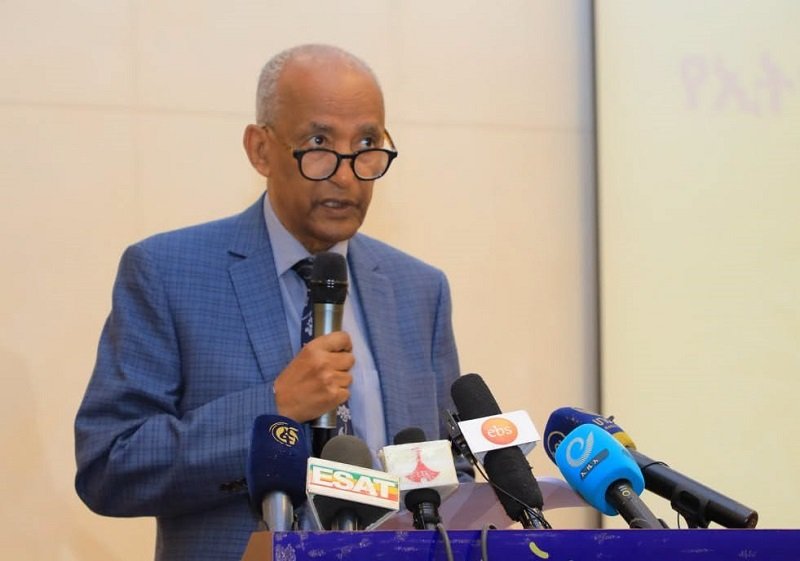
Borkena, Toronto — Ethiopia’s National Dialogue Commission on Wednesday announced eight major agenda areas it has compiled since its establishment. The issues are expected to be discussed during the upcoming national dialogue scheduled for next month.
The Commission reported that more than 2,000 agenda items were collected during the consultation process.
However, it presented only eight broad categories, each containing multiple sub-themes.
The eight main agenda areas are:
- Nation-building
- Government structure and system
- Addis Ababa & Dire Dawa governance
- Religious issues
- Rule of law, institutions & human rights
- Social & economic issues (including farmers & pastoralists)
- Corruption & good governance
- Peacebuilding & conflict resolution
The Commission said it consulted more than 200,000 people both inside and outside the country. It described the process as “inclusive.” In addition to those engaged in the agenda-setting exercise, it also opened participation to individuals, civic organizations, and government bodies.
The issue of Article 39 of the current constitution, which stipulates “right for self-determination including secession,” and the status of Addis Ababa—over which radical Oromo nationalist groups, including Prime Minister Abiy Ahmed’s party, claim exclusive rights—are among the key issues expected to be discussed in the upcoming dialogue.
Despite claims of inclusivity and independence, the National Dialogue Commission has faced criticism over transparency, neutrality, and representation. Critics have pointed to vague criteria in selecting individuals to represent communities across different regions, with some alleging that participants are aligned with the ruling party.
Opposition parties have also criticized the process as partisan and government-influenced, with major opposition groups boycotting it.
Similarly, several diaspora organizations have rejected the Commission, arguing that it is neither fully inclusive nor independent, and accusing it of favoring the ruling party.
Armed groups operating in the country were entirely absent in the process. The commission has expressed concern about it.
__
Join our Telegram Channel: t.me/borkena
Like borkena on Facebook
Join the conversation. Follow us on X (formerly Twitter) @zborkena to get the latest Ethiopian news updates regularly. Subscribe to the YouTube channel. To share information or for submission, email info@borkena.com
It was the duty of the National Dialogue Commission to organize the public feedback to ultimately lead to a system that can tackle the current high inflation, an increasingly high cost of living, ethnic-based kidnapping, displacement and murder of civilians, a pervasive air of insecurity all over the country, destruction of places of worship, schools and health facilities, and mass killings of innocent citizens and thousands of youth in a senseless civil war.
To achieve this difficult task, the Commission would have done much better if it had first studied the 1987 Constitution very carefully to interface it with our current national problems. It would have been also more effective if its Chairman had been a well-read and experienced political scientist or a distinguished constitutional lawyer instead of being a mental health professor. The same also applies to other members of the Commission.
My contribution here will be limited to only two groups of items: (a) Some important elements that need change in the current Constitution, and (b) missing essential elements in both the 8-theme agenda and the Constitution.
(a) SOME ELEMENTS THAT NEED TO BE CHANGED IN THE CURRENT CONSTITUTION.
The 8-them agenda appears to suggest that the Commission has not recognized the sources of all our current social, economic and political problems:
(i) Article 39 is clearly unnecessary if all citizens are equal under the law. Meles and Lencho were above the law and knew their Constitution was undemocratic and oppressive so that they needed to prepare for an inevitable secession. However, if we enact a democratic constitution and everybody is equal before the law, then this article will not be necessary.
(ii) the 9 kililils were fabricated by TPLF-OLF for 9 select tribes, putting our remaining 74 tribes to live under the policies, dictates and whims of the select 9, with no regard for equality with any of the select 9, and hence with no rights to be part of Article 47(1) as members of the republic; the cities of Addis Ababa and Dire Dawa have been similarly forgotten.
(iii) our current constitution is neither federal nor democratic, and gives a free hand to the Executive branch of the Government to dictate on all national issues, including war and foreign affairs.
(iv) The House of the Federation is largely led and managed by Kilil officials (see Article 61)who are all appointees of the Prime Minister under our permanently one-party system, with authority (see Article 62) to order all three branches of the “federal” government, including the Prime Minister, the parliament and the judiciary, thereby violating Article 52 of the Constitution.
(v) All western democratic nations have several ethnic groups, but none divide their country into ethnic regions and none ever make special laws for ethnic groups or for different religions. In Ethiopia, ethnic rule has fully discredited itself, first in Tigray and now in Oromia where rule by kith-and-kin has led to poverty, insecurity, and death through corrupt rule during the last 50 years.
It is, therefore, time to drop the blind worship for ethnicity and adopt the democratic system of the West (UK, USA, Germany, etc.) in its most complete form to get out of the current ethnic mess.
The Commission’s agenda 3 retains the House of the Federation which has been a source of incompetence and poor governance over the last 30 years, and Agenda 2 appears to suggest Kilil will also remain to help create further chaos and civil war. What the Commission does not see is that 83 kilils cannot be created for our 83 tribes in Ethiopia to ensure equality of all tribes and, consequently, the types of conflicts that Oromia has been creating to annex portions of all its neighboring kilils will continue to generate more deaths, more displacement and more civil war.
(b) MISSING ELEMENTS BOTH IN THE 1987 CONSTITUTION AND IN THE 8-THEME AGENDA.
To achieve peace, all political prisoners need to be set free.
We need an independent JUDICIAL REVIEW body since the House of the Federation needs to be erased under its current form.
Article 55 of the Constitution is inadequate to control Government officials that violate the Constitution. We need a stronger constitutional provision like that in the UK and USA, to enable us to dismiss a criminal leadership and then take it to court.
As the backbone of our national security, national defense forces, our livelihood and our economy, our farmers and አርብቶ-አደሮች need Government subsidies for essential inputs; the US allocates billions of Dollars and EU budgets billions of Euros to ensure the growth and survival of their rich farmers every year. We have to do that too as a government priority.
The tasks of the National Defense Forces need to be clearly defined and the authority to declare war should be in the hands of an informed and credible civilian group.
Amharic has been used as an official working language for centuries, irrespective of the Emperors’ ethnicity ; it is written and widely spoken. Politicizing language should stop, much like the whole world’s use of English from a great nation where, at one time, “The Sun never sets in the British Empire.” was true.
In conclusion, the 8-theme agenda does not suggest any constructive change or show that lessons have been learnt from our gloomy past, perhaps suggesting lack of independence from its authors. It is time that we show we are tired of an undemocratic and backward rule after suffering under its yoke for well over 50 years and 7 failed elections.
Where can we find the entire report and detailed outlines on the dialogue agenda prepared by the commission written in English? I would appreciate it very much if some one graces us with the link.
I have said this many times in the past. The old country we all left behind and that produced us all is at a point it has never been there before. Since 1974 it has gone through communism, ‘developmental democracy’, ethnic conflicts and now this. This is it. There are two ways that will lead to two destinations. One will lead to where the country going belly up with its people butchering each other like mortal wild animals. The 2nd one starts with its ‘know-betters’ getting their acts together, find their mojo so that gem of the colored and humanity will be on its way to the Promised Land’ where there will be no one above the law with security and stability so the country’s citizens have inalienable rights to life liberty and pursuit of happiness.
Because we have no access to reflect our views, and the tour led by some of the commission leaders seemed not to be to the point, I put my observations as follows:
For a nation like Ethiopia struggling with ethnic, religious, and political conflicts with the outcome of bloodshed causing the loss of hundreds of thousands during recent civil wars, such as in Badme with Eritrea, the so-called independent country (though there is no clear basis for Eritrea’s independence from Ethiopia) much of the supply of basic commodities and income originates from Ethiopia. This includes more than half a million native Eritreans living in Ethiopia, including refugees, while Eritrea has the largest refugee population in Africa. The initial conflict and all civil wars are intricately linked with that region.
The major topics of the commission’s agenda look fine as follows:
1. Nation-building – The nation of Ethiopia continues to build itself despite many challenges threatening its existence. The public should discuss how to strengthen it.
2.Government structure and system – The government structure is federal, which is good, but with shortcomings. It is based on ethnicity, which brings hostility over various issues, making some ethnic groups feel like foreigners in their own country.
3.Addis Ababa & Dire Dawa governance – Both cities must be autonomous as they have diverse populations from all major and minor ethnic groups. The fight for dominance by ethnic groups must be removed through an inclusive process.
4.Religious issues – Separation of religion and government must be implemented in Ethiopia according to international law. The recent official support of the government for religious institutions like the Waqf must be stopped.
5.Rule of law, institutions & human rights – Rule of law is essential, but there are significant shortcomings that restrict the nation’s growth due to lack of proper law enforcement in many parts of the country.
6.Social & economic issues (including farmers & pastoralists) – Social and economic conditions must be addressed free from political interference, which is the key factor behind poverty.
7.Corruption & good governance – Corruption is the cancer of every nation, especially developing ones. Serious legal measures must be implemented along with awareness and education programs.
8.Peacebuilding & conflict resolution – Peacebuilding and conflict resolution are key factors for a nation’s survival and must be included in state policy and all educational systems so that future generations live in peace instead of endless civil wars.
Degone Moretu, Pastor