
By Mohamud A. Ahmed – Cagaweyne

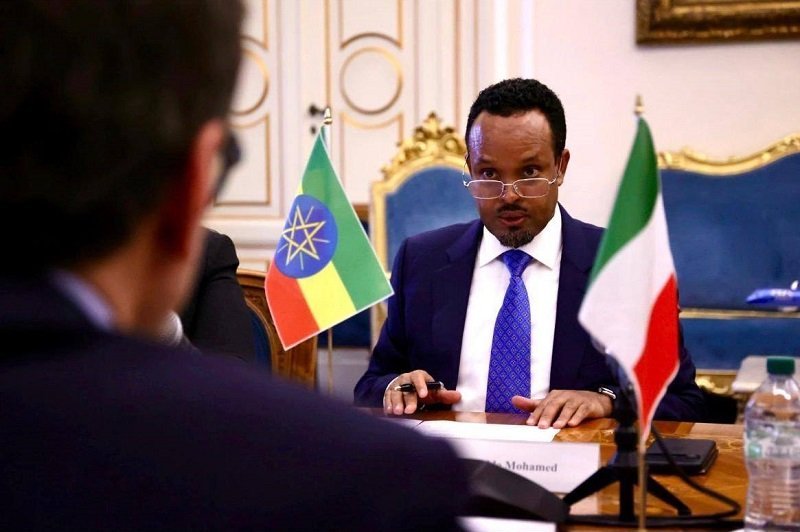
Is Ahmed Shide truly indispensable, or has the narrative of indispensability itself become a convenient fiction in a climate increasingly drawn to intrigue over evidence? That question lingered with me after reading a recent Facebook post by Koki Abesolome, a piece I found myself returning to several times over the course of a few hours. Not because it persuaded , but because it compelled reflection.
Its confidence was unmistakable, its structure intricate, and its claims sweeping. It carried the rhythm of authority, the tone of insider knowledge, and the vocabulary of political economy. It is precisely this kind of writing, intellectually adorned and assertive in tone, that demands not passive acceptance but disciplined scrutiny.
Before proceeding, a note of intellectual candor is necessary. Ahmed Shide remains the only full ministerial portfolio holder representing the Somali Region within the current federal arrangement, and I, too, come from that region. It would therefore be easy, perhaps even expected, for some to read what follows as a reflexive defense. I would urge the opposite. This is not written in the spirit of regional alignment or political shielding. If anything, proximity imposes a higher burden of rigor. It requires one to interrogate more carefully, not less, to separate sentiment from structure, and to engage arguments on their merits rather than their emotional resonance.
The post in question advances a sweeping thesis, one that suggests Ethiopia’s fiscal architecture, particularly in times of conflict, rests upon a concealed compact between Prime Minister Dr. Dr. Abiy Ahmed and his finance minister. It argues that off-budget war financing is not merely incidental but systematically orchestrated, that financial flows are quietly redirected from productive sectors to military expenditure, and that Shide’s continued presence is indispensable not for governance, but for the preservation of secrecy itself. It is an argument that borrows heavily from the lexicon of political economy, presenting conjecture with the cadence of expertise and inference with the posture of fact.
Yet there is a subtle but important distinction between sounding analytical and being analytical. The more polished the narrative, the greater the obligation to examine its foundations. What initially appears as structured reasoning begins, upon closer inspection, to reveal itself as a chain of assumptions, each leaning on the next, none firmly anchored in verifiable evidence. Complexity, when detached from proof, ceases to illuminate. It begins instead to obscure.
The first point of tension lies in the substitution of terminology for demonstration. Concepts such as off-budget financing, executive discretion, and mutual dependency are invoked with fluency, yet nowhere are they substantiated through documentary evidence. There are no cited audit discrepancies, no procurement anomalies, no inconsistencies in fiscal reporting, and no disclosures from oversight institutions. The argument relies instead on the persuasive power of language. In serious financial analysis, however, terminology is not evidence. It is merely a descriptive tool. When it replaces verification, analysis quietly gives way to speculation, and speculation, when dressed in technical vocabulary, can easily be mistaken for insight.
Closely related is the reliance on tenure as a proxy for indispensability. Ahmed Shide’s extended service is presented as evidence that he must be the custodian of hidden financial structures. Yet continuity in a finance ministry, particularly in a country navigating debt restructuring, macroeconomic reform, and external financing negotiations, is not unusual. It is often a deliberate choice. Institutional memory matters. Negotiating with creditors, managing reform programs, and maintaining fiscal coherence require familiarity with systems that cannot be easily transferred overnight. Experience explains presence. It does not, on its own, substantiate claims of concealed financial architecture.
The treatment of international financial institutions in the post further illustrates this analytical drift. The suggestion that a single minister can mislead organizations such as the International Monetary Fund or the World Bank reflects a misunderstanding of how modern financial governance operates. These institutions do not function on personal assurances alone. Their engagement is structured through periodic reviews, quantitative performance benchmarks, fiscal reporting requirements, and safeguard mechanisms designed precisely to detect inconsistencies. Disbursements are not acts of trust but outcomes of verification. Data is scrutinized, not simply received. To imply that such frameworks hinge on the discretion of a single individual is to underestimate the institutional architecture that governs them.
Equally problematic is the notion that only two individuals possess a comprehensive understanding of Ethiopia’s wartime financing. This idea, while rhetorically compelling, belongs more to political theater than institutional reality. Modern public finance systems, even in states with governance challenges, operate through layered bureaucracies. Treasury departments, central banks, procurement agencies, military finance units, and reporting frameworks all intersect. Opacity may exist, but it is rarely centralized. It is often fragmented, dispersed across systems that are themselves imperfectly coordinated. To reduce this complexity to a two person arrangement is to simplify a system that is, by its very nature, resistant to such reduction.
The comparative cases introduced in the post, Sudan, Syria, Russia, and Rwanda, appear at first to lend weight to the argument. Yet comparison without structural context risks becoming analytical theater. Each of these countries operates under distinct historical, institutional, and geopolitical conditions. Their fiscal systems, revenue sources, and wartime economies differ in fundamental ways. To align them superficially with Ethiopia is to substitute thematic similarity for analytical precision. True comparative political economy demands more than parallels. It requires equivalence in structure, context, and institutional behavior.
Perhaps most revealing is what the argument leaves unsaid. Ethiopia’s macroeconomic challenges are neither hidden nor inexplicable. Debt distress, foreign exchange shortages, inflationary pressures, structural reform costs, and the fiscal consequences of conflict are all well documented. These visible dynamics provide substantial explanatory power. They do not require an unseen architecture to make sense. To bypass these realities in favor of a concealed narrative is not depth. It is displacement, an inclination to privilege intrigue over empiricism.
This is not to suggest that concerns about transparency are unfounded. They are not. Even institutions such as the International Monetary Fund have emphasized the need for improved fiscal reporting, broader coverage of extrabudgetary entities, and stronger oversight mechanisms. These are legitimate areas of concern. But there is a critical distinction between identifying gaps and asserting covert systems. The former invites investigation. The latter demands proof. Suspicion may initiate inquiry, but it cannot conclude it.
The concept of indispensability, when examined more closely, also begins to lose its analytical coherence. Individuals matter in governance, particularly in moments of economic fragility, but systems rarely hinge entirely on one person. States adapt. They recalibrate, sometimes imperfectly, sometimes with friction, but they do not simply collapse because a single official departs. Institutional relationships with creditors, debt structures, fiscal frameworks, and administrative processes are broader than any individual. To elevate indispensability beyond this reality is to transform analysis into mythology.
What the post ultimately reveals is less about the hidden architecture of Ethiopia’s financial system and more about the power of narrative in environments shaped by uncertainty. It demonstrates how easily complexity can be mimicked, how readily terminology can substitute for evidence, and how quickly suspicion can be mistaken for certainty. It is a reminder that in political discourse, the appearance of sophistication can often obscure the absence of substantiation.
A more disciplined inquiry would proceed differently. It would examine budget execution reports, audit findings, extrabudgetary accounts, contingent liabilities, and foreign exchange allocation mechanisms. It would seek documents rather than impressions, data rather than drama. It would ground its claims in evidence rather than elevate its language to compensate for its absence. It would ask not what sounds plausible, but what can be demonstrated.
Ahmed Shide may indeed be valuable to Dr. Dr. Dr. Abiy Ahmed, but that value can be explained through continuity, experience, and institutional familiarity. There is no need to construct an elaborate theory of concealed financial architecture without evidence to sustain it.
In the end, the question is not whether suspicion is warranted. It often is. The question is whether suspicion has been mistaken for proof. And in that distinction lies the boundary between commentary and analysis, between narrative and knowledge, and ultimately between what we are told and what can be known.
The Mohamud A. Ahmed – Cagaweyne is Columnist,Political and Security Analyst, and Researcher with Greenlight Advisors Group – Somali Region of Ethiopia. He can be reached at +251 900 644 648 or +254 759717898 (WhatsApp)
Editor’s Note : Views in the article do not necessarily reflect the views of borkena.com
__
Join our Telegram Channel : t.me/borkena
To Support Borkena : https://borkena.com/subscribe-borkena/ – one time support or small monthly options available. Inquire information about it : info@borkena.com
Like borkena on Facebook
To submit Press Release, send submission to info@borkena.com
Add your business to Ethiopian Business Listing / Ethiopian Business Directory
Join the conversation. Follow us on X (Formerly Twitter) @zborkena to get the latest Ethiopian News updates regularly.
It is funny you are arguing with a former world bank economist Koki Abeselom (Dr. Yonas Biru). It is clear you are a die hard PP supporter so you don’t need to jump to protect them without knowing who you are defending them from. Sorry for you and the likes so called educated but bend for position and finance.