
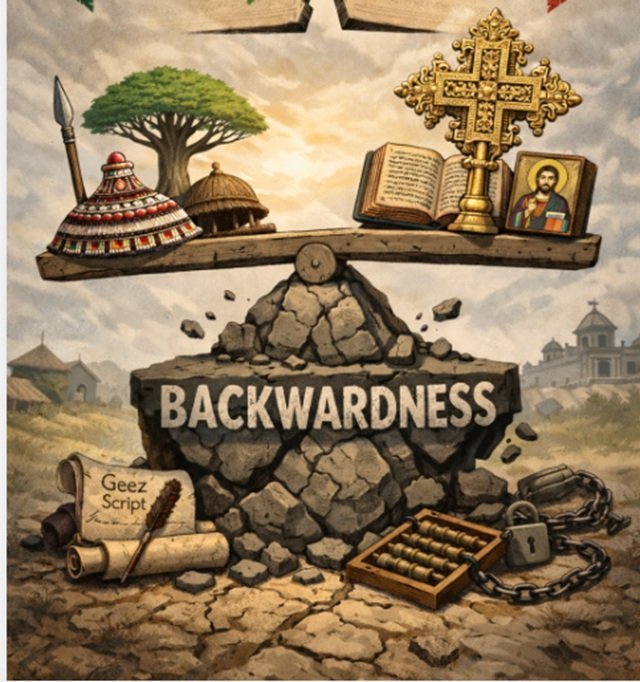
By Tsegaye Mulushoa
Abstract
In this short article, I intend to examine recurring claims in the public commentary of Dr. Yonas Biru (also calls himself on Social Media as Koki Abeselome) , focusing on three interrelated issues: (1) the comparison between the Gadaa System and Geʽez language, (2) the construction of equivalence among contemporary Ethiopian political actors, and (3) assertions linking religion to economic underdevelopment. Drawing on Ethiopian historiography, political anthropology, and comparative political economy, the article argues that these claims rest on category confusion, institutional conflation, and selective empirical reasoning. By clarifying distinctions between linguistic traditions and governance systems, the article contributes to ongoing debates on Ethiopian political thought and the methodological challenges of civilizational analysis.
- Introduction
Debates over history, identity, and political legitimacy have become increasingly prominent in Ethiopian public discourse, particularly among diaspora intellectuals. Within this context, Yonas Biru has emerged as a visible and controversial commentator whose work frequently employs broad historical comparisons and civilizational claims.
One recurring argument is the proposition that the Gadaa System and Geʽez language constitute equivalent civilizational frameworks. While rhetorically compelling, this comparison raises important methodological concerns. Specifically, it conflates distinct categories of social organization and risks obscuring the institutional diversity that characterizes Ethiopian history.
This article evaluates three dimensions of such claims: (1) the comparison between Gadaa and Geʽez, (2) the construction of equivalence among contemporary political actors, and (3) the relationship posited between religion and economic development. The central argument is that these claims rely on analytical imprecision that weakens their explanatory value.
- Conceptual Distinctions: Language And Governance
The Geʽez language is a classical Semitic language preserved primarily within the Ethiopian Orthodox Tewahedo Church and the Eritrean Orthodox Tewahedo Church. It functions as a written and liturgical medium, sustaining religious knowledge, textual continuity, and ecclesiastical authority (Pankhurst 2001).
By contrast, the Gadaa System is an indigenous system of governance practiced by the Oromo people. It organizes political authority through age-based generational classes and cyclical leadership (Legesse 1973).
These two institutions differ fundamentally in their analytical category: Geʽez is a linguistic and textual system, whereas Gadaa is a socio-political institution. Treating them as equivalent therefore introduces a category error.
Civilizational Comparison and Category Error
The claim of equivalence between Gadaa and Geʽez rests on the assumption that they represent comparable civilizational units. However, as S. N. Eisenstadt (2008) argues, civilizations are constituted by multiple interacting dimensions, including symbolic systems, institutions, and social structures. Analytical clarity requires maintaining distinctions among these dimensions.
Literacy and Orality
Geʽez belongs to a literate tradition, characterized by written transmission, codification, and institutional memory. This enables the preservation and standardization of knowledge across generations.
The Gadaa System operates primarily through oral transmission, relying on ritual practice and intergenerational knowledge. As Donald Levine (2000) notes, Ethiopian society has historically incorporated both literate and oral systems, each with distinct modes of organization.
Institutional Function
Geʽez serves a religious and intellectual function, embedded in liturgical and theological practice.
Gadaa serves a political and legal function, structuring governance, authority, and social regulation.
Following Charles Tilly (1992), conflating distinct institutional forms undermines comparative analysis by obscuring their specific logic and functions.
Structure and Authority
Geʽez is defined by standardized script, canonical texts, and interpretive traditions.
Gadaa is defined by cyclical leadership, age-grade organization, and distributed authority.
These differences reflect distinct organizational principles—textual versus institutional—rather than comparable civilizational units.
- Political Equivalence And Institutional Context
The tendency to equate the Oromo Liberation Front (OLF) with Fano is not merely analytically weak, it is politically misleading. Such comparisons flatten fundamentally different trajectories of organization, legitimacy, and popular support.
The OLF emerged as an ideologically driven nationalist movement with a long history of armed struggle and political mobilization (Jalata 2012). However, its legacy remains deeply contested, particularly in light of recurrent allegations of violence against civilians in areas where OLF-affiliated or splinter groups have operated. For example, multiple reports over recent years have documented attacks on Amhara civilians in parts of western and southern Oromia Region, often attributed by local communities and regional authorities to armed factions linked to the broader OLF movement. While attribution in conflict settings is complex, these patterns have contributed to enduring perceptions of insecurity and grievance among affected populations.
By contrast, Fano, particularly as it has consolidated under leaders such as Zemene Kassie, has evolved into a mass-based resistance movement grounded in claims of community defense and political representation. Far from being a loosely organized militia, Fano increasingly operates as a coordinated force with articulated political objectives, including the reconfiguration of state power and the protection of Amhara populations.
Supporters argue that Fano now exercises substantial influence across the Amhara Region and reflects widespread local backing. Within this perspective, its legitimacy derives not only from mobilization capacity but from a perceived role as a guarantor of security in the absence or failure of federal protection.
Equating such a movement with the OLF ignores these critical distinctions. As Christopher Clapham (2018) emphasizes, political actors must be understood within their institutional and historical contexts. Fano’s emergence is tied to specific experiences of insecurity, contested state authority, and grassroots mobilization, rather than to a singular ideological project.
A more accurate analysis therefore recognizes Fano as an ascending political force one that blends territorial influence, popular support, and strategic ambition. Under figures such as Zemene Kassie, it represents not simply a regional militia, but a movement seeking national political transformation. Reducing it to an equivalent of the OLF obscures both its distinctive character and its growing significance in Ethiopia’s evolving political landscape.
Religion and Economic Development
The assertion that religion inherently produces economic underdevelopment is not supported by comparative evidence. Highly religious societies—including the United States, Israel, Saudi Arabia, and United Arab Emirates exhibit varied economic trajectories.
Empirical studies (Barro and McCleary 2003) demonstrate that religion influences economic behavior in complex ways, while Max Weber (2001) highlights the contingent relationship between religious ethics and economic systems. Broader institutional factors remain more decisive (Acemoglu and Robinson 2012).
- Conclusion
Hence, the conclusive argument is that:
- The comparison between the Gadaa System and Geʽez language reflects a category error that conflates linguistic and political institutions.
- Claims of equivalence between actors such as the Oromo Liberation Front and Fano obscure critical institutional differences.
- Assertions linking religion to economic underdevelopment lack empirical support.
Greater analytical precision is essential for advancing scholarly and public debates on Ethiopian history and politics.
References
Acemoglu, Daron, and James A. Robinson. 2012. Why Nations Fail: The Origins of Power, Prosperity, and Poverty. New York: Crown.
Barro, Robert J., and Rachel M. McCleary. 2003. “Religion and Economic Growth Across Countries.” American Sociological Review 68 (5): 760–781.
Clapham, Christopher. 2018. Transformation and Continuity in Revolutionary Ethiopia. Cambridge: Cambridge University Press.
Eisenstadt, S. N. 2008. “Civilizational Identity and Cultural Memory.” International Sociology 23 (6): 671–691.
Jalata, Asafa. 2012. Oromo Nationalism and the Ethiopian Discourse. Trenton, NJ: Red Sea Press.
Legesse, Asmarom. 1973. Gada: Three Approaches to the Study of African Society. New York: Free Press.
Levine, Donald N. 2000. Greater Ethiopia: The Evolution of a Multiethnic Society. Chicago: University of Chicago Press.
Lyons, Terrence. 2007. “Conflict-Generated Diasporas and Transnational Politics in Ethiopia.” Conflict, Security & Development 7 (4): 529–549.
Pankhurst, Richard. 2001. The Ethiopians: A History. Oxford: Blackwell.
Tilly, Charles. 1992. Coercion, Capital, and European States, AD 990–1990. Oxford: Blackwell.
Weber, Max. 2001. The Protestant Ethic and the Spirit of Capitalism. London: Routledge.
Editor’s Note : Views in the article do not necessarily reflect the views of borkena.com
__
Support Borkena : https://borkena.com/subscribe-borkena/
Join our Telegram Channel : t.me/borkena
Like borkena on Facebook
Add your business to Ethiopian Business Listing / Ethiopian Business Directory Business Listing Toronto
Join the conversation. Follow us on X (Formerly Twitter) @zborkena to get the latest Ethiopian News updates regularly. Subscribe to YouTube channel To share information or for submission, send e-mail to info@borkena.com
__
Support Borkena : https://borkena.com/subscribe-borkena/
Join our Telegram Channel : t.me/borkena
Like borkena on Facebook
Add your business to Ethiopian Business Listing / Ethiopian Business Directory Business Listing Toronto
Join the conversation. Follow us on X (Formerly Twitter) @zborkena to get the latest Ethiopian News updates regularly. Subscribe to YouTube channel To share information or for submission, send e-mail to info@borkena.com
Yonas’s analysis putting Gadas Oromouma primtive social organization with Geesze Semitic linguistic script is a mockery. But I am more alarmed by your presentation that Fano is a Democratic armed Organization comparing with OLF .For independent observer the difference is geography not ideology both are narrow ethnic nationalist have nothing ingredients in their souls to be a Democratic Organization.
Indeed Yonas is a jester parading in a western monkey suit. He is irrelevant and uses sensationalism to get attention. He will remain an outcast as he claws for some crumbs from his benefactor Abiyot Ahmed Ali.
Fano and OLF are certainly distinctly different in ideology and purpose. OLF formerly has for over 50 years had an incoherent and reductionist narrative. Paul Henze after surveying the OLF for several years surmised that “the OLF eying the OLF in the 1980s surmised correctly “ OLF is an amateurish, unfriendly, and dysfunctional organization.” And a threat to the stability of Ethiopia.
Fano on the other hand is well organized, has been and continues to defeat Abiyot’s regime mercenaries and mechanized forces in its than 3 years of establishment.
Fano is fighting to once and for all defeat/bury the existential threat against Amharas which started from the 1973 Derg junta. And eventually the stabilization of Ethiopia and the Ethiopian people.