
By Amsal Woreta
Captain Ibrahim Traoré’s ascension to power in September 2022 at the age of thirty-six represents a significant shift in Burkina Faso’s political landscape. His rise to the presidency coincides with changing public attitudes toward military governance, as evidenced by polling data indicating 66% of Burkinabé now accept military rule—a substantial increase from the 24% recorded in 2012. This transformation in public sentiment merits scholarly examination, particularly as it occurs against the backdrop of broader political transformations across the Sahel region.
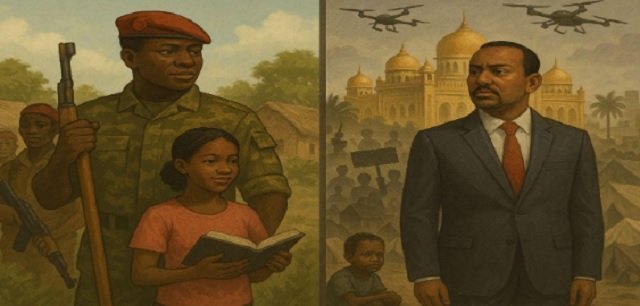
Traore ́ ‘s governance approach bears distinct parallels to Thomas Sankara’s revolutionary leadership of the 1980s, primarily in its emphasis on economic sovereignty and national self-determination. Despite Burkina Faso’s challenge on the Human
Development Index, where it ranks 185th out of 193 countries, certain economic indicators suggest notable progress has occurred, with extreme poverty declining from 83% to 27.7% between 1990 and 2023. However, this statistical improvement requires contextual analysis within the broader regional economic trends.
The current administration’s policy orientation focuses explicitly on economic independence from European influence through several key initiatives. These include the nationalization of two gold mines and the establishment of a national refinery with a projected annual processing capacity of 150 tons. These measures reflect a deliberate strategy to reclaim control over national resources and restructure economic relationships with former colonial powers.
Nevertheless, Burkina Faso’s security situation presents a formidable challenge to Traore ́ ‘s administration. The displacement of over two million people internally and escalating violence since his assumption of power constitute pressing humanitarian and governance concerns that complicate any assessment of his leadership effectiveness. This tension between economic nationalism and security deterioration raises fundamental questions about the sustainability of Traore ́ ‘s approach to governance in a deeply fragmented security environment.
Ibrahim Traoré: Political Trajectory and Biographical Context
Captain Ibrahim Traoré’s emergence as a national leader follows a distinctive path that merits scholarly attention. Born on March 14, 1988, in Bondokuy, a modest settlement in Burkina Faso’s Mouhoun Province, Traore ́ ‘s ascent from military officer to head of state represents a significant political phenomenon within contemporary African leadership dynamics.
Educational Formation and Ideological Foundations
Traoré’s educational development began in his native Bondokuy, where he completed primary schooling before relocating to Bobo-Dioulasso for secondary education. Contemporary accounts from this period characterize him as “quiet” and “very talented,” with instructors particularly noting his intellectual capabilities and reserved demeanor.
His pursuit of higher education commenced in 2006 at the University of Ouagadougou, where he undertook geological studies. During this university period, Traoré’s political consciousness developed through active participation in student organizations, most notably:
- The Association of Muslim Students
- The Marxist Association nationale des étudiants du Burkina (ANEB)
Within ANEB structures, Traoré eventually attained the position of delegate, gaining recognition for advocating on behalf of fellow students in confrontations with university administrators. This early engagement with collective representation potentially foreshadowed his later political aspirations. Upon completing his studies with honors in 2009, Traoré immediately transitioned to military service.
Military Service and Professional Development
Traore ́ ‘s military career began at the Georges-Namoano Military Academy in 2009, followed by specialized anti-aircraft training in Morocco before returning to infantry assignments in Kaya, northern Burkina Faso. His career progression appears to have proceeded at a notable pace, achieving lieutenant rank by 2014, subsequently receiving assignment to the United Nations peacekeeping mission in Mali (MINUSMA).
During this deployment, reports indicate Traoré distinguished himself in 2018 during confrontations with militant forces in Mali’s Timbuktu region. Following this international service, he returned to Burkina Faso amid the country’s expanding jihadist insurgency. His combat experience encompassed several signiicant operations, including:
- The “Otapuanu offensive” of 2019 in eastern Burkina Faso
- Counter-insurgency operations in Djibo.
- Various security operations throughout the northern Sahel region
A source cited on Radio Omega described Traoré as “close to his men, willful and courageous,” further noting his consistent presence in forward deployments. His service led to promotion to captain in 2020.
Throughout this period, Traoré developed significant criticisms of Burkina Faso’s political leadership, witnessing first hand the material shortages affecting military personnel while observing alleged corruption among political elites. His position gradually evolved into that of a spokesperson for disaffected troops stationed in northern regions.
Political Transition and Assumption of Power
The political environment transformed on January 24, 2022, when Lieutenant Colonel PaulHenri Sandaogo Damiba overthrew civilian president Roch Marc Kaboré. Traoré initially supported this coup and subsequently received an appointment as commander of an artillery regiment in Kaya in March 2022.
However, security conditions continued deteriorating under Damiba’s administration. A critical juncture arrived in September 2022 following an insurgent attack that resulted in eleven military and numerous civilian casualties. This incident catalyzed discontent among military personnel, particularly younger oficers with direct combat experience.
On September 30, 2022, Traoré led a subsequent coup that removed Damiba after merely eight months in ofice. Traoré’s justiication centered on his predecessor’s failure to address the Islamist insurgency that had destabilized Burkina Faso since 2015. Initially designated head of the Patriotic Movement for Safeguard and Restoration, Traoré formally assumed the Interim Presidency on October 6, 2022.
At 34 years of age, Traoré became Africa’s youngest head of state, inevitably evoking comparisons to Thomas Sankara, who similarly assumed power as a 34-year-old captain in an earlier era. Unlike many predecessor politicians, Traoré has maintained modest personal habits and presents an image of integrity, acknowledging during his initial address: “I know I’m younger than most of you here. We didn’t want to know what happened, but we didn’t have a choice.”
Traoré’s emergence signifies a potential generational transformation in African leadership paradigms—a younger military officer determined to address security challenges while simultaneously pursuing economic autonomy from former colonial influences.
A New Generation of Leadership in African Politics
The emergence of Captain Ibrahim Traoré at the age of 37 (born March 14, 1988) constitutes a significant deviation from established patterns of political leadership across Africa, where the average age of heads of state remains approximately 63 years. His ascension to power represents not merely a personnel change but rather signals a fundamental transformation in leadership paradigms across a continent experiencing rapid demographic and political evolution.
Youth as Political Capital: Symbolic Dimensions
Traoré’s youth carries political significance that transcends merely the chronological age. As the second-youngest head of state globally, his leadership directly challenges entrenched assumptions that correlate political authority with seniority. The enthusiastic reception he received at President John Mahama’s inauguration ceremony in January 2025, where he garnered the most pronounced applause among 21 African heads of state, demonstrates how his appeal extends beyond national boundaries into the broader regional consciousness.
His deliberate presentation at official functions merits particular analytical consideration. Appearing at diplomatic ceremonies in battle fatigues with visible sidearm creates a stark visual juxtaposition against other regional leaders who, according to one regional analyst, “struggled to walk but clung to power by rigging elections”. This martial self-presentation appears calculated to project an image of active wartime leadership focused on addressing security crises rather than adopting conventional symbols of civilian authority.
Traoré’s rejection of material privileges traditionally associated with high office further distinguishes his leadership style. His decision to decline presidential salary increases established under previous administrations, maintaining instead his military captain’s compensation, resonates particularly with populations accustomed to seeing political office as a path to personal enrichment. In what ways might this performance of austerity inluence public perceptions of political legitimacy beyond Burkina Faso’s borders?
Demographic Imperatives and Political Representation
Traoré’s leadership must be contextualized within Africa’s demographic reality, where more than 60% of the population is under 25 years of age, yet merely 14% of parliamentarians across the continent are under forty. This pronounced representational disparity partially explains the enthusiastic response his leadership has generated among younger populations throughout the region.
The captain’s appeal derives from several interconnected policy positions that align with generational aspirations for economic autonomy and political self-determination:
- His economic nationalism, exemplified through gold mine nationalization and development of domestic reining capacity.
- His explicit rejection of Western financial institutions and their conditional lending practices
- His rhetorical challenges to former colonial powers, particularly France
These policy orientations constitute what political analyst Enoch Randy Aikins characterizes as “the determination to break away from the shackles of the Bretton Woods institutions”—a perspective that resonates particularly among younger Africans who perceive decades of structural economic disadvantage perpetuated through international financial relationships.
Traore ́ ‘s symbolic appeal extends well beyond Burkina Faso’s borders. Public demonstrations supporting his leadership have emerged in multiple countries, including a notable protest in Ouagadougou (April 2025) where participants explicitly rejected historical patterns of Western intervention, with one supporter declaring: “Because Colin Powell lied, Iraq was destroyed. Barack Obama lied; Gaddai was killed. But this time, their lies will not affect us”. Similar solidarity movements materialized in London, Accra, and parts of Nigeria, where organizers faced legal repercussions.
Moreover, his image has generated what researchers’ term “algorithmic populism” a digital amplification phenomenon that extends his influence through social media networks. This virtual support persists despite evidence that Burkina Faso’s security situation has deteriorated during his tenure, with militant Islamist violence increasing approximately 20% compared to the two-year period preceding his coup.
Traore ́ ‘s prominence thus represents both the consequence and catalyst of shifting leadership expectations across Africa. As nations confront multifaceted challenges requiring innovative approaches, younger leaders offering alternative perspectives increasingly gain political traction. His presidency therefore functions simultaneously as manifestation and driver of generational transition in African leadership—a development that warrants continued scholarly examination as the continent’s political landscape evolves.
Ideological Foundations: Sankara’s Legacy in Traoré’s Political Vision
The ideological underpinnings of Captain Ibrahim Traoré’s governance appear fundamentally connected to Thomas Sankara’s brief but consequential leadership during the 1980s. Sankara’s revolutionary approach to governance continues to inluence Burkina Faso’s political consciousness despite his assassination decades ago. This ideological continuity merits examination, particularly as it shapes Traoré’s policies toward addressing the persistent legacies of colonialism within Burkinabé society.
Pan-African Orientation and Anti-Imperial Discourse
Pan-Africanism and anti-imperialism constitute the central pillars of Traoré’s political philosophy. His discourse on sovereignty and self-determination relects broader currents in post-colonial African political thought that emphasize liberation from Western economic and political structures. The practical manifestation of this orientation became particularly evident in February 2023 when Traoré expeditiously expelled French military forces from Burkina Faso, merely one month after demanding their withdrawal. Following this action, he articulated a desire to “look at other horizons, because we want win-win partnerships,” indicating a deliberate reorientation of Burkina Faso’s international relationships.
This geopolitical realignment has included developing closer ties with alternative powers such as Russia and Türkiye, altering Burkina Faso’s position in regional politics. The formation of the Alliance of Sahel States with Mali and Niger in 2023 further demonstrates his commitment to regional coordination outside traditional Western-dominated frameworks. When addressing the Russia-Africa summit, Traoré challenged African leaders to “stop behaving like puppets who dance every time the imperialists pull the strings” – rhetoric that gained significant traction across various African contexts.
Historical Parallels: Sankara and Traoré
The similarities between Traoré and Sankara extend beyond their shared military background and early age upon assuming power. Both leaders:
- Ascended to leadership positions as 34-year-old military captains.
- Rejected ostentation in favor of modest personal lifestyles.
- Implemented resource nationalization policies.
- Promoted economic self-sufficiency over foreign dependency.
- Emphasized cultural autonomy and national identity.
Traoré himself has explicitly acknowledged Sankara’s influence, describing him as a “great visionary” whose “integrity, patriotism, and commitment to a sovereign Burkina Faso continue to inspire many compatriots like him and Africans and non-Africans alike”. Following Sankara’s example of personal austerity, Traoré maintains his pre-coup military salary rather than accepting increased presidential compensation. This rejection of privileges typically associated with political leadership has resonated with many Burkinabé citizens.
Traore ́ ‘s governance approach similarly reflects Sankara’s emphasis on institutional reform and anti-corruption measures. As one observer noted, “With Sankara, there were a lot of things for his compatriots to live for and with Traoré many years later, there is hope that Burkina Faso is once again blazing that familiar progressive African trail”.
Economic Sovereignty and Cultural Decolonization
Traore ́ ‘s economic vision centers on achieving greater self-determination through strategic control of national resources. This has manifested in the nationalization of two gold mines previously under foreign control and the establishment of a national gold refinery for domestic processing. Such policies bear striking resemblance to Sankara’s approach to resource management and economic planning.
His administration has additionally created tomato processing facilities and a National Support Center for Artisanal Cotton Processing, establishing production chains that maintain economic value within Burkina Faso. These initiatives align with a broader strategy of reducing import dependency through domestic production capacity development.
Most controversially, Traoré has publicly rejected assistance from the International
Monetary Fund and World Bank, asserting that “Africa doesn’t need the World Bank, IMF, Europe, or America”. This position challenges established economic orthodoxy that has structured development paradigms across post-colonial Africa for decades.
Even in cultural matters, Traoré has implemented measures aimed at strengthening national identity, such as prohibiting colonial-era legal attire in courts in favor of traditional Burkinabé clothing. This symbolic measure relects a deeper commitment to cultural decolonization beyond purely economic considerations.
The framing of Burkina Faso’s contemporary struggles as “a war of independence” rather than merely combating terrorism demonstrates how Traoré has situated current challenges within a broader historical narrative of anti-colonial resistance. This rhetorical approach has proven particularly effective in mobilizing support both domestically and across various African contexts.
Security Challenges and Military Strategy under Traoré
The security dimension constitutes the most pressing challenge facing Captain Ibrahim Traoré’s administration since his ascension to power in 2022. His governance approach has prioritized addressing the insurgency through multifaceted strategies that combine conventional military operations with unprecedented civilian mobilization. This section examines the security context, strategic responses, and internal challenges that characterize Traoré’s military governance.
Insurgency and Territorial Control
Burkina Faso currently confronts an acute security crisis characterized by significant territorial losses to militant groups affiliated with Al-Qaeda and Islamic State. These nonstate actors effectively control approximately 40% of national territory, creating governance vacuums across substantial portions of the country. Traore ́ ‘s primary strategic objective centers on reclaiming these territories through intensified military operations. The humanitarian consequences of this conflict have been severe, with documented casualties exceeding 10,000 lives over a seven-year period and displacement affecting approximately two million people.
In April 2023, the military administration declared a “general mobilization” following particularly deadly attacks. This declaration established legal mechanisms for requisitioning personnel and resources while simultaneously imposing restrictions on certain civil liberties. Despite these measures, statistical data indicates violence has increased by approximately 35% since the initial coup, raising questions about the effectiveness of current security approaches.
The operational environment presents considerable challenges for military forces. Following the September 2022 coup, major military operations were suspended in several critical zones, including the north-central region, tri-border area, and both eastern and western operational sectors. This operational interruption created security vacuums that armed groups quickly exploited, demonstrating the fragility of territorial control in contested regions.
Civilian Defense Forces and Popular Mobilization
The most distinctive element of Traore ́ ‘s security strategy involves the extensive mobilization of civilian defense forces through the Volunteers for the Defense of the Homeland (VDP) program. While established in 2020, this initiative expanded significantly under Traore ́ ‘s administration, which announced recruitment targets of 50,000 additional volunteers. Official reports indicate these targets were exceeded, with authorities claiming over 90,000 civilian enlistments.
The training regime for these civilian auxiliaries appears minimal, consisting of approximately 14 days focused primarily on weapons handling and basic tactical instruction. Following this abbreviated preparation, VDPs are deployed alongside conventional forces, typically under military command structures through the Brigade for Vigilance and Patriotic Defense. Traoré himself characterized this approach by stating: “We have our own Wagners, and they are the VDP we recruit”, drawing explicit parallels to Russian private military contractors operating elsewhere in Africa.
This civilian mobilization requires substantial resources. The administration established a Patriotic Support Fund financed through voluntary contributions and special taxation on selected consumer goods including alcohol, tobacco, and mobile telecommunications. The reliance on civilian defense forces appears partly necessitated by the limited personnel resources of conventional forces, estimated at 15,000-20,000 soldiers supplemented by approximately 8,000 gendarmes.
Internal Security Threats and Regime Stability
Beyond external insurgency, Traore ́ ‘s administration confronts significant internal security challenges. In April 2024, authorities announced they had discovered and prevented a “major plot” against the government. According to official statements from Security Minister Mahamadou Sana, this conspiracy allegedly involved active and former military personnel collaborating with “terrorist leaders” in plans to attack the presidential palace.
Government officials claimed the plotters intended to “sow total chaos and place the country under supervision of an international organization”. The administration specifically accused neighboring Côte d’Ivoire of harboring individuals connected to this conspiracy, further complicating already strained regional relationships following Burkina Faso’s withdrawal from ECOWAS.
Several security incidents have raised questions about internal stability. In June 2023, shooting incidents were reported near both the presidential palace and the public broadcaster RTB. While official explanations attributed these events to accidents or misunderstandings among security forces, some analysts suggest these incidents may indicate growing dissatisfaction within military ranks.
The administration’s aggressive anti-corruption measures and internal realignments have generated opposition within security institutions. Reports indicate several military personnel, including senior officers suspected of questionable loyalty, have been reassigned to foreign missions, effectively removing them from positions of domestic influence. These measures reflect the administration’s ongoing efforts to consolidate control while simultaneously confronting both external and internal security threats.
Ibrahim Traoré’s Leadership in Burkina Faso: Historical Context and
Contemporary Significance
Hero Image for Why Ibrahim Traoré Stands Out: The Untold Story of Burkina Faso’s Young Leader
Captain Ibrahim Traoré’s ascension to power in September 2022 at the age of thirty-six represents a significant shift in Burkina Faso’s political landscape. His rise to the presidency coincides with changing public attitudes toward military governance, as evidenced by polling data indicating 66% of Burkinabé now accept military rule—a substantial increase from the 24% recorded in 2012. This transformation in public sentiment merits scholarly examination, particularly as it occurs against the backdrop of broader political transformations across the Sahel region.
Traore ́ ‘s governance approach bears distinct parallels to Thomas Sankara’s revolutionary leadership of the 1980s, primarily in its emphasis on economic sovereignty and national self-determination. Despite Burkina Faso’s challenging position on the Human Development Index, where it ranks 185th out of 193 countries, certain economic indicators suggest notable progress has occurred, with extreme poverty declining from 83% to 27.7% between 1990 and 2023. However, this statistical improvement requires contextual analysis within the broader regional economic trends.
The current administration’s policy orientation focuses explicitly on economic independence from European influence through several key initiatives. These include the nationalization of two gold mines and the establishment of a national refinery with a projected annual processing capacity of 150 tons. These measures reflect a deliberate strategy to reclaim control over national resources and restructure economic relationships with former colonial powers.
Nevertheless, Burkina Faso’s security situation presents a formidable challenge to Traore ́ ‘s administration. The displacement of over two million people internally and escalating violence since his assumption of power constitute pressing humanitarian and governance concerns that complicate any assessment of his leadership effectiveness. This tension between economic nationalism and security deterioration raises fundamental questions about the sustainability of Traore ́ ‘s approach to governance in a deeply fragmented security environment.
Ibrahim Traoré’s Background and Ascent to Power
Captain Ibrahim Traoré emerged from modest origins in Bondokuy, a small town in Burkina Faso’s Mouhoun Province, born on March 14, 1988. His educational trajectory followed a typical pattern for upwardly mobile youth in the region—primary education in his hometown, secondary schooling in Bobo-Dioulasso, and eventual university studies at the University of Ouagadougou where he focused on geology. Contemporary accounts suggest his university years witnessed the development of his political consciousness through involvement with student organizations, particularly the Marxist-oriented Association nationale des étudiants du Burkina (ANEB), where he advocated for student rights in confrontations with university authorities.
Traore ́ ‘s military career began in 2009 at the Georges-Namoano Military Academy, followed by specialized anti-aircraft training in Morocco. His advancement through military ranks proceeded at a notable pace, achieving lieutenant status by 2014 and subsequently participating in the United Nations peacekeeping mission in Mali (MINUSMA). His combat experience expanded upon returning to Burkina Faso, where he engaged in counterinsurgency operations across the country’s increasingly volatile northern regions. By 2020, these contributions had earned him promotion to captain.
The political landscape in Burkina Faso underwent a dramatic transformation in January 2022 when Lieutenant Colonel Paul-Henri Sandaogo Damiba overthrew the civilian government of Roch Marc Kaboré. Traoré initially supported this coup and received an appointment as head of an artillery regiment. However, the continuing deterioration of national security under Damiba’s leadership created conditions for further military intervention. Following an insurgent attack that resulted in significant military and civilian casualties in September 2022, Traoré led a second coup that removed Damiba after merely eight months in power.
Traoré’s assumption of the interim presidency on October 6, 2022, at age 34, established him as Africa’s youngest head of state. This fact inevitably evoked comparisons with Thomas Sankara, who similarly took power as 34-year-old captain decades earlier. The parallels extend beyond mere chronological coincidence to encompass ideological orientation, leadership style, and policy priorities—suggesting a deliberate effort to position his administration within a historical continuum of revolutionary governance in Burkina Faso.
Generational Shift in African Leadership
Captain Ibrahim Traoré’s emergence at age 34 as Burkina Faso’s head of state represents a significant anomaly in African leadership demographics, where the average age of heads of state approximates 63 years. This age disparity acquires particular significance when juxtaposed against continental demographics, where over 60% of Africans are under 25 years of age, yet merely 14% of parliamentarians across Africa are under forty. Traoré’s youth thus highlights a profound representation gap in African governance structures.
The symbolic dimensions of Traoré’s leadership extend beyond mere chronological considerations. His appearance at Ghana’s presidential inauguration in January 2025 wearing military fatigues with a visible sidearm created a striking visual contrast with other attending heads of state. This martial presentation reflects his self-conceptualization as a wartime leader primarily concerned with resolving his nation’s security crisis rather than adopting conventional political aesthetics. Similarly, his maintenance of a captain’s salary rather than accepting presidential compensation resonates with citizens as evidence of disinterest in personal enrichment—a quality that distinguishes him from numerous African leaders who accumulate substantial wealth while in office.
Traore ́ ‘s governance approach has gained notable traction among younger populations throughout West Africa, suggesting potential shifts in regional political expectations. His economic policies—particularly the nationalization of extractive industries, establishment of domestic processing facilities, and rhetorical rejection of international financial institutions—align with growing demands for economic sovereignty and resource nationalism among African youth. Political analyst Enoch Randy Aikins characterizes Traore ́ ‘s approach as representing “the determination to break away from the shackles of the Bretton Woods institutions,” a perspective that resonates with populations frustrated by decades of perceived external economic control.
Nevertheless, this popularity persists despite contradictory evidence regarding governance outcomes. Security indicators suggest violence has increased by approximately 20% since Traoré’s assumption of power compared to the preceding two-year period. This apparent contradiction between popularity and performance metrics raises important questions about evaluation criteria and information ecosystems in contemporary African politics. The phenomenon some analysts term “algorithmic populism”—the amplification of political messaging through digital networks irrespective of empirical governance outcomes— appears particularly relevant to understanding Traoré’s regional appeal.
Ideological Foundations and Sankara’s Legacy
The ideological foundations of Captain Ibrahim Traoré’s leadership reveal substantial intellectual debts to Thomas Sankara’s revolutionary governance during the 1980s. Sankara, often characterized as “Africa’s Che Guevara,” established a political framework combining Marxist economic analysis with pan-African solidarity that continues to influence Burkina Faso’s political consciousness decades after his assassination. Traoré has deliberately positioned his administration within this historical continuum, adopting both symbolic practices and substantive policies reminiscent of his predecessor.
Pan-Africanism and anti-imperialism constitute central elements of Traore ́ ‘s political philosophy. His decision to expel French military forces from Burkina Faso in February 2023, merely one month after demanding their withdrawal, exemplifies his commitment to reconfiguring postcolonial relationships. Following this action, Traoré articulated a desire to “look at other horizons, because we want win-win partnerships,” signaling intentional realignment of Burkina Faso’s international relationships. The subsequent establishment of the Alliance of Sahel States (AES) with Mali and Niger in 2023 further demonstrates his commitment to regional solidarity as an alternative to traditional Western partnerships.
The parallels between Traoré and Sankara extend beyond ideological orientation to encompass speciic governance practices. Both leaders maintained modest lifestyles while implementing nationalization policies aimed at reclaiming national resources from foreign control. Both advocated economic self-sufficiency and reduced foreign dependency while emphasizing cultural pride and national identity. Traoré himself acknowledges this intellectual lineage, describing Sankara as a “great visionary” whose approach to governance provides continuing inspiration.
Under Traore ́ ‘s leadership, Burkina Faso has initiated various policies aimed at economic self-determination. The nationalization of gold mines previously controlled by foreign interests, establishment of domestic processing facilities, and development of value-added industries in sectors like cotton and tomato processing all reflect efforts to retain economic benefits within national borders. His categorical rejection of international financial institutions, exemplified by statements insisting “Africa doesn’t need the World Bank, IMF, Europe, or America,” challenges orthodox development models that have dominated the continent for decades.
Even symbolic gestures, such as banning colonial-era legal attire in courts in favor of traditional Burkinabé clothing, reflect deeper commitments to cultural decolonization and national pride. These various initiatives collectively embody what one supporter characterized as “a war of independence” rather than merely counterterrorism operations—framing Burkina Faso’s contemporary challenges within a broader narrative of anti-imperial resistance.
Military Strategy and Security Challenges
Burkina Faso under Captain Ibrahim Traoré’s leadership confronts a security landscape characterized by extraordinary complexity and persistent violence. The country battles an intensifying insurgency, with militant organizations affiliated with both Al-Qaeda and Islamic State controlling approximately 40% of national territory. Traore ́ ‘s administration has adopted a security-irst approach combining conventional military operations with unprecedented civilian mobilization yet faces substantial challenges both externally and internally.
The humanitarian consequences of this security crisis continue mounting, with violence claiming over 10,000 lives throughout seven years of conlict and displacing approximately two million people from their homes. The military junta’s declaration of “general mobilization” in April 2023 following a series of deadly attacks created legal mechanisms to requisition people, goods, and services while restricting certain civil liberties. Despite these measures, security indicators suggest violence has increased by approximately 35% since the initial coup occurred.
Military operations face significant logistical and operational constraints. Following the September 2022 coup, ongoing major operations were suspended across several critically affected regions, including the north-central zone, tri-border area, and eastern and western sectors. This operational hiatus created security vacuums that armed groups rapidly exploited, complicating subsequent counterinsurgency efforts.
The most distinctive element of Traore ́ ‘s security approach involves extensive civilian mobilization through the Volunteers for the Defense of the Homeland (VDP) program. Originally established in 2020, this initiative expanded dramatically under Traoré, who announced the recruitment of 50,000 additional volunteers. These civilian auxiliaries receive minimal preparation, typically just 14 days of training primarily focused on weapons handling and basic tactics—before deployment alongside regular military forces. This approach raises significant questions regarding civilian protection and adherence to international humanitarian standards.
Beyond external security threats, Traoré confronts internal challenges to his authority. In April 2024, authorities announced they had thwarted a “major plot” to overthrow the government, allegedly involving current and former soldiers collaborating with “terrorist leaders.” The government speciically implicated neighboring Côte d’Ivoire in harboring conspirators, further straining regional relationships already under pressure from Burkina Faso’s withdrawal from ECOWAS. Unexplained incidents, including shooting near both the presidential palace and public broadcaster in June 2023, have fueled speculation about potential dissatisfaction within military ranks. These internal tensions complicate Traoré’s efforts to address the broader security crisis while maintaining political control.
Economic Nationalism and Resource Control
Captain Ibrahim Traoré’s economic policies constitute a deliberate attempt to reconigure Burkina Faso’s position within global economic structures. His approach represents a significant departure from traditional development models toward economic nationalism that prioritizes state control over natural resources and domestic value addition. This orientation manifests most prominently in the mining sector, which constitutes the cornerstone of Burkina Faso’s export economy.
The nationalization of two gold mines—Boungou and Wahgnion—in August 2023 for approximately $80 million signaled Traoré’s determination to reassert state control over extractive industries. This acquisition price represented merely a fraction of the $300 million these mines commanded when sold by London-listed Endeavor Mining to Lilium Mining the previous year. This transaction reflected Traore ́ ‘s broader perspective regarding resource sovereignty, exemplified by his declaration: “We are going to get our mining licenses back, and we are going to mine it ourselves”. Given gold’s critical importance to Burkina Faso’s economy, accounting for approximately 82% of the country’s $8.2 billion merchandise exports and contributing 16% of GDP—control over this sector constitutes a strategic priority for economic independence.
Legal frameworks supporting this economic nationalism emerged through the New Mining Code adopted in July 2024, which fundamentally restructured ownership arrangements by establishing state shareholding interests ranging from 15-30% in mining operations. This legislation further mandated mining companies to “contribute to establishing the national gold reserve,” thereby strengthening Burkina Faso’s financial sovereignty.
Beyond extractive industries, Traoré has initiated ambitious domestic industrialization programs. Construction of Burkina Faso’s first gold refinery commenced in November 2023, creating capacity to process approximately 150 tons annually. This facility prevents the export of unrefined gold to Europe, retaining value-addition within national borders. Similarly, establishing the National Support Center for Artisanal Cotton Processing, developing tomato processing plants, and investing in transportation infrastructure through projects like the Ouagadougou-Donsin Airport and planned high-speed rail network reflect efforts to build economic self-sufficiency.
Traore ́ ‘s economic rhetoric has explicitly rejected traditional international inancial institutions. His statement that “Africa doesn’t need the World Bank, IMF, Europe, or America” represents a categorical challenge to orthodox development financing mechanisms. This position has generated considerable support among constituencies viewing it as liberation from what one analyst characterized as “the shackles of the Bretton Woods institutions”.
Nevertheless, pragmatic considerations sometimes override ideological positions. Burkina
Faso received a $31.7 million disbursement from the IMF alongside a $100.4 million World Bank Human Capital Protection Project in 2024, suggesting more nuanced engagement with international financing than public pronouncements might indicate. This apparent contradiction between rhetoric and practice reflects the complex realities of economic management in resource-constrained environments.
Editor’s Note : Views in the article do not necessarily reflect the views of borkena.com
__
Subscribe : https://borkena.com/subscribe-borkena/
Join our Telegram Channel : t.me/borkena
Like borkena on Facebook
Add your business to Ethiopian Business Listing / Ethiopian Business Directory Business Listing Toronto
Join the conversation. Follow us on X (Formerly Twitter) @zborkena to get the latest Ethiopian News updates regularly. Subscribe to YouTube channel To share information or for submission, send e-mail to info@borkena.com