
Borkena
Toronto – The war in Ethiopia’s Amhara region is severely disrupting economic activity. For the last two years, the regional administration admitted failing to meet its revenue targets, while reports also revealed a worsening humanitarian crisis—including near-famine conditions in some areas, as previously reported by Borkena.
Much of the Oromia region remains embroiled in conflict, harming local businesses. In Tigray, basic services have been restored for over a year, but meaningful economic recovery—including tourism—has yet to materialize.
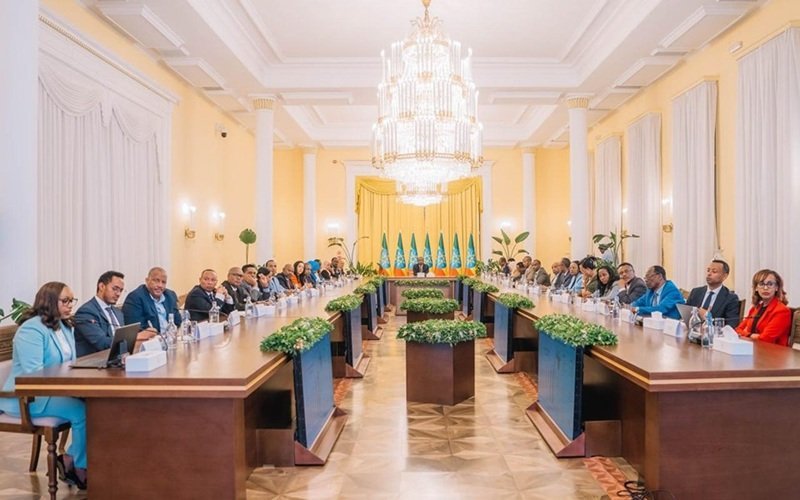
Despite this, Prime Minister Abiy Ahmed’s administration portrays a different economic narrative. Yesterday, he convened his cabinet to assess Ethiopia’s performance over the past nine months.
Fitsum Assefa, Minister of Planning and Development, presented the country’s economic outlook during the meeting at the recently renovated Emperor Haile Selassie’s Jubilee Palace.
The government touted a “stable macroeconomic landscape” and projected 8.4% economic growth. Officials linked this alleged success to macroeconomic reforms introduced in July 2024, which triggered a drastic depreciation of the Ethiopian Birr. Critics described the currency’s plunge as a “free fall,” with the Birr losing over 100% of its value against the U.S. dollar and other major currencies within six months. When the market-based exchange rate was introduced in July 2024, $1 USD traded for 57–58 Birr; it now exceeds 134 Birr.
Rumors suggest the reform was a precondition for the International Monetary Fund’s (IMF) Extended Credit Facility (ECF), which endorsed Abiy’s policies as a “homegrown economic growth plan.” Indeed, the government secured funds from the IMF.
Teachers and health workers protesting in many parts of Ethiopia in connection with months of unpaid salaries have been making headlines in many parts of the county – another reality that seems to contradict claims of economic growth.
Yesterday’s presentation claimed the new exchange regime boosted remittance inflows and foreign currency reserves. Unverified rumors also allege the policy enables illicit wealth holders to move money abroad in hard currency, though no evidence has surfaced.
The government also announced the Grand Ethiopian Renaissance Dam (GERD) is now “98.66% complete.” For nearly a year, the government has been making a headline in state-owned media outlets with a claim that it was over 97% completed. Initially designed to hold 74 billion cubic meters of water, Prime Minister Abiy declared it ready after retaining 42 billion cubic meters about a year or so ago. The number of turbines has also been reduced by at least two from the original plan.
“we should not feel complacent about what we have achieved over the past six months. We should work harder in the next three months,” Abiy remarked in a way asserting what was presented is real when it is not. Also, his party is said to have more than 30,000 paid “media army” that is reportedly working a full time and rotational basis to counter voices from opposition voices and distort information. It was Reuters who revealed that the government has a media army.
With the ruling party controlling over 95% of parliament, scrutiny of these growth claims is unlikely. Meanwhile, war continues to ravage Amhara, and fears of renewed conflict loom in the Tigray region of Ethiopia. Reports suggest the TPLF faction, led by Debretsion Gebremichael, is preparing for war with Eritrea’s support—a claim Eritrea dismisses as “warmongering.”
Abiy Ahmed’s ruling party has about 15 million registered members.
__
Subscribe : https://borkena.com/subscribe-borkena/
Join our Telegram Channel : t.me/borkena
Like borkena on Facebook
Add your business to Ethiopian Business Listing / Ethiopian Business Directory Business Listing Toronto
Join the conversation. Follow us on X (Formerly Twitter) @zborkena to get the latest Ethiopian News updates regularly. Subscribe to YouTube channel To share information or for submission, send e-mail to info@borkena.com
Your statement on Ethiopia’s economic and political situation offers a critical perspective, but it rests on assumptions that need unpacking. You imply that conflicts in Amhara, Oromia, and Tigray negate the government’s 8.4% growth claim, assuming hardship precludes macroeconomic gains. However, growth can occur in specific sectors like agriculture despite regional crises. You also frame the Birr’s depreciation as catastrophic, overlooking potential benefits like export competitiveness. The suggestion that IMF reforms were coercive assumes Ethiopia lacked agency, yet the government might have strategically aligned with these terms. These assumptions risk oversimplifying a complex economy.
A skeptic would challenge your narrative with alternative evidence. Ethiopia’s agriculture, a GDP cornerstone, could drive growth outside conflict zones, as IMF reports indicate a 6.1% GDP rise in 2023. The Birr’s devaluation, while painful, aligns with reforms that boosted remittances in other nations, suggesting possible upsides you dismiss. On the GERD, a skeptic might see its 42 billion cubic meters of water storage as a milestone, despite adjusted targets, rather than evidence of failure. Claims of a “media army” might reflect standard political strategy, not unique deception, given global parallels in narrative management.
Your reasoning shows gaps under scrutiny. You argue that unpaid salaries and conflicts disprove growth, but GDP can rise unevenly without benefiting all. The “free fall” of the Birr ignores how overvalued currencies distort markets, and you don’t quantify conflict’s economic toll, weakening the link to national stagnation. The GERD critique feels vague—discrepancies in completion percentages don’t negate tangible progress. Rumors of TPLF-Eritrea ties lack grounding, risking speculation over substance. Your logic would strengthen by addressing these leaps.
Alternative framings could enrich your analysis. View growth as sectoral, not universal, with urban or agricultural gains coexisting with rural strife. The Birr’s fall could be a calculated trade-off to end foreign exchange shortages, not just IMF pressure. The GERD might serve as a nationalist symbol, prioritizing unity over technical precision. Conflicts could reflect structural issues like ethnic federalism, not just Abiy’s failures. These perspectives shift focus from outright dismissal to nuanced critique.
To prioritize truth, your statement needs refinement. Unverified claims—like illicit wealth transfers or TPLF-Eritrea plans—undermine credibility without evidence. You lean on critical sources, risking confirmation bias, and could engage IMF data for balance. The assertion that growth is “not real” lacks proof; questioning its distribution (who benefits?) would be sharper. To clarify your intent—critiquing Abiy, exposing disconnects, or highlighting crises—quantify impacts and avoid overgeneralizing. Let’s focus your goal and tighten the argument. What’s your next step?
Right Ethiopia is a highly knowledge based economy focused in Addis Ababa. It is not agricultural economy. It is not an aid economy. Who sponsored a protestant pastor – Franklin Graham – to Addis Ababa who pledged to the regime in power that USAID will be restored. There is no productivity in Amhara (agriculture or industry), No Productivity in most parts of Oromia and Tigray. Ethiopia can still grow 8.4 percent! AMEN NEW.. AMEN! haha
For the last seven years the political land scape disruptes the economy amd over all situtation of the country. Boldly milli9ns displaced from their origin, hundred thousands died and individuals as well as public properties and infrastrucutures has been destroyed mainly by federal government measure. However still the liar so called prime minister expressed the fast economic growth and prosperity of the nation.but in reality millions mainly in Amhara is under sever starvation and the over all economy is going back.